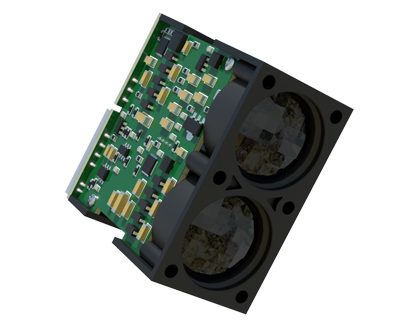
In the realm of industrial process control and environmental monitoring, the precise measurement of substance concentration is paramount. Among the various technologies available, laser concentration sensors have emerged as a sophisticated and highly reliable solution. This article delves into the operational principles, key applications, and critical factors for selecting the appropriate laser concentration sensor for specific industrial needs.
At its core, a laser concentration sensor operates on the principle of light absorption spectroscopy, most commonly Tunable Diode Laser Absorption Spectroscopy (TDLAS). A laser diode emits a beam of light at a specific wavelength that corresponds to an absorption line of the target gas or particle. As this laser beam passes through the sample medium, molecules of the target substance absorb a portion of the light energy. The sensor's detector then measures the attenuation of the light beam. The degree of absorption is directly proportional to the concentration of the target substance, as described by the Beer-Lambert law. Advanced sensors often employ wavelength modulation techniques to enhance sensitivity and minimize interference from background noise or other gases, allowing for detection in the parts-per-million (ppm) or even parts-per-billion (ppb) range.
The advantages of laser-based sensors are significant. They offer exceptional selectivity due to the precise wavelength targeting, meaning they can distinguish between similar compounds. Their response time is extremely fast, enabling real-time monitoring and control. Furthermore, they are non-intrusive in many configurations, requiring no physical contact with the sample, which minimizes maintenance and prevents sensor contamination. This makes them ideal for harsh or corrosive environments common in industrial settings.
The applications for laser concentration sensors are vast and cross multiple industries. In the energy sector, they are crucial for monitoring combustion efficiency and detecting methane leaks in natural gas pipelines and facilities. In semiconductor manufacturing, they ensure ultra-pure process environments by detecting trace contaminants. Environmental monitoring agencies utilize these sensors for continuous emissions monitoring (CEM) from smokestacks and for assessing urban air quality. In the pharmaceutical and chemical industries, they safeguard processes by monitoring gas concentrations during production and in storage areas to prevent hazardous conditions.

Selecting the right laser concentration sensor requires careful consideration of several technical parameters. First, the target analyte must be clearly defined, as the laser wavelength is substance-specific. The required measurement range (from trace to high concentrations) and the necessary precision (ppm or ppb level) will dictate the sensor's class. Environmental conditions such as temperature, pressure, and the presence of dust or other interferents must be accounted for; many sensors are housed in rugged, explosion-proof enclosures for such challenges. The physical installation is another key factor—options include in-situ probes for direct insertion into a duct or pipe, or extractive systems that draw a sample to a remotely located sensor. Finally, integration capabilities with existing plant control systems (e.g., 4-20 mA outputs, digital protocols like Modbus, Ethernet/IP) are essential for data acquisition and process automation.
In conclusion, laser concentration sensors represent a pinnacle of optical measurement technology, providing unmatched accuracy, speed, and reliability for quantitative gas and particle analysis. Their adoption drives improvements in safety, efficiency, regulatory compliance, and product quality across a diverse industrial landscape. As laser technology continues to advance, these sensors will become even more compact, cost-effective, and capable, further solidifying their role as an indispensable tool for modern industrial engineering and environmental stewardship.