Laser ranging target sensors, often referred to as laser distance sensors or laser measurement sensors, represent a critical class of non-contact measurement devices widely adopted across modern industrial automation, robotics, and quality control systems. These sensors operate on the fundamental principle of emitting a focused laser beam towards a target object and precisely measuring the time it takes for the reflected light to return to the sensor's receiver. This time-of-flight (ToF) data is then converted into an accurate distance measurement. The core components include a laser diode (typically using visible red or Class 1/Class 2 infrared lasers for safety), a high-sensitivity photodetector, and sophisticated signal processing electronics.
The operational methodology can be broadly categorized into two primary techniques: pulse-based time-of-flight and phase-shift measurement. Pulse ToF systems emit short, high-intensity laser pulses and measure the direct round-trip time. This method is exceptionally effective for long-range measurements, often exceeding hundreds of meters, with typical accuracies in the millimeter to centimeter range. In contrast, phase-shift systems modulate the amplitude of the continuous laser beam and measure the phase difference between the emitted and reflected signals. This technique offers superior resolution and accuracy, often down to the sub-millimeter level, making it ideal for precision short to medium-range applications such as part positioning and thickness gauging.
Industrial applications for laser ranging target sensors are vast and varied. In automated guided vehicles (AGVs) and mobile robotics, these sensors provide essential navigation and obstacle detection data, enabling safe and efficient path planning and material handling. Within production lines, they are indispensable for precise positioning of components, monitoring fill levels in tanks or silos, and verifying dimensional tolerances of manufactured parts. The construction and surveying sectors rely on long-range variants for topographic mapping, volume calculation, and alignment tasks. A key advantage in these environments is their immunity to electromagnetic interference and ability to function reliably in challenging conditions involving dust, varying light levels, or vibrations, where traditional contact probes or ultrasonic sensors might falter.
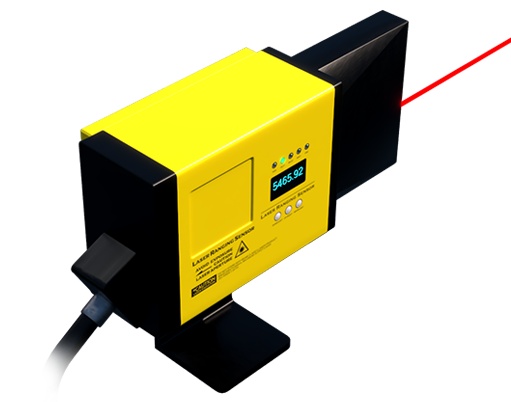
Selecting the appropriate laser ranging sensor requires careful consideration of several technical parameters. The measurement range defines the minimum and maximum distances the device can reliably detect. Resolution indicates the smallest detectable change in distance, while accuracy specifies the maximum deviation between the measured value and the true distance. The response time or sampling rate determines how quickly the sensor can update its measurement, a critical factor in high-speed automation. Other vital specifications include the laser spot size, which affects measurement stability on uneven surfaces, the type of output signal (analog voltage/current, digital interfaces like IO-Link, RS-232, or Ethernet), and the ingress protection (IP) rating for durability against dust and moisture.
Recent technological advancements are pushing the boundaries of performance and integration. The development of more compact, robust housings allows for installation in space-constrained locations. Enhanced digital filtering algorithms improve signal stability on poorly reflective or moving targets. The integration of onboard intelligence and industrial communication protocols facilitates seamless data exchange with PLCs and SCADA systems, enabling predictive maintenance and real-time process optimization. Furthermore, the emergence of multi-echo processing technology allows a single sensor to distinguish between the desired target signal and background reflections from glass, foam, or mesh, significantly expanding application possibilities.
Despite their robustness, optimal performance depends on correct installation and an understanding of environmental factors. The target surface's reflectivity, color, and texture directly influence signal strength; dark, matte, or absorbent surfaces may require special reflectors or a higher-powered sensor model. Ambient temperature fluctuations can affect electronic drift, necessitating sensors with built-in temperature compensation. Regular maintenance, primarily keeping the optical lens clean from obstructions like oil film or dust, is essential for sustained accuracy.
In conclusion, laser ranging target sensors are a cornerstone technology for precision measurement in Industry 4.0. Their ability to deliver fast, accurate, and reliable distance data without physical contact makes them invaluable for enhancing productivity, ensuring quality, and enabling advanced automation. As sensor fusion and IoT connectivity evolve, these devices will become even more intelligent and integral to creating responsive, data-driven industrial ecosystems. Engineers and system integrators must continue to evaluate the latest specifications and application notes to fully leverage their capabilities for solving complex measurement challenges.