Inductive proximity sensors are fundamental components in industrial automation, offering non-contact detection of metallic objects. These sensors operate on the principle of electromagnetic induction, generating an oscillating magnetic field. When a metallic target enters this field, eddy currents are induced, causing a change in the sensor's oscillation amplitude. This change is detected and converted into a binary output signal, typically indicating the presence or absence of the target. Their robustness, reliability in harsh environments, and immunity to non-metallic materials make them indispensable for tasks like position sensing, counting, and end-of-travel detection in machinery.
Microcontrollers (MCUs), the compact integrated circuits designed to govern specific operations, serve as the intelligent core for processing sensor data. Modern MCUs, such as those based on ARM Cortex-M or classic 8-bit architectures like AVR or PIC, provide a versatile platform for interfacing with inductive sensors. The integration process primarily involves connecting the sensor's output to a digital input pin of the microcontroller. Most standard inductive sensors provide a digital signal (e.g., NPN open-collector or PNP output), which is directly compatible with MCU input pins. A pull-up or pull-down resistor is often required to ensure a defined logic level when the sensor output is in its off-state.
For analog inductive sensors that output a voltage or current proportional to the detection distance, an MCU's built-in Analog-to-Digital Converter (ADC) is utilized. This allows for more nuanced measurements, such as determining the precise distance to a target or monitoring subtle changes in position. The MCU can then process this digitized data, executing programmed logic to trigger actions—actuating a solenoid, updating a display, sending data over a communication protocol, or even implementing predictive maintenance algorithms by monitoring signal trends.
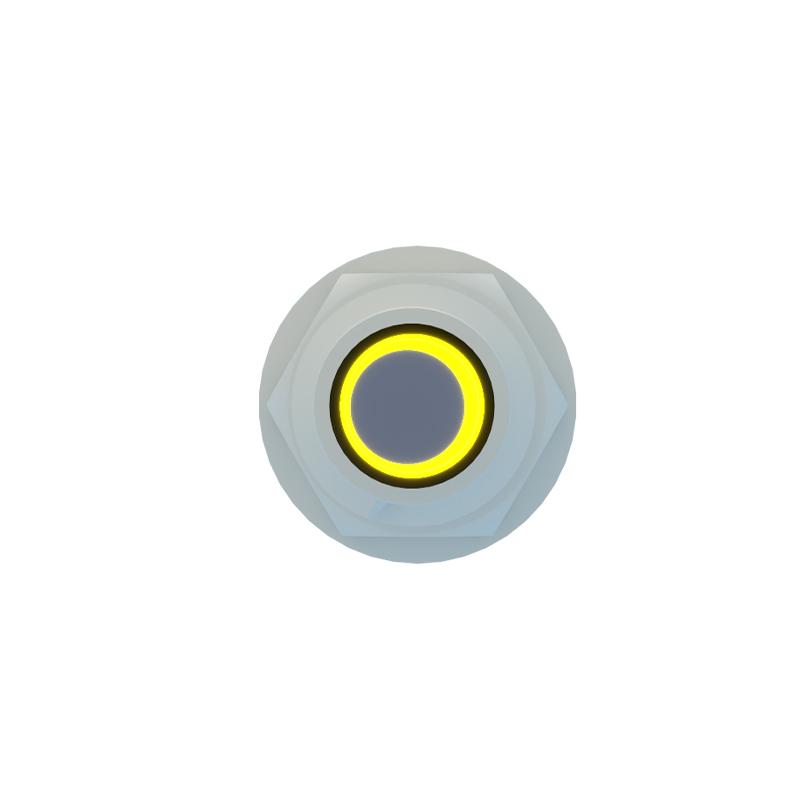
Programming the microcontroller involves configuring the relevant input pins and writing code to read the sensor's state. In a simple digital interface example, the code continuously polls the input pin or utilizes interrupt-driven routines for immediate response. For instance, an interrupt can be triggered on a rising or falling edge of the sensor signal, allowing the MCU to instantly react to a part detection event without constant polling, thereby optimizing processing efficiency. For analog interfaces, the ADC peripheral must be initialized to sample the voltage at a specified rate, with the digital values then mapped to meaningful engineering units like millimeters.
Key considerations for successful integration include electrical compatibility and environmental robustness. Designers must ensure voltage levels match; a 24V DC sensor output cannot be directly connected to a 3.3V MCU pin without a suitable voltage divider or opto-isolator. Electrical noise is a significant challenge in industrial settings. Inductive sensors themselves are susceptible to electromagnetic interference from motors or power lines. Proper shielding, twisted-pair cabling, and placing ferrite beads near the MCU's input can mitigate noise. Furthermore, the MCU's firmware should incorporate software debouncing or filtering techniques to reject transient signal spikes that could cause false triggers.
The synergy between inductive proximity sensors and microcontrollers unlocks advanced functionalities. In a conveyor system, multiple sensors connected to a single MCU can track object position, count items, and verify orientation before a robotic arm performs pick-and-place operations. The MCU can log data for quality control or network it via Ethernet, CAN bus, or Modbus to a central supervisory system. In safety applications, a microcontroller can implement a dual-channel monitoring system using two independent sensors, creating a redundant and fail-safe interlock for a machine guard door.
Looking forward, the evolution of both technologies continues to enhance integration. Modern inductive sensors with IO-Link communication capability can transmit detailed parameter and diagnostic data digitally to the MCU, moving beyond simple switching signals to smart sensor nodes. On the MCU side, increasing computational power and integrated peripherals, such as high-resolution ADCs and robust industrial communication controllers, simplify design and enable more complex, data-driven automation solutions. This combination remains a cornerstone for building efficient, reliable, and intelligent automated systems across manufacturing, packaging, and material handling industries.