Proximity sensors are indispensable components in modern industrial automation, providing non-contact detection of objects for countless control, counting, positioning, and safety applications. Among the most common detection targets are cylindrical objects, such as rods, shafts, rollers, pipes, and cans. However, the detection of cylindrical shapes presents unique challenges compared to flat surfaces. This article delves into the technical considerations, sensor selection criteria, and installation best practices for reliably detecting cylindrical objects with inductive and capacitive proximity sensors.
The fundamental principle of an inductive proximity sensor involves generating an electromagnetic field. When a metallic object enters this field, it induces eddy currents within the object, causing a change in the sensor's internal oscillation amplitude. This change is detected by the sensor's circuitry, triggering an output signal. For capacitive sensors, the principle relies on changes in capacitance. The sensor forms one plate of a capacitor, with the target object acting as the second plate. The introduction of any object (metallic or non-metallic) into the sensing field alters the dielectric constant and thus the capacitance, leading to an output switch.
When the target is a cylinder, several geometric and material factors critically influence performance. The most significant is the effective sensing distance. Proximity sensors are typically rated with a rated operating distance (Sn) for a standard mild steel square target (e.g., 1mm thick, side length equal to the sensor's diameter or 3x Sn, whichever is smaller). A cylindrical target presents a curved surface with a smaller frontal area relative to the sensor face. This curvature reduces the amount of conductive material interacting with the electromagnetic field at a given distance. Consequently, the actual sensing distance for a cylinder will be less than the sensor's published Sn. The reduction factor depends on the cylinder's diameter relative to the sensor's sensing face diameter.
As a rule of thumb, for reliable detection, the diameter of the cylindrical target should be at least equal to, and preferably 1.5 to 2 times, the diameter of the sensor's sensing face. For example, an 18mm diameter sensor should ideally detect a cylinder of at least 27mm to 36mm in diameter at or near its full Sn. If the cylinder diameter is smaller than the sensor face, the effective sensing distance can be drastically reduced, sometimes by 50% or more. Manufacturers provide correction factor graphs in their datasheets, which are essential for precise calculation.
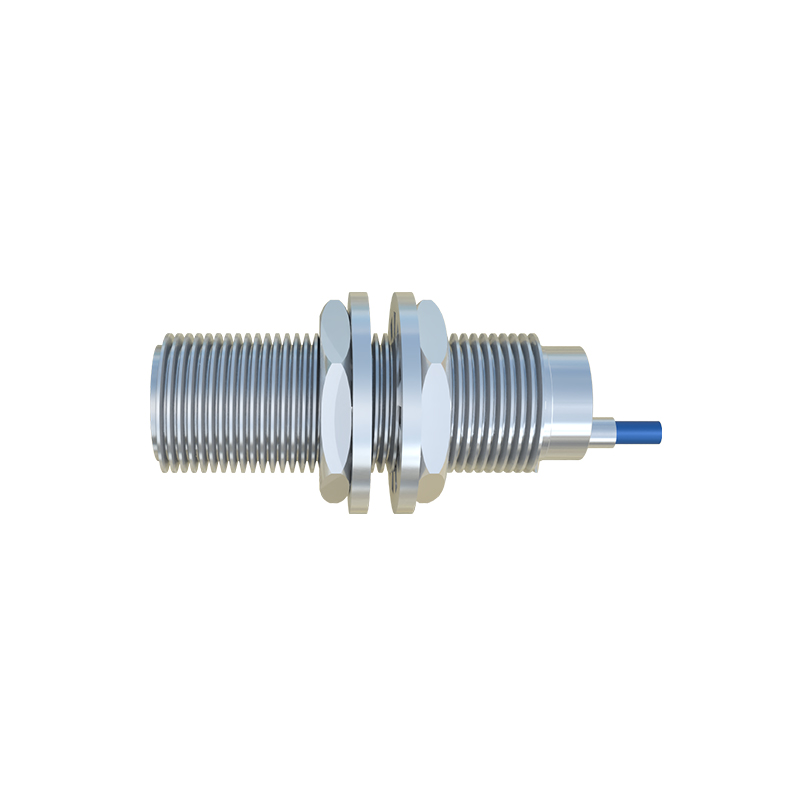
Sensor selection is paramount. For metallic cylinders, inductive sensors are the default choice. Key specifications to examine include:
1. Sensing Face Design: Shielded (flush-mountable) or unshielded (non-flush). Shielded sensors have a focused field, allowing side-by-side mounting without interference, which is often advantageous in tight spaces near cylindrical rollers or shafts. Unshielded sensors have a longer range and a wider field but require more mounting clearance.
2. Output Type: DC (NPN/PNP) or AC, NO (Normally Open) or NC (Normally Closed). Choose based on the control system's input card requirements.
3. Material Specificity: Standard sensors are tuned for mild steel. For cylinders made of stainless steel, aluminum, copper, or brass, the sensing distance will be reduced. Select "Factor 1" sensors for all metals or sensors specifically designed for non-ferrous metals if detecting aluminum or copper cylinders is a primary task.
4. Environmental Rating: IP67 or IP69K for washdown environments (common in food & beverage with stainless steel pipes), resistance to coolants, oils, and welding spatter.
For non-metallic cylinders (plastic pipes, glass bottles, cardboard tubes), a capacitive proximity sensor is required. These sensors can detect the material itself or the liquid/contents inside. The same cylinder diameter considerations apply, but the dielectric constant of the material becomes the dominant factor. Materials with higher dielectric constants (like water-based liquids) are easier to detect than low-constant materials (like dry plastics).
Installation and alignment are critical for consistency. The optimal sensing position is when the cylinder's axis is perpendicular to the sensor's face, with the sensor aimed at the center of the cylinder's curved surface. Avoid detecting the very edge of a cylinder, as the minimal material presence can cause unreliable switching. For detecting the presence/absence of a cylinder in a V-groove or between rollers, position the sensor axially to view the cylinder's end face if possible, as this presents a flat, larger surface. Always account for mechanical tolerances, vibration, and thermal expansion in the system by derating the usable sensing distance. A good practice is to use no more than 60-80% of the calculated effective sensing distance for the actual installation gap.
In high-speed applications, such as counting cans on a conveyor,