In the realm of industrial automation, proximity sensors are indispensable for object detection, positioning, and counting. Traditionally, these sensors are renowned for their ability to detect metallic objects with high reliability. However, a common misconception persists: that proximity sensors are only suitable for metals. This article delves into the capabilities and technologies enabling proximity sensors to effectively sense non-metallic materials, expanding their utility across diverse industries.
The fundamental principle of an inductive proximity sensor, the most common type, is based on generating an electromagnetic field. When a metallic object enters this field, eddy currents are induced on the object's surface, causing a change in the oscillation amplitude within the sensor's coil. This change is detected, triggering the sensor's output. Non-metallic materials like plastics, wood, glass, or liquids do not conduct electricity in the same way and thus do not generate significant eddy currents. This is the root of the belief that they are undetectable.
To overcome this limitation, specific types of proximity sensors are employed for non-metallic detection. The primary technology used is the capacitive proximity sensor. Unlike inductive sensors, capacitive sensors generate an electrostatic field. They can detect any object that alters the dielectric constant of the space between the sensor's active face and its ground electrode. Since all materials have a dielectric constant different from air (vacuum=1), they can be sensed. For instance, water has a high dielectric constant (~80), plastics range from 2 to 5, and wood varies. When a non-metallic object enters the sensing field, it changes the capacitance of the system, which is measured by the oscillator circuit. Once this change reaches a preset threshold, the output state switches.
Key factors influencing the sensing of non-metals with capacitive sensors include:
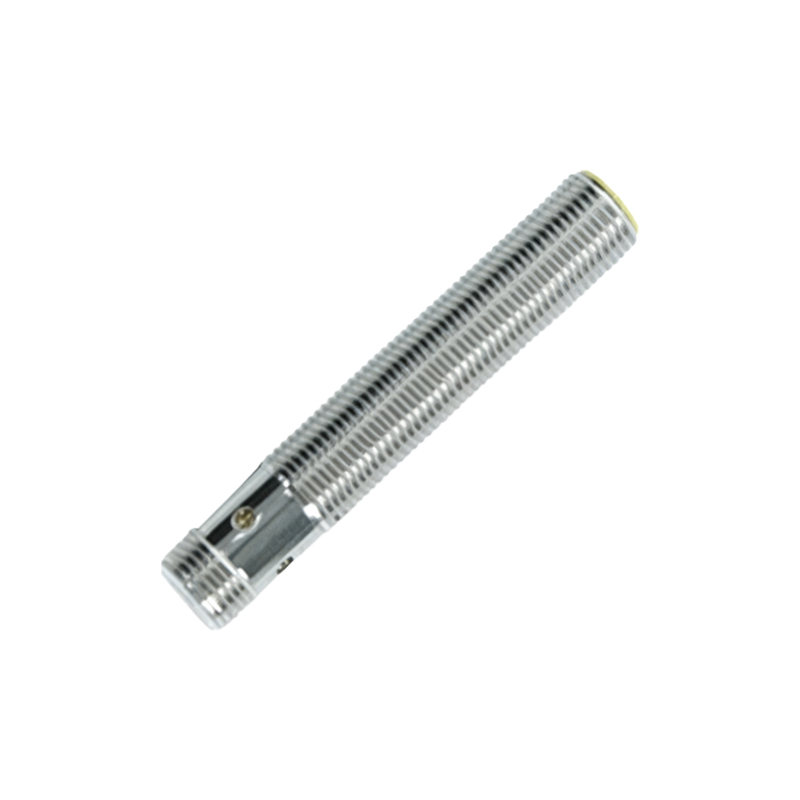
1. Dielectric Constant (εr): Materials with a higher dielectric constant (e.g., water, ceramics, PVC) are detected at greater distances than those with a lower constant (e.g., dry wood, certain foams).
2. Object Size and Thickness: Larger and thicker objects cause a more significant change in capacitance, improving detection reliability.
3. Sensor Adjustment: Most capacitive sensors feature a sensitivity potentiometer. This allows engineers to calibrate the sensor to ignore the background (like a container wall) and only detect the target material, or to sense materials with very low dielectric constants.
4. Environmental Conditions: Humidity, dust, and temperature can affect the dielectric constant of air and the target, potentially requiring shielded sensor designs or environmental compensation.
Another, less common but highly effective, technology for this purpose is the ultrasonic proximity sensor. These sensors emit high-frequency sound waves and measure the time taken for an echo to return from any object—metallic or non-metallic. They are excellent for detecting objects regardless of color, transparency, or material composition, making them ideal for complex applications like detecting clear glass bottles or varying liquid levels.
Applications for non-metallic object detection are vast and critical:
Packaging: Detecting plastic bottles, cardboard boxes, foil wrappers, and glass containers on conveyor lines.
Food & Beverage: Sensing liquid levels in non-metallic tanks, detecting plastic or glass containers, and verifying the presence of food products.
Woodworking & Paper: Detecting wood panels, paper rolls, and composite materials for positioning and counting.
Pharmaceutical: Verifying the presence of plastic vials, blister packs, and other non-metallic packaging.
Chemical Industry: Monitoring plastic granulate levels in silos or detecting the interface between different liquids in a pipe.
When selecting a sensor for non-metallic objects, engineers must carefully consider the material properties, required sensing distance, environmental conditions (presence of dust, moisture, or temperature extremes), and the required response speed. Capacitive sensors offer a cost-effective solution for most solid and liquid non-metals, while ultrasonic sensors provide greater range and versatility for challenging materials or where contact is impossible.
In conclusion, the statement that proximity sensors cannot detect non-metals is a significant oversimplification. Through the application of capacitive and ultrasonic sensing technologies, modern proximity sensors provide robust, reliable solutions for detecting a wide array of non-conductive materials. Understanding the principles of dielectric constants and sensor adjustment is key to successfully integrating these devices, thereby unlocking higher levels of automation and process control in virtually every manufacturing sector. The evolution of sensor technology continues to blur the lines, making material-agnostic detection an increasingly standard capability.