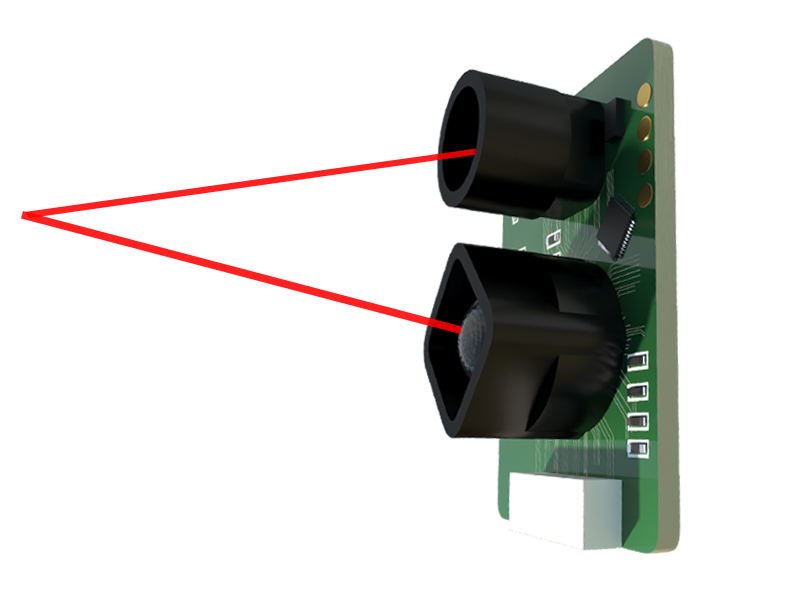
The manufacturing of laser vision sensors represents a critical frontier in industrial automation, merging precision optics, advanced electronics, and sophisticated software to create systems capable of transforming production lines. These sensors, which project laser lines or patterns onto objects and use cameras to capture the resulting deformation, enable non-contact, high-speed measurement and inspection. The production process itself is a testament to engineering rigor, beginning with the selection and calibration of laser diodes. These diodes must emit stable, consistent wavelengths—often in the visible red or blue spectrum or invisible infrared—tailored to the application's material and environmental demands. The laser's output is then shaped through precisely engineered diffractive optical elements (DOEs) or line generators to create the ideal pattern for triangulation.
Parallel to this, the imaging subsystem is manufactured with equal precision. High-resolution global or rolling shutter CMOS sensors are integrated with low-distortion lenses, selected for their focal length and ability to maintain clarity under varying factory conditions. The assembly of these optical and electronic components occurs in cleanroom environments to prevent particulate contamination that could scatter light or obscure lenses. Each unit undergoes rigorous calibration using certified reference artifacts with known dimensions. This step is crucial, as it builds the sensor's internal mathematical model that translates pixel data in the camera into accurate 3D point cloud coordinates in real-world units.
The heart of a modern laser vision sensor is its embedded processing unit. Manufacturing here involves programming firmware that executes complex algorithms for sub-pixel edge detection, point cloud registration, and noise filtering. The production line tests these algorithms against thousands of simulated and physical scenarios to ensure reliability in detecting edges, measuring gaps, steps, and volumes, or identifying defects on surfaces moving at high speeds. Robust housing is another key manufacturing phase. Enclosures are typically crafted from hardened aluminum or stainless steel, integrating precise mounting features and achieving high IP ratings (e.g., IP67) to withstand dust, coolant, vibration, and electromagnetic interference prevalent in industrial settings.

Recent trends in manufacturing focus on enhancing integration and intelligence. Sensors are now being produced with built-in Ethernet-AP interfaces, PROFINET, or EtherCAT connectivity for seamless data piping into PLCs and industrial networks. Furthermore, the integration of AI co-processors directly onto the sensor's circuit board during manufacturing is a growing trend. This allows for "sensor-level" machine learning, where the device can be trained on the production line to recognize specific defect patterns or complex profiles without streaming all data to a central computer, thereby reducing latency and network load.
The final stage of production involves comprehensive validation. Each sensor is subjected to performance verification for key parameters: measurement repeatability, accuracy across its entire field of view, linearity, and long-term stability under thermal cycling. Manufacturers also perform application-specific tests, such as scanning various materials (from shiny metal to dark rubber) at different conveyor speeds. This end-to-end control ensures that the laser vision sensor delivered to the factory floor is not just a collection of components, but a reliable, calibrated instrument ready to drive quality control, robot guidance, and logistics automation, forming the essential eyes of the smart factory.