Material proximity switch sensors, often simply called proximity sensors, are indispensable components in modern industrial automation and machinery. These non-contact sensing devices detect the presence or absence of an object (the "target") within a specified range without any physical contact. Their ability to perform reliably in harsh environments—filled with dust, moisture, or extreme temperatures—makes them superior to mechanical limit switches in countless applications.
At their core, these sensors operate based on the principle of electromagnetic fields or capacitive coupling. The most common types are inductive and capacitive proximity sensors. Inductive proximity sensors are the workhorses for detecting metallic objects. They generate an oscillating electromagnetic field from a coil in the sensing face. When a conductive metal target enters this field, eddy currents are induced within the target, which loads the oscillator circuit inside the sensor. This loading effect is detected, triggering a solid-state output switch to change state (ON or OFF). The sensing range depends on the sensor's design and the type of metal; typically, ferrous metals like iron and steel are detected at longer ranges than non-ferrous metals like aluminum or copper.
Capacitive proximity sensors, on the other hand, can detect both metallic and non-metallic materials, including liquids, powders, plastics, and wood. They function by generating an electrostatic field. Any object that enters this field alters the capacitance of the sensor's circuit. The sensor monitors this change in capacitance, and once it exceeds a preset threshold, the output switches. This makes capacitive sensors incredibly versatile for tasks like monitoring fill levels in tanks, detecting paper or glass, or sensing granular materials.
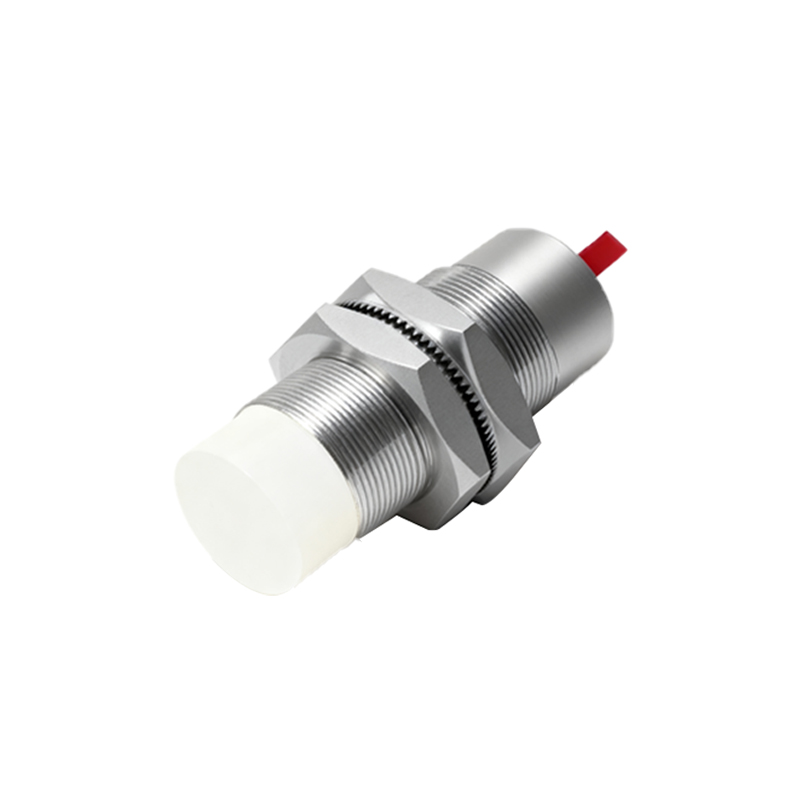
The selection of a material proximity switch sensor hinges on several critical factors beyond just the target material. The operating distance, or sensing range, must be chosen with a safety margin (typically 70-80% of the nominal range) to account for mechanical tolerances and temperature variations. Environmental conditions are paramount; sensors are rated with Ingress Protection (IP) codes (e.g., IP67) to define their resistance to dust and water. For high-temperature applications near ovens or welding stations, specialized high-temperature models are essential. The output type is another key decision: two-wire, three-wire (PNP or NPN sourcing/sinking), or analog outputs. Three-wire DC sensors are most common, with PNP (sourcing) configurations being prevalent in Europe and Asia, and NPN (sinking) often used in North America.
Installation and wiring require careful attention. Metal surroundings can influence the sensor's electromagnetic field, so manufacturers specify minimum distances for side-by-side mounting (to prevent mutual interference) and from surrounding metal (to ensure proper sensing range). Using shielded cables in electrically noisy environments and ensuring proper grounding are standard best practices to prevent erratic switching.
The applications for these robust sensors are vast and span every industry. In automotive manufacturing, inductive sensors count gears, detect piston position, and confirm robotic arm end-of-travel. On packaging lines, capacitive sensors ensure bottles are present and filled before capping. In material handling, they provide position feedback for conveyor systems, palletizers, and automated storage/retrieval systems. They are fundamental to CNC machines for tool positioning and in the wood and plastics industries for detecting non-metallic workpieces.
Maintenance is generally minimal due to their solid-state, non-contact nature. However, periodic checks are recommended. The sensing face should be kept clean from buildup of dirt, grease, or metal chips, which can attenuate the sensing field and reduce the effective range. Regularly verifying the switching function and checking for physical damage to the housing or cable ensures long-term reliability.
In conclusion, material proximity switch sensors are a foundational technology for enabling precise, reliable, and maintenance-free object detection. Understanding the distinction between inductive and capacitive types, along with careful consideration of the target material, environment, and electrical requirements, allows engineers and technicians to select the optimal sensor. This ensures smoother machine operation, improved process control, and enhanced safety across the entire spectrum of industrial automation.