In the realm of industrial automation and control, capacitive proximity sensors stand as versatile and reliable components for non-contact detection. Unlike their inductive counterparts which primarily detect metals, capacitive sensors can detect a vast array of materials, including liquids, plastics, glass, wood, and granular substances. This fundamental capability makes them indispensable in diverse applications, from packaging and food processing to chemical handling and level control.
The core operating principle of a capacitive proximity sensor is based on the concept of capacitance. At its heart, the sensor contains an oscillator circuit. One plate of the capacitor is formed by the sensor's active face or sensing electrode. The other plate is formed by the target object or the surrounding ground. When no target is present, the oscillator is inactive. As a target object enters the sensor's electrostatic field, it alters the dielectric constant between the plates, effectively changing the capacitance. When this change reaches a predetermined threshold, it triggers the oscillator to start. This oscillation is then processed by the sensor's internal circuitry, ultimately causing a solid-state output (typically PNP or NPN) to switch states, signaling the presence of the object.
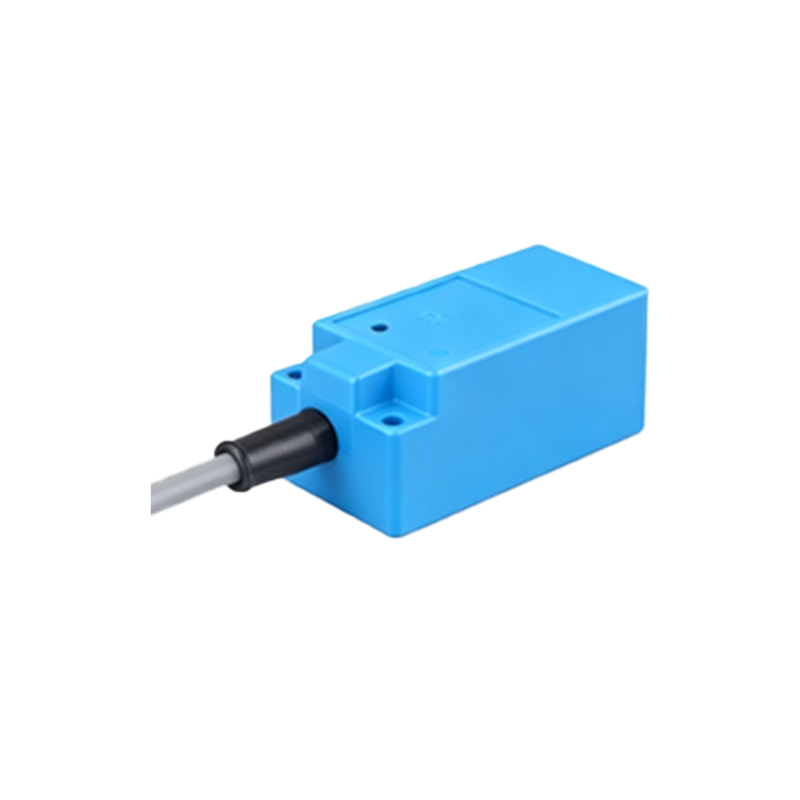
A key feature of capacitive sensors is their sensitivity adjustment, often via a potentiometer. This allows technicians to fine-tune the sensing distance or "switching point" to ignore background materials (like a container wall) and reliably detect the target material inside. This adjustability is crucial for applications like level sensing in tanks, where the sensor must detect the liquid or powder content without being falsely triggered by the tank wall itself.
Capacitive sensors are categorized primarily by their housing style. Cylindrical models are common for general-purpose mounting in machined holes. Rectangular or block-style sensors offer a larger sensing area and are often used for level detection. Furthermore, they come in shielded (flush-mountable) and unshielded (non-flush) versions. Shielded sensors have a metallic ring around the active face that focuses the electrostatic field forward, allowing them to be mounted flush in metal without causing interference. Unshielded sensors have a more extended lateral sensing field and are not suitable for flush metal mounting but often provide a longer sensing range.
The applications for capacitive proximity sensors are extensive. A primary use is level detection and control. They can monitor the fill level of liquids, pastes, powders, or granules in containers made of plastic, glass, or other non-metallic materials. In the packaging industry, they detect the presence of bottles, caps, or labels, regardless of the material. In woodworking, they sense wood panels or composite boards. They are also employed in moisture detection and even as touch-sensitive switches in human-machine interfaces.
Selecting the right capacitive sensor requires careful consideration of several parameters. First, define the target material, as different dielectrics affect the sensing range. The nominal sensing distance (Sn) specified by manufacturers is typically calibrated for a grounded metal target. For other materials, a reduction factor must be applied. The sensor housing material (e.g., PTFE, PBT) must be compatible with the operating environment, which may involve exposure to chemicals, washdowns, or extreme temperatures. Output type (eNP, PNP, analog), voltage range (10-65V DC, or AC/DC models), and connection style (cable or connector) are also critical choices.
Installation and environmental factors significantly impact performance. Ensure the sensor is mounted securely, free from excessive vibration. For level sensing applications, account for material buildup on the sensor face, which can cause false triggering; some models feature anti-coating circuitry to mitigate this. Maintain adequate clearance from surrounding metal objects as specified in the datasheet to prevent erratic behavior. Regular testing and sensitivity adjustment during commissioning are essential for reliable operation.
In summary, capacitive proximity sensors offer a unique and flexible solution for non-contact detection across a broad spectrum of non-metallic and metallic materials. Their operation, rooted in the disturbance of an electrostatic field, provides reliability in challenging conditions where other sensor types may fail. By understanding their principle, variants, and application considerations, engineers and technicians can effectively integrate these sensors to enhance automation processes, improve efficiency, and ensure precise control in countless industrial settings.