In the realm of precision measurement and industrial automation, the red laser distance sensor stands as a pivotal tool. Its functionality, often captured in detailed images and diagrams, reveals a world of advanced technology applied to everyday tasks. This guide delves into the significance of red laser distance sensor images, explaining what they depict and how this technology is utilized across various sectors.
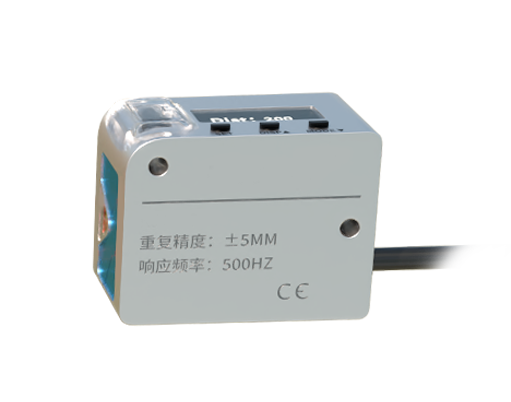
At its core, a red laser distance sensor operates on the principle of time-of-flight or phase-shift measurement. A visible red laser diode emits a concentrated beam of light towards a target. The sensor then calculates the distance by measuring the time it takes for the reflected light to return or by analyzing the phase shift of the modulated laser beam. Images of these sensors typically showcase a compact, often cylindrical or rectangular housing with a clear lens for the laser emission point. The defining visual characteristic is, unsurprisingly, the bright red dot or line projected onto the target surface, providing immediate visual feedback for alignment and measurement.
High-quality product images and technical schematics are invaluable for engineers, technicians, and procurement specialists. These visuals help in identifying key features such as the type of housing (e.g., IP67 rated for dust and water resistance), connection interfaces (M8, M12 connectors), and mounting options. Close-up images often highlight the laser class rating (usually Class 2, which is eye-safe under normal operating conditions), a crucial safety specification. Furthermore, application photos demonstrate the sensor in real-world scenarios—mounted on a robotic arm for bin picking, integrated into a warehouse vehicle for obstacle detection, or positioned on a production line for height verification of components.
The applications of red laser distance sensors are vast and varied, and corresponding images tell the story of their integration. In industrial automation, they are the eyes of machinery, enabling precise positioning, contour profiling, and fill level control in tanks or silos. Clear images from manufacturing settings show sensors ensuring consistent product dimensions or guiding automated guided vehicles (AGVs) through dynamic environments. In the construction and surveying fields, images often depict handheld laser distance meters, using a red laser point to quickly measure room dimensions or land plots. The forestry sector utilizes them in advanced tools for measuring tree height and canopy density.

When analyzing red laser distance sensor images for technical evaluation, several performance parameters are visually or contextually implied. The range of the sensor, which can vary from a few centimeters to several hundred meters, is often a focal point in specification sheets accompanied by range-diagram images. The spot size of the red laser is another critical aspect; a smaller spot allows for more precise measurement of small objects or edges, which is easily comparable in side-by-side image comparisons. Images also help understand the concept of sampling rate, as a sensor deployed on a fast-moving assembly line would be depicted in a high-speed context.

Choosing the right sensor involves more than just reviewing specifications; application images provide context. For instance, an image showing a sensor in a brightly lit outdoor setting underscores the need for models with robust ambient light suppression. A picture of a sensor near reflective metal surfaces highlights the importance of models with algorithms to handle difficult surfaces. These practical visuals bridge the gap between datasheet numbers and real-world performance.
In conclusion, red laser distance sensor images are far more than simple product photographs. They are educational tools, technical references, and proof of concept. They illustrate the elegant application of laser physics to solve practical measurement challenges in logistics, robotics, construction, and beyond. By understanding what to look for in these images—from the clarity of the laser spot to the suitability of the housing for the environment—professionals can make informed decisions, ensuring that this versatile technology delivers accuracy, efficiency, and reliability where it matters most. As technology evolves, these images will continue to showcase sensors with higher speeds, better accuracy, and smarter integration, always centered on that unmistakable, precise red beam.