In the realm of industrial automation, precision and efficiency are paramount. Laser color recognition sensors have emerged as a critical technology, enabling machines to perceive and differentiate colors with remarkable accuracy. These sophisticated devices operate by emitting a focused laser beam onto a target surface. The reflected light is then analyzed to determine its spectral characteristics, allowing the sensor to identify specific colors or shades. Unlike traditional color sensors that rely on ambient light, laser-based systems offer superior consistency, as the laser provides a stable, high-intensity light source unaffected by external lighting conditions. This makes them indispensable in applications where environmental variability is a concern.
The core technology behind these sensors often involves advanced spectroscopic principles or high-resolution optical filters combined with photodetectors. When the laser light strikes an object, the material's properties influence the wavelength and intensity of the reflected light. By comparing this data against pre-programmed color values, the sensor can execute precise sorting, quality control, or alignment tasks. For instance, in packaging lines, laser color sensors can verify label colors, ensuring correct product branding. In electronics manufacturing, they assist in component placement by recognizing color-coded parts. The automotive industry utilizes them for inspecting paint finishes and detecting minute color variations that might indicate defects.
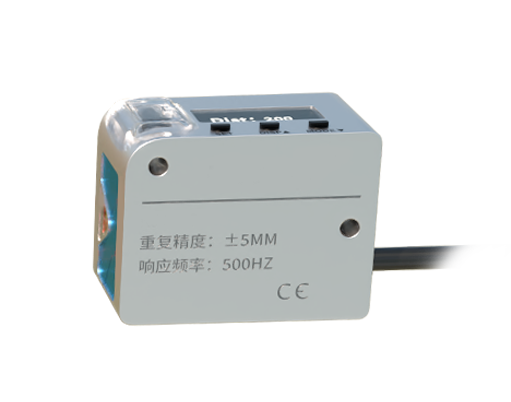
One significant advantage of laser color sensors is their ability to operate at high speeds, making them suitable for fast-paced production environments. Their narrow laser beam allows for precise targeting of small areas, even on moving objects, reducing errors caused by surface irregularities or background interference. Modern iterations often incorporate intelligent features such as teach-in functions, where the sensor can "learn" reference colors directly from samples, simplifying setup and calibration. Additionally, connectivity options like IO-Link or Ethernet/IP facilitate seamless integration into larger Industry 4.0 frameworks, enabling real-time data exchange and remote monitoring.
Despite their robustness, selecting the appropriate laser color sensor requires careful consideration of factors like sensing distance, resolution, and environmental durability. For harsh conditions, models with rugged housings and high ingress protection ratings are essential. Maintenance typically involves periodic lens cleaning and verification of calibration to ensure long-term reliability. As industries increasingly adopt smart manufacturing practices, the demand for these sensors is expected to grow, driven by needs for greater automation and quality assurance. Future developments may focus on enhancing spectral analysis capabilities and integrating artificial intelligence for adaptive color recognition, further expanding their utility across diverse sectors.
In summary, laser color recognition sensors represent a fusion of optical engineering and automation, offering unmatched precision in color detection tasks. Their ability to perform reliably under varying conditions underscores their value in modern industrial systems, contributing to enhanced productivity and reduced operational costs. As technology advances, these sensors will continue to evolve, paving the way for more innovative applications in automation and beyond.