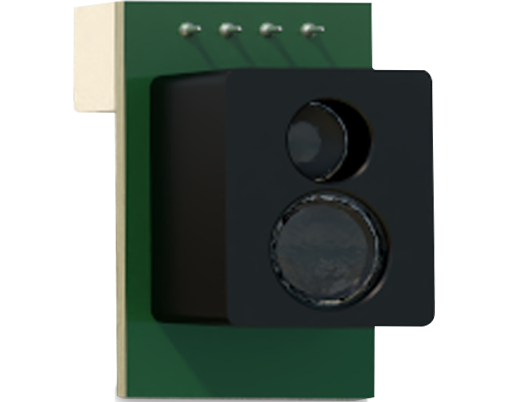
In the realm of industrial automation and precision measurement, laser photoelectric sensors stand as pivotal components, enabling high-accuracy detection, positioning, and inspection tasks. Unlike conventional photoelectric sensors that utilize LED light sources, laser sensors employ a focused, coherent laser beam, offering superior performance in terms of resolution, range, and response speed. This article delves into the operational principles, key advantages, diverse applications, and critical factors for selecting the right laser photoelectric sensor for specific industrial needs.
The fundamental principle of a laser photoelectric sensor revolves around the emission, reflection, or interruption of a laser beam to detect the presence, absence, or position of an object. These sensors typically consist of a laser diode transmitter and a photodetector receiver. They operate primarily in three modes: through-beam, retro-reflective, and diffuse reflective. In the through-beam (or opposed) mode, the transmitter and receiver are separate units positioned opposite each other. An object is detected when it interrupts the laser beam traveling from the transmitter to the receiver. This mode offers the longest sensing distances and highest reliability, as it is largely unaffected by the object's color, surface texture, or reflectivity. The retro-reflective mode uses a single housing containing both the transmitter and receiver, along with a separate reflector. The laser beam is projected toward the reflector and bounces back to the receiver. Detection occurs when an object blocks this reflected beam. This mode simplifies wiring and alignment compared to through-beam setups. Lastly, the diffuse reflective (or proximity) mode integrates the transmitter and receiver in one unit without needing a reflector. It detects an object by measuring the light scattered back from the object's surface. While more compact and easier to install, its effective range and performance can be influenced by the object's color and surface properties.
The adoption of laser technology imparts several distinct advantages. First is exceptional precision. The highly collimated laser beam produces a very small, well-defined spot, allowing for the detection of minute objects or precise edge detection with resolutions down to micrometers. This is crucial in electronics manufacturing, such as verifying chip placement on a PCB. Second, extended sensing range is a hallmark. Laser sensors can achieve detection distances significantly greater than standard LED-based sensors, often spanning several meters even in diffuse reflective mode, making them ideal for large-scale material handling or warehouse automation. Third, high response speed enables these sensors to keep pace with ultra-fast production lines, capable of detecting objects moving at high velocities without missing a trigger. Furthermore, the intense, focused beam provides excellent resistance to ambient light interference, ensuring stable operation in environments with variable lighting conditions, such as near welding stations or in outdoor applications.
The applications of laser photoelectric sensors are vast and span numerous industries. In automotive manufacturing, they are used for precise gap and flush measurement between body panels, robot guidance, and part presence verification on assembly lines. Within the packaging industry, they ensure accurate label placement, detect missing caps on bottles, and control the fill level in containers. In electronics and semiconductor fabrication, their pinpoint accuracy is indispensable for wafer alignment, component counting, and lead inspection. Logistics and warehousing leverage their long-range capabilities for pallet detection, conveyor belt tracking, and automated guided vehicle (AGV) navigation. Additionally, they play a vital role in quality control processes, measuring dimensions, checking for defects, and verifying assembly completeness.

Selecting the appropriate laser photoelectric sensor requires careful consideration of several parameters. The primary factor is the sensing mode, chosen based on the installation constraints, required range, and object characteristics. Next, the required sensing distance and spot size must be evaluated against the sensor's specifications. For detecting very small objects, a sensor with a minute laser spot is necessary. The response time must be faster than the process cycle time to avoid bottlenecks. Environmental conditions cannot be overlooked; sensors with robust housings (e.g., IP67 rated) are needed for dusty, humid, or washdown environments. The type of output required (e.g., digital PNP/NPN, analog, or IO-Link for smart sensor capabilities) must integrate with the existing control system. Finally, features like adjustable sensitivity, teach-in functionality for easy setup, and built-in diagnostics can greatly enhance usability and reduce downtime.
In conclusion, laser photoelectric sensors are sophisticated instruments that deliver unmatched precision, range, and speed for demanding industrial applications. By understanding their operating modes, inherent benefits, and the key selection criteria, engineers and system integrators can effectively harness their capabilities to optimize automation processes, enhance quality assurance, and improve overall operational efficiency. As technology advances, we can anticipate further miniaturization, integration of smarter communication protocols, and enhanced robustness, solidifying their indispensable role in the future of industrial sensing.