In the realm of industrial automation and control systems, proximity sensors are indispensable components. Their primary function is to detect the presence or absence of an object within a specified range without physical contact. A critical parameter defining their performance and suitability for any given application is the 'sensing distance' or 'operating distance.' This article delves into the technical aspects of proximity sensing distance, its influencing factors, and key considerations for optimal deployment.
The nominal sensing distance (Sn) is the theoretical detection range specified by the manufacturer under ideal conditions, typically defined for a standard target. This standard target is usually a square piece of mild steel (e.g., Fe 360) with a side length equal to the diameter of the sensor's active face or three times the rated sensing distance, whichever is greater. It is crucial to understand that Sn is a reference value. The actual, reliable sensing distance in a real-world installation is the effective operating distance (Sr). Sr is typically 0.9 times Sn for inductive sensors and can vary more significantly for capacitive or ultrasonic sensors due to environmental factors. Engineers must always design with Sr, not Sn, to ensure system reliability.
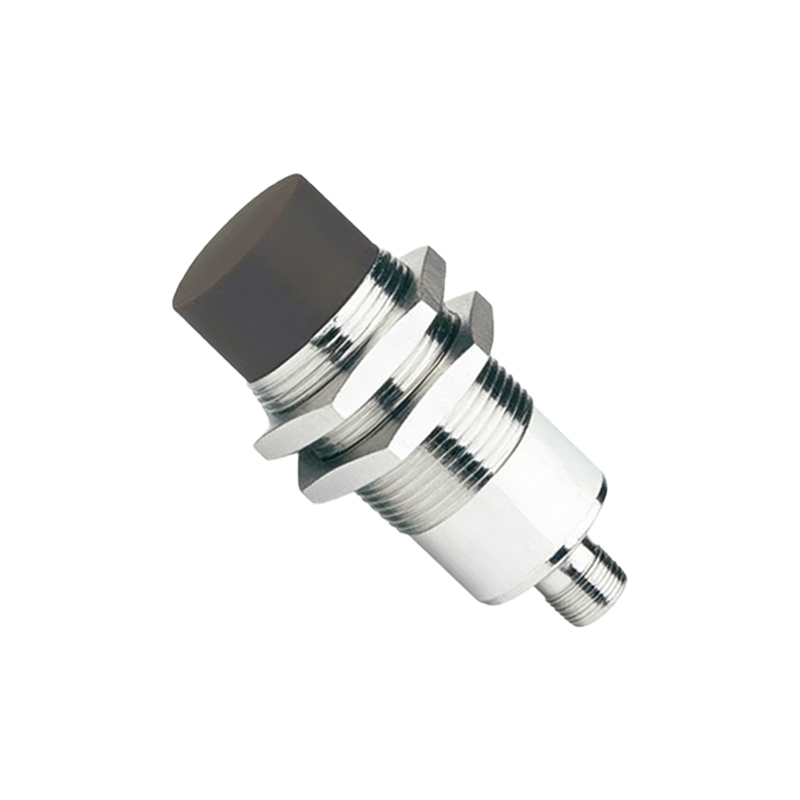
Several key factors directly influence the actual sensing distance achieved in the field. First, the target material is paramount. Inductive sensors, which detect metallic objects, have varying sensitivities. For instance, the sensing distance for stainless steel is often only 60-80% of that for mild steel. For non-ferrous metals like aluminum or copper, it can drop to 30-50%. Capacitive sensors, sensitive to a wider range of materials, also show distance variations based on the target's dielectric constant.
Second, the target size and shape matter. A target smaller than the sensor's active face or the standard target will reduce the effective sensing distance. Similarly, a rounded or irregularly shaped target may not present the optimal surface area for detection, requiring closer proximity. Third, environmental conditions play a significant role. Temperature extremes can affect the electronic components and oscillation circuits within the sensor, potentially altering its sensitivity. The presence of dust, oil, or other contaminants on the sensor's face can attenuate the sensing field, reducing range. For capacitive sensors, ambient humidity or condensation can drastically alter performance by changing the dielectric environment.
Installation is another critical factor. Embedding a sensor flush in a metal mounting bracket (flush-mounted) allows it to be installed without side-interference from the surrounding metal. However, non-flush mountable sensors must be installed with a clear zone around their sensing face, as specified by the manufacturer, to prevent damping effects from adjacent metal, which can severely reduce the nominal sensing distance. Furthermore, the approach direction of the target is important. The sensing field is not a perfect cylinder; for most sensors, the axial approach provides the full rated distance, while a radial or lateral approach may result in a shorter detection range.
Selecting the correct sensor based on required distance involves careful calculation. A fundamental rule is the derating or safety factor. To account for supply voltage fluctuations, temperature drift, component aging, and target variations, engineers should apply a safety factor, commonly 0.6 to 0.8. Therefore, the maximum installation distance should be calculated as: Installation Distance ≤ (Effective Operating Distance Sr) × (Safety Factor). For example, if an application requires detecting an object 8mm away, one should select a sensor with an Sr of at least 10mm (using a 0.8 safety factor: 8mm / 0.8 = 10mm).
Finally, understanding the difference between sensing distance and repeatability is vital. Repeatability refers to the consistency with which a sensor detects a target at the same point under unchanged conditions. It is usually a very small value (e.g., ±0.02mm). High repeatability is essential for precision positioning applications, whereas the absolute sensing distance is more critical for simple presence detection. In conclusion, proximity sensing distance is not a single, fixed number but a system characteristic influenced by a complex interplay of sensor technology, target properties, and environmental context. A thorough understanding of these parameters ensures robust, fail-safe integration into any industrial control system, maximizing efficiency and minimizing downtime.