Two-wire proximity sensors represent a fundamental component in modern industrial automation, offering a simplified and cost-effective solution for object detection without physical contact. Unlike their three-wire or four-wire counterparts, these sensors integrate the switching element directly into the power supply line, eliminating the need for a separate control wire. This design inherently brings both advantages and specific considerations that engineers must account for during system design and integration.
The operational principle of a two-wire AC or DC sensor is elegantly straightforward. It is connected in series with the load (such as a PLC input, relay, or contactor coil) to the power supply. In its normal state (no target detected), a small leakage or quiescent current flows through the sensor, sufficient to maintain its internal electronics but ideally too low to activate the load. When a metallic or other detectable target enters the sensor's sensing range, the internal solid-state switch (like a TRIAC for AC or a transistor for DC) turns on, allowing significant current to flow through the circuit, thereby energizing the load. The key challenge lies in managing this off-state leakage current to prevent unintended load activation, especially with highly sensitive control devices.

One of the primary advantages of the two-wire system is its wiring simplicity. Installation requires only two wires, reducing material costs, cabinet space, and wiring time. This makes them particularly attractive for applications with a high number of sensing points or in compact machinery. Furthermore, they offer inherent protection against incorrect polarity connection in AC versions and can simplify retrofit projects where adding an additional control wire is impractical. Many two-wire sensors also boast robust construction, with IP67 or higher ratings, making them suitable for harsh environments involving dust, moisture, or vibration.
However, designers must carefully navigate their limitations. The off-state leakage current, typically ranging from 1 to 2 mA for DC sensors and higher for AC types, can be enough to inadvertently turn on a sensitive PLC digital input module. This often necessitates the use of a bleeder resistor in parallel with the load to shunt this current. Additionally, the voltage drop across the sensor in the on-state (often 1.5V to 3V) must be subtracted from the supply voltage available to the load. In low-voltage DC systems, this drop can be critical. The load current must also remain within the sensor's specified switching capacity; exceeding it can cause permanent damage.
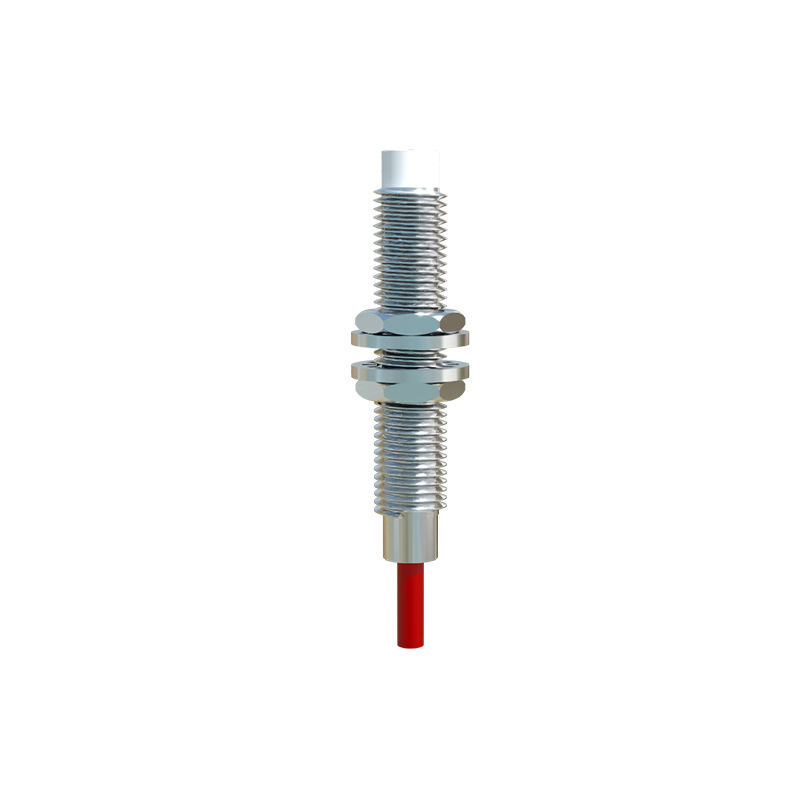
Selection criteria for a two-wire proximity sensor extend beyond just sensing range and housing style. Engineers must first decide between AC and DC versions based on the available control circuit power. DC sensors are prevalent in modern PLC-based systems due to cleaner switching and compatibility with electronic loads. Key specifications to scrutinize include: the maximum leakage current (Ir), the voltage drop at rated current (Ud), the minimum load current required for stable operation, and the switching frequency. For inductive loads like relay coils, protective circuits (snubbers) may be required to suppress voltage spikes that could degrade the sensor's internal switch.
Application examples are vast across manufacturing and processing. They are commonly used for simple presence/absence detection of metal parts on conveyors, as end-of-travel limit switches in actuators, for monitoring bin levels, and in safety interlock systems where wiring simplicity enhances reliability. Their compatibility with standard pilot devices makes them a direct replacement for mechanical limit switches in many scenarios, offering the benefits of non-contact sensing—no moving parts, long life, and high-speed operation.
In conclusion, two-wire proximity sensors are a powerful tool for the control engineer's arsenal. Their simplicity and robustness make them ideal for a wide array of standard detection tasks. Successful implementation hinges on a thorough understanding of their electrical characteristics—particularly leakage current and voltage drop—and a careful matching of these parameters to the connected load. By doing so, engineers can build reliable, efficient, and cost-effective automation systems that stand the test of time in demanding industrial environments. Always consult the manufacturer's datasheet for precise specifications and application guidelines tailored to the specific sensor model.