Proximity sensors are indispensable components in modern industrial automation, providing non-contact detection of objects within their sensing range. These devices are widely used for position sensing, object counting, jam detection, and end-of-travel control in various manufacturing and processing environments. To ensure optimal performance, reliability, and safety, adherence to specific technical specifications during selection, installation, and operation is paramount. This article outlines the core technical specifications and application guidelines for inductive, capacitive, and magnetic proximity sensors in industrial settings.
The primary consideration is the sensor's sensing distance, or nominal range. This is the maximum distance at which a standard target can be reliably detected. It is crucial to derate this value in practical applications, typically using 70-80% of the nominal range to account for environmental factors like temperature fluctuations, voltage tolerances, and target material variations. For inductive sensors, the target must be a ferrous or non-ferrous metal. The sensing distance can vary significantly based on the target's material, size, and shape. A standard target is usually a square of mild steel (Fe360) with a thickness equal to the sensor's face diameter or 1mm, whichever is greater. Capacitive sensors can detect non-metallic materials (plastics, wood, liquids) but require careful adjustment of the sensitivity potentiometer to avoid false triggers from background objects or humidity changes.
Electrical specifications are critical for system integration. The operating voltage range (e.g., 10-30V DC or 90-250V AC) must match the control system's supply. Output configuration—whether NPN (sinking) or PNP (sourcing) for DC sensors, or Normally Open (NO) / Normally Closed (NC)—must be compatible with the programmable logic controller (PLC) or relay input module. The load current rating must not be exceeded. For DC 3-wire sensors, attention must be paid to the residual current (leakage current) when the sensor is in the "OFF" state, as a high leakage current can falsely activate a PLC input. A bypass resistor may be required in such cases.
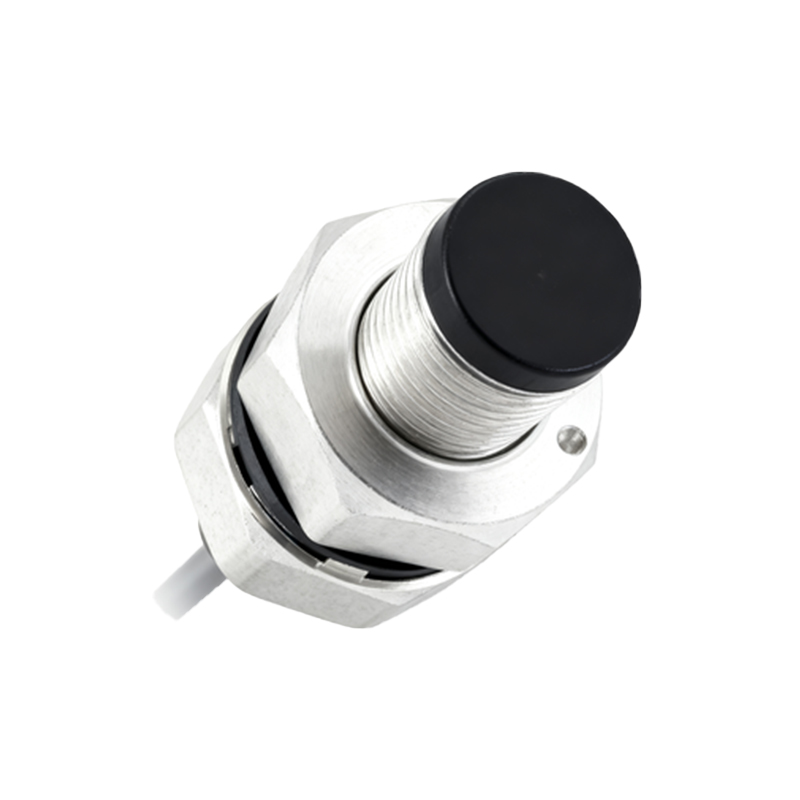
Environmental ratings define the sensor's robustness. The Ingress Protection (IP) rating, such as IP67 or IP69K, indicates the level of protection against dust and water ingress, which is vital for washdown areas or dusty environments. The temperature range specifies the ambient operating and storage limits. Sensors used in extreme temperatures or near welding equipment may require high-temperature variants with appropriate shielding. Resistance to chemicals, oils, and coolants should also be verified from the datasheet.
Installation practices profoundly impact performance. Inductive and capacitive sensors are susceptible to the influence of surrounding metals. Flush-mountable (shielded) sensors can be installed embedded in metal without affecting their sensing range, whereas non-flush (unshielded) sensors offer a longer range but require a non-metallic zone around the sensing face. The recommended lateral spacing between two adjacent sensors must be maintained to prevent mutual interference. For counting or precise positioning applications, the repeat accuracy specification—the consistency of the switch point under identical conditions—is more important than the absolute sensing distance.
Finally, output indicators and short-circuit protection are essential for diagnostics and durability. An LED status indicator simplifies troubleshooting. Advanced sensors feature IO-Link communication for digital parameter setting and detailed condition monitoring. For DC sensors, built-in protection against reverse polarity, overload, and short-circuit ensures longevity and prevents damage to the sensor or controller during wiring errors.
In conclusion, a systematic approach to evaluating sensing distance, electrical characteristics, environmental durability, and installation constraints against the application's specific requirements is essential. Consulting the manufacturer's detailed datasheet and following their installation guidelines will guarantee a robust and maintenance-free implementation, maximizing uptime and productivity in automated systems.