Laser sensors have become indispensable tools across numerous industries, from manufacturing and robotics to autonomous vehicles and consumer electronics. Their ability to provide precise, non-contact distance measurements is foundational. A critical parameter in their application is the minimum sensing distance, often referred to as the "dead zone" or "blind zone." Understanding the formula and principles behind this minimum distance is essential for proper sensor selection and system integration.
The minimum measurable distance for a laser sensor is not governed by a single universal formula but is determined by a combination of physical, optical, and electronic factors intrinsic to the sensor's design. The primary limitation stems from the time required for the sensor's receiver electronics to recover after emitting a powerful laser pulse. During this brief recovery or "settling" time, the extremely strong reflected signal from a very close object is indistinguishable from the internal electronic noise of the emitting circuit itself. Therefore, the sensor cannot reliably process the return signal until this period has elapsed.
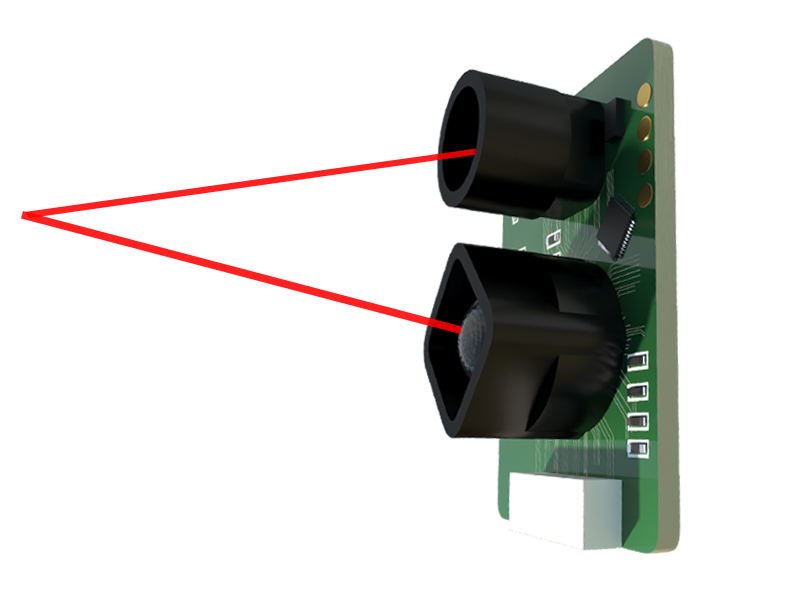
We can conceptualize this using the fundamental principle of time-of-flight (ToF), which is common in many laser distance sensors. The distance (d) is calculated as d = (c * t) / 2, where 'c' is the speed of light and 't' is the measured round-trip time of the laser pulse. The minimum distance (d_min) is thus directly limited by the minimum measurable time (t_min), which is the receiver's recovery time: d_min = (c * t_min) / 2.
For example, if a sensor's receiver requires 10 nanoseconds (10 x 10^-9 seconds) to recover, the minimum theoretical distance can be calculated: d_min = (3 x 10^8 m/s * 10 x 10^-9 s) / 2 = 1.5 meters. This is a simplified theoretical limit. In practice, sensor manufacturers employ sophisticated optical and signal processing techniques to drastically reduce this dead zone.
Key factors influencing the practical minimum distance include:
1. Optical Design: The physical separation and angle between the laser emitter and the photodetector receiver. A larger baseline separation allows for better isolation, reducing internal signal crosstalk and enabling shorter minimum distances. Some designs use coaxial optics (aligned paths) with complex beam splitters, which can achieve very small dead zones but are more complex and costly.
2. Laser Pulse Characteristics: The width and shape of the emitted laser pulse. An ultra-short, sharp pulse allows for measurements closer to the sensor, as the emitted energy dissipates quickly, allowing the receiver to "listen" sooner.
3. Signal Processing Algorithms: Advanced digital signal processing (DSP) is used to filter out the residual noise from the emission event and amplify the weak early-return signals. Techniques like waveform analysis and constant fraction discrimination help in accurately identifying the start of the return pulse.
4. Sensor Technology: Different laser sensing technologies have inherent minimum distance characteristics. While pulsed ToF sensors have the recovery time challenge, phase-shift measurement lasers may have different limitations related to modulation wavelength ambiguity at very short ranges. Laser triangulation sensors, which use a different geometric principle, typically have a very well-defined and often very short minimum working distance as part of their designed measurement range.
Therefore, when selecting a laser sensor, one must consult the manufacturer's datasheet for the specified "Minimum Measuring Distance" or "Dead Zone." This value is empirically determined for each model. Attempting to measure an object within this zone will result in invalid data, erratic readings, or a complete lack of output.
To mitigate issues related to the minimum distance in system design, engineers can:
* Choose a sensor with a minimum distance specification less than the closest expected target position.
* Physically offset the sensor from the measurement area using a mechanical bracket.
* Consider alternative technologies like ultrasonic sensors for very close-range applications, though they may sacrifice precision.
In summary, the minimum distance for a laser sensor is a critical specification rooted in the time-domain recovery of its receiver electronics, conceptually described by d_min = (c * t_min) / 2. The actual achievable value is a result of integrated optical and electronic design. A thorough understanding of this parameter ensures reliable performance and prevents a common pitfall in the deployment of these versatile and precise measurement devices.