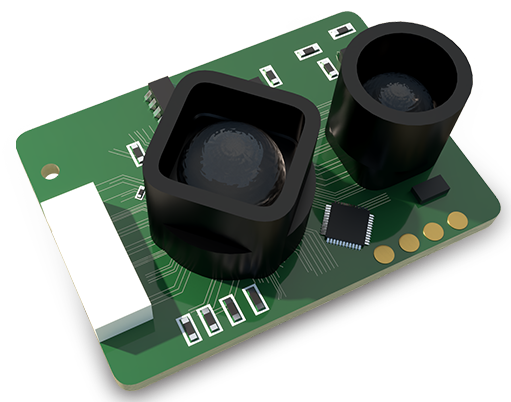
Laser distance sensors, also ofen referred to as laser rangefinders or LiDAR (Light Detection and Ranging) in specific configurations, have become indispensable tools across a vast spectrum of industries. From robotics and industrial automation to construction, surveying, and even consumer electronics, their ability to deliver rapid, non-contact, and highly accurate distance measurements is transformative. At the core of their operation lies not just sophisticated hardware, but a series of precise computational methods. Understanding these calculation principles is key to selecting the right sensor for an application and interpreting its data correctly.
The fundamental principle is straightforward: the sensor emits a focused pulse or modulated beam of laser light towards a target, and then detects the light that is reflected back. The distance is derived from the properties of this returning signal. The primary calculation methods are Time-of-Flight (ToF), Phase-Shift Measurement, and Triangulation. Each employs a different computational approach suited to specific range, accuracy, and cost requirements.
The Time-of-Flight (ToF) method is conceptually the simplest and is dominant for medium to long-range measurements (from a few centimeters up to several hundred meters). The sensor calculates the distance based on the time interval between the emission of a laser pulse and the reception of its reflection. The formula is elegantly simple: Distance (d) = (Speed of Light (c) × Time of Flight (t)) / 2. The division by two accounts for the round-trip journey of the light. The critical computational challenge here is measuring incredibly short time intervals with extreme precision. For instance, to achieve a millimeter resolution, the electronics must resolve time differences on the order of 6.67 picoseconds (ps). Modern ToF sensors use high-speed electronic circuits, often with Time-to-Digital Converters (TDCs), to perform this measurement. The calculation must also account for factors like the sensor's internal signal path delays, which are calibrated out. For continuous-wave ToF, the laser is modulated with a known frequency, and the phase difference between the emitted and received signals is used to derive the time delay, offering a different computational path to the same result, often with improved precision at shorter ranges.

The Phase-Shift Measurement technique is a refinement of the continuous-wave ToF method, optimized for high precision at shorter distances. Instead of timing a single pulse, the sensor emits a laser beam whose intensity is modulated with a high-frequency sine wave (typically in the MHz to GHz range). The reflected wave returns with a phase shift relative to the emitted wave. The distance is proportional to this phase shift (φ). The calculation involves the formula: d = (c × φ) / (4π × f_modulation), where f_modulation is the modulation frequency. The sensor's processor measures the phase shift, often using heterodyne or homodyne detection techniques. A significant computational aspect is dealing with the ambiguity inherent in phase measurement: a phase shift of, say, 360 degrees is indistinguishable from 0 degrees. This limits the unambiguous range to a distance equivalent to one wavelength of the modulation frequency. Therefore, sensors often use multiple modulation frequencies to resolve this ambiguity and extend the measurable range while maintaining high accuracy, a process that requires sophisticated embedded algorithms.
For applications requiring very high accuracy at short ranges (sub-micron to millimeter level), Triangulation is the preferred method. Here, the calculation is based on geometry rather than the speed of light. The laser emitter, the receiving lens, and the photodetector (usually a Position Sensitive Device or PSD/CCD) form a triangle. A focused laser spot is projected onto the target. The lens images this spot onto the linear sensor. As the target distance changes, the position of the imaged spot on the sensor shifts. The core computation uses the principle of similar triangles: d = (B × f) / (x * sin(θ)) in a simplified form, where B is the baseline distance between the emitter and receiver lens, f is the focal length of the receiver lens, x is the displacement of the spot on the sensor, and θ is the angle of emission. The onboard microprocessor continuously calculates the distance based on the precise centroid position (x) read from the sensor. This method is computationally intensive regarding signal processing to pinpoint the spot location accurately, especially on surfaces of varying reflectance, but it delivers exceptional lateral and axial resolution.
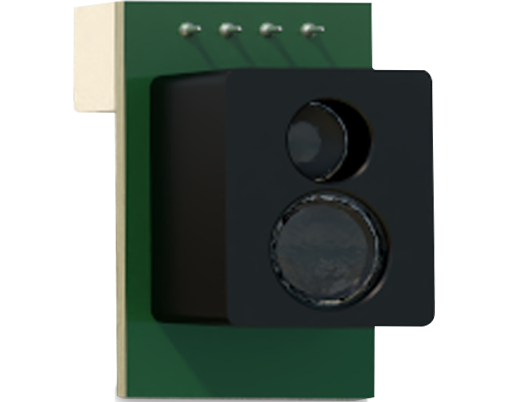
Beyond these core calculations, modern laser sensors incorporate extensive signal processing and compensation algorithms. The raw calculated distance is just the starting point. Processors filter out noise (e.g., from ambient light or electrical interference) using digital filters. They compensate for temperature variations that affect laser wavelength and electronic timing. For transparent objects or specific surface colors (like black surfaces that absorb infrared light), advanced sensors may adjust laser power or use specialized algorithms to maintain a valid return signal. In multi-echo or peak-detection modes, the firmware can calculate distances to multiple targets in the beam path by analyzing the full waveform of the return signal, a capability crucial in logistics or level sensing in silos.
In conclusion, the calculation of distance by a laser sensor is a seamless integration of physics, high-speed electronics, and embedded software. Whether it's the direct time measurement of ToF, the precise phase analysis of modulated light, or the geometric computation of triangulation, each method translates the fundamental behavior of light into a reliable digital measurement. This computational prowess enables machines to perceive their environment in 3D, guiding autonomous vehicles, ensuring robotic precision on assembly lines, and providing the critical data that drives modern automation and measurement science forward.