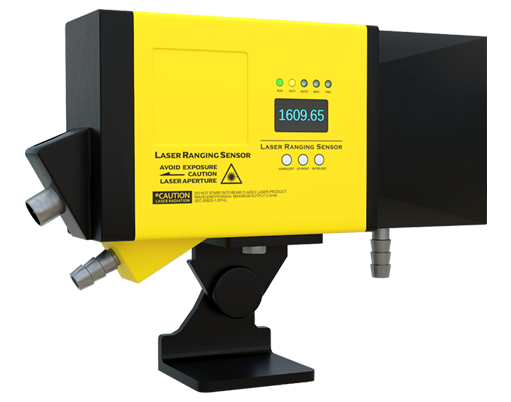
In the realm of industrial automation, precision measurement is paramount. Laser distance sensors have emerged as a cornerstone technology, offering unparalleled accuracy, speed, and versatility for a wide array of applications. Unlike traditional contact-based measurement tools, these sensors operate on non-contact principles, making them ideal for delicate materials, high-speed processes, and harsh environments. This article delves into the fundamental working principles, key application areas, and critical factors to consider when selecting a laser distance sensor for your specific needs.
The core principle behind a laser distance sensor is triangulation or time-of-flight measurement. In the triangulation method, a laser diode projects a visible or infrared spot onto the target object. The reflected light is then focused onto a sensitive position-sensitive detector (PSD) or a CMOS/CCD array. The position of the light spot on the detector shifts depending on the distance to the target. This shift is analyzed by the sensor's internal processor to calculate the exact distance with high resolution. This method is exceptionally effective for short to medium ranges, typically from a few millimeters up to several meters, delivering micron-level accuracy. For longer ranges, often exceeding tens or hundreds of meters, time-of-flight (ToF) sensors are employed. These sensors measure the time it takes for a laser pulse to travel to the target and back. Given the constant speed of light, the distance is calculated precisely as Distance = (Speed of Light × Time of Flight) / 2. ToF sensors are commonly used in surveying, logistics, and autonomous vehicle guidance.

The applications of laser distance sensors are vast and continually expanding. In manufacturing, they are indispensable for dimensional gauging, thickness measurement of materials like glass or metal sheets, and controlling robot positioning and palletizing. The electronics industry relies on them for wafer mapping, component placement verification, and coplanarity checks. In logistics and warehousing, they facilitate volume measurement of packages, level monitoring in silos, and automated guided vehicle (AGV) navigation. Furthermore, they play a critical role in construction for alignment, profiling, and monitoring structural deformations. Their non-contact nature also makes them perfect for measuring hot, vibrating, or soft objects that would be damaged or yield inaccurate results with tactile probes.
Selecting the right laser distance sensor requires careful consideration of several technical parameters. First, define the required measuring range and the desired resolution or repeatability. A sensor with a 100mm range and 1µm resolution is suited for micro-measurements, while one with a 300m range and 1cm accuracy fits outdoor surveying. The type of target surface significantly influences performance. For optimal results on diffuse, matte surfaces, standard sensors work well. For shiny, reflective, or dark surfaces, specialized models with background suppression or advanced filtering algorithms are necessary to prevent erroneous readings. The response time or sampling rate is crucial for dynamic processes; high-speed sensors can capture thousands of measurements per second. Environmental factors cannot be overlooked. Industrial settings may demand sensors with robust housings (IP67/IP69K ratings), resistance to vibrations, and stable operation across a wide temperature range. Finally, consider the output interface—common options include analog (4-20 mA, 0-10 V), digital (RS-232, RS-485), and industrial Ethernet protocols (EtherCAT, PROFINET)—to ensure seamless integration with your PLC or control system.

In conclusion, laser distance sensors are powerful tools that bridge the gap between physical objects and digital control systems. By understanding their operating principles—be it precise triangulation for minute details or robust time-of-flight for vast distances—engineers can harness their capabilities to enhance quality control, optimize processes, and enable automation. The key to successful implementation lies in a meticulous selection process that aligns the sensor's specifications with the application's specific demands regarding range, target, speed, and environment. As technology advances, these sensors will continue to evolve, offering even greater precision and opening new frontiers in measurement and automation.