In the realm of industrial automation and control systems, proximity switch sensors play a pivotal role in enabling non-contact detection of objects. Among these, the CS1-J series stands out as a reliable and widely used inductive proximity sensor designed for harsh industrial environments. This article delves into the fundamental working principle of the CS1-J proximity switch sensor, explaining its operation, key components, and typical applications in a clear, technical manner.
At its core, the CS1-J is an inductive proximity sensor. This means it operates based on the principle of electromagnetic induction to detect the presence or absence of metallic objects without any physical contact. The primary components of the sensor include an oscillator circuit, a coil (which generates an electromagnetic field), a signal evaluation circuit, and an output switching element (typically a solid-state transistor).
The working cycle begins with the internal oscillator generating a high-frequency alternating magnetic field. This field emanates from the active face of the sensor, which is usually the front surface. When a metallic target (such as steel, aluminum, brass, or copper) enters this oscillating electromagnetic field, eddy currents are induced on the surface of the target object. These eddy currents, according to Lenz's law, create their own magnetic field that opposes the original field generated by the sensor's coil.
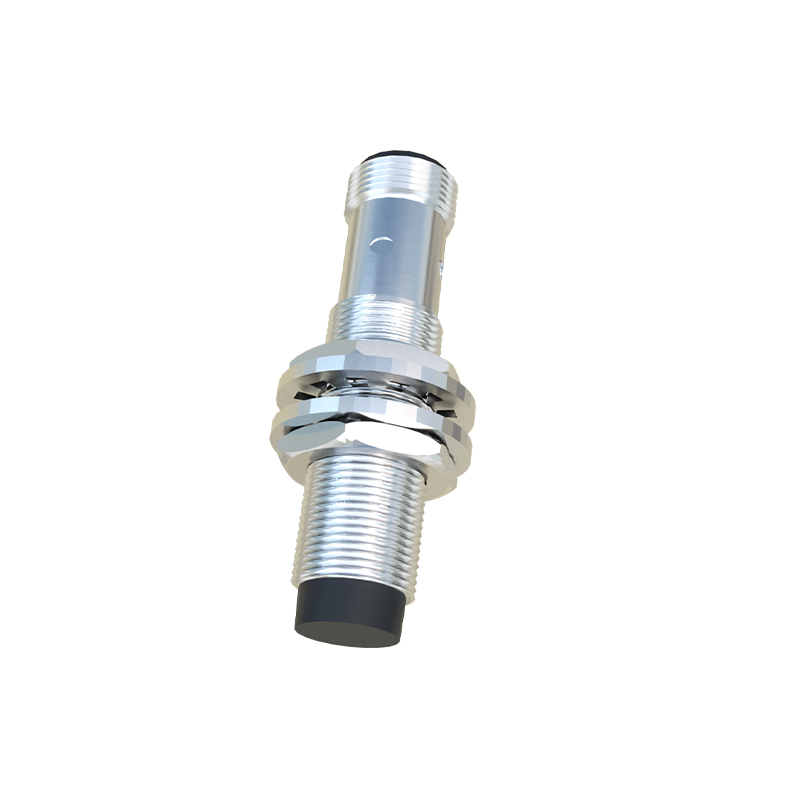
This opposition results in a damping or attenuation of the oscillator's amplitude. The sensor's built-in signal evaluation circuit continuously monitors the amplitude of the oscillation. Once the damping effect reaches a predetermined threshold—indicating that a target object is within the specified sensing range—the evaluation circuit triggers a change in the state of the output switch. For a normally open (NO) configuration, the output turns ON (conducts current). When the target object moves away, the oscillation amplitude restores, and the output reverts to its original OFF state.
The CS1-J sensor is characterized by its defined sensing distance, which is non-adjustable and calibrated for specific target materials (usually mild steel). It is crucial to note that the effective sensing distance can vary with different metals; for instance, it is typically shorter for non-ferrous metals like aluminum or copper compared to ferrous steel. This sensor series is often designed to be shielded (flush-mountable), allowing installation flush with metal surfaces without affecting its sensing field, making it ideal for space-constrained applications.
Key advantages of the CS1-J inductive proximity switch include its robustness, long operational life (due to non-contact operation), high switching frequency, and immunity to environmental factors like dust, oil, and moisture when properly housed. Common industrial applications encompass position detection of machine parts, limit switching in automated assembly lines, counting metallic objects on conveyors, and ensuring safety in machinery by confirming the presence of guards or tools.
In summary, the CS1-J proximity switch sensor is an efficient and durable solution for metallic object detection. Its reliance on electromagnetic induction ensures reliable performance in demanding settings, forming an integral component in modern electrical control panels and automated systems. Understanding its principle aids engineers in proper selection, installation, and troubleshooting, thereby optimizing system efficiency and reliability.