In the realm of industrial automation, proximity switch sensors stand as fundamental components for non-contact detection. Among these, PNP-type sensors are widely favored for their compatibility with common PLC input modules and straightforward wiring logic. The production of a high-quality PNP proximity switch sensor is a meticulous process that integrates precision engineering, rigorous material selection, and stringent quality control to ensure reliability in demanding environments.
The journey begins with the sensor's core: the sensing element. For inductive proximity sensors, which detect metallic objects, this is typically a coil wound around a ferrite core, forming part of an oscillator circuit. The production of this coil requires precise winding machinery to achieve consistent inductance values, which directly influence the sensor's switching frequency and sensing range. The ferrite material is chosen for its stable magnetic properties at varying temperatures. For capacitive sensors, used for non-metallic materials, the sensing face acts as one plate of a capacitor, and its production focuses on achieving a precise and stable surface area and dielectric.
The housing, often made from nickel-plated brass, stainless steel, or high-grade PBT/PPS plastics, is machined or molded to provide robust environmental protection (IP67/IP69K ratings are common). The internal components are then carefully assembled. The oscillator circuit, which generates an electromagnetic field, is tuned. In a PNP sensor, the output stage is designed with a PNP transistor. This means the sensor's output wire acts as a sourcing output; when a target is detected, the sensor switches the output to connect to the positive supply voltage (+V). This circuitry is built on a compact, durable printed circuit board (PCB) designed to withstand vibration and electrical noise.
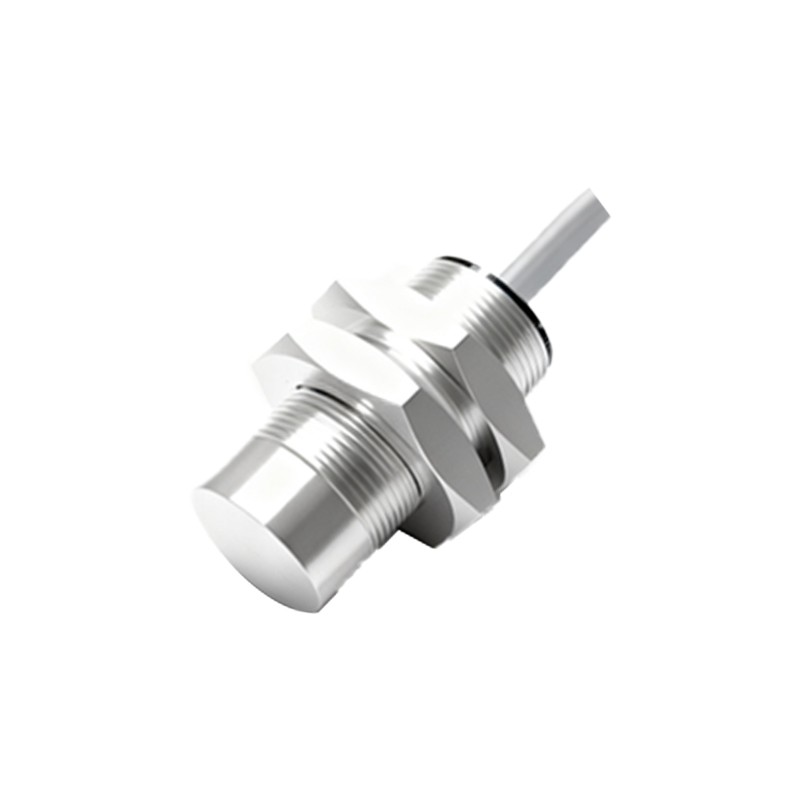
A critical phase is potting or encapsulation. The internal cavity, containing the coil and electronics, is filled with a thermosetting epoxy resin. This process serves multiple vital functions: it immobilizes components against shock and vibration, provides exceptional moisture and chemical resistance, and enhances heat dissipation. The potting compound's thermal expansion coefficient must be matched to the housing and components to prevent stress cracks over temperature cycles.
Following assembly, each sensor undergoes a series of calibrations and tests. The sensing distance, a key parameter, is calibrated against standardized test targets. For instance, an M18 inductive sensor might be calibrated for an 8mm nominal sensing range. Hysteresis, the difference between the switch-on and switch-off points, is set to prevent output chattering. Electrical tests verify the PNP sourcing behavior—ensuring the output voltage rises to near +V when activated and leaks minimal current when inactive. Long-duration endurance tests under elevated temperature and humidity simulate years of operation in a condensed timeframe.
The choice between shielded (flush-mountable) and unshielded designs is integral to production. Shielded sensors have a metallic ring surrounding the sensing face, confining the magnetic field, allowing flush installation in metal. Their production involves precise integration of this shielding ring. Unshielded sensors have a longer range but require non-metallic surroundings.
Finally, labeling and marking with essential data (type, voltage range, output type "PNP NO/NC", sensing distance) complete the process. Packaged sensors are often subjected to a final Automated Optical Inspection (AOI) and sample-based performance audits.
In summary, the production of PNP proximity switches is a sophisticated blend of electrical engineering and material science. It demands precision at every stage—from coil winding and transistor selection to potting and calibration—to deliver a sensor that provides millions of reliable, maintenance-free detection cycles. This relentless focus on production quality is what enables these components to form the reliable sensory backbone of modern automated systems, from packaging machinery to automotive assembly lines.