In the realm of precision measurement and industrial automation, laser displacement and height sensors have emerged as indispensable tools. These non-contact devices provide high-accuracy, high-speed measurements critical for quality control, process monitoring, and robotic guidance. This article delves into their working principles, key specifications, diverse applications, and essential factors for selection.
At its core, a laser displacement sensor operates on the principle of optical triangulation. The sensor projects a focused laser beam onto the target surface. The reflected or scattered light from this point is then captured by a receiving lens and focused onto a position-sensitive detector, typically a CCD or CMOS array. When the target's distance changes, the position of the light spot on the detector shifts proportionally. By calculating this shift, the sensor's internal processor precisely determines the distance to the target. This method allows for measurements with resolutions down to the sub-micron level and at very high sampling rates.

Laser height sensors, often a specific configuration of displacement sensors, are optimized for measuring the height or thickness of objects relative to a reference plane. They are frequently used in pairs or with a calibrated reference to provide absolute height data. The fundamental technology remains triangulation, but the system setup and data processing are tailored for profile and dimensional inspection.
Key performance specifications define a sensor's capability. Measurement Range is the distance over which the sensor can operate reliably. Spot Size refers to the diameter of the laser beam on the target, affecting the ability to measure small features or rough surfaces. Resolution is the smallest detectable change in distance. Linear Accuracy indicates how closely the sensor's output matches the true distance across its entire range. Sampling Rate determines how many measurements can be taken per second, crucial for dynamic or high-speed applications. Finally, the Laser Class (typically Class 2 or Class 1M for industrial use) defines safety requirements.
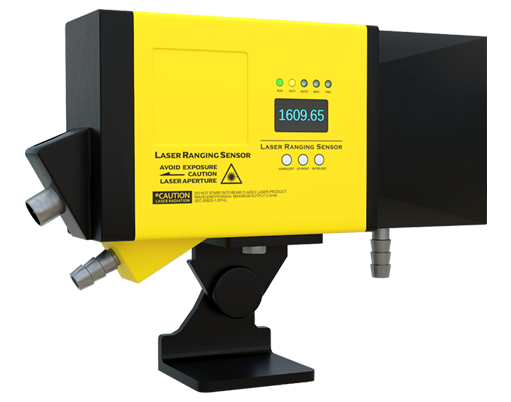
The applications for these sensors are vast and span numerous industries. In automotive manufacturing, they measure panel gaps, inspect weld seams, and verify component dimensions. In electronics, they ensure the coplanarity of BGA solder balls, measure chip thickness, and inspect PCB warpage. In metal processing, they monitor sheet flatness, roll gap dimensions, and surface defects. In pharmaceutical packaging, they verify fill levels, check cap placement, and inspect blister packs. Furthermore, they are integral to robotic systems for precise positioning, bin picking, and assembly verification.
Selecting the right sensor requires careful consideration of the application's demands. First, define the object characteristics: material (color, transparency, reflectivity), surface texture (glossy, matte, rough), and target size. A highly reflective or transparent surface may require a sensor with special filters or a diffused laser type to avoid measurement errors. Second, establish the required performance parameters: necessary resolution, accuracy, and measurement speed. Third, consider the environmental conditions: ambient light, temperature fluctuations, dust, oil, or vibration, which may necessitate protective housings or specific wavelength lasers. Fourth, evaluate the output interfaces needed, such as analog voltage/current, digital (RS-232, Ethernet), or fieldbus protocols (PROFIBUS, EtherCAT), for integration with PLCs or data acquisition systems. Finally, factor in mounting constraints and ease of calibration.

Modern advancements continue to push the boundaries. Confocal chromatic sensors offer exceptional performance on transparent or multi-layered materials. Line laser profilers extend the point measurement into a 2D profile or 3D contour by using a laser line instead of a single spot. Integration with smart factory frameworks and Industrial Internet of Things (IIoT) platforms enables predictive maintenance and big-data analytics for process optimization.
In conclusion, laser displacement and height sensors are powerful enablers of precision and efficiency in modern industry. A thorough understanding of their technology and a methodical approach to selection are paramount to leveraging their full potential, ensuring reliable data for improved product quality, reduced waste, and enhanced automated processes. As technology evolves, their role in enabling smarter, more adaptive manufacturing will only grow more significant.