Laser sensors have become indispensable tools across a vast spectrum of industrial and technological fields, offering unparalleled precision, speed, and reliability for measurement, detection, and positioning tasks. Their operation is fundamentally based on the emission of a focused beam of light and the analysis of its interaction with a target object. The specific method of analysis defines the sensor type, each with distinct advantages and ideal use cases. Understanding these common types is crucial for selecting the right sensor for any given application.
One of the most prevalent categories is the Time-of-Flight (ToF) Laser Sensor. This type measures the time it takes for a laser pulse to travel to a target and back to the receiver. Since the speed of light is constant, the sensor's internal processor can calculate the distance to the object with high accuracy. ToF sensors are excellent for long-range measurements, often spanning several meters to hundreds of meters. They are widely used in applications like vehicle LiDAR for autonomous navigation, bulk level measurement in silos, and large-scale 3D scanning and mapping. Their main strengths are long range and the ability to provide a precise distance value regardless of the target's surface color or texture, though very reflective or absorbent surfaces can pose challenges.
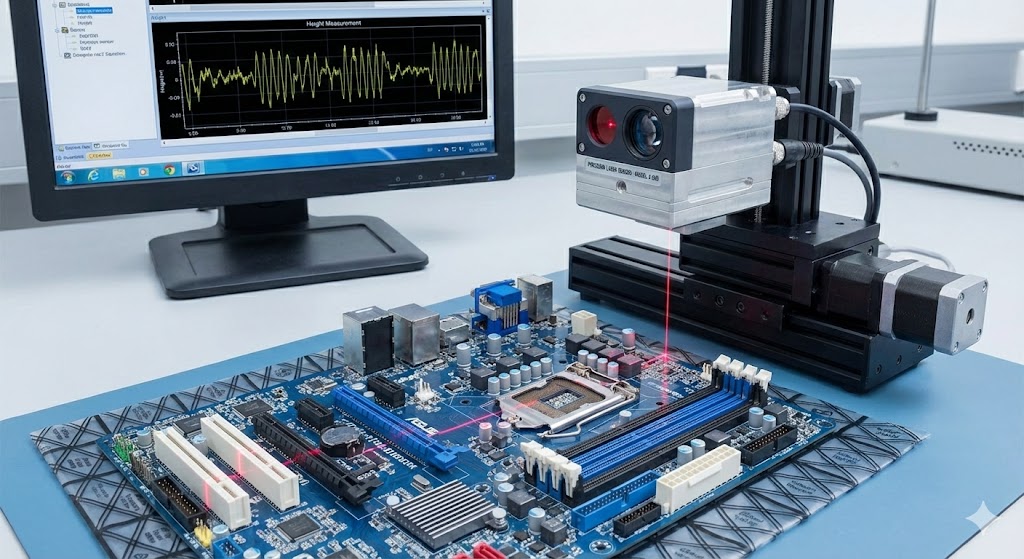
In contrast, Triangulation Laser Sensors excel in high-precision, short-range measurements. The principle involves projecting a laser spot onto the target surface. The reflected light is received by a position-sensitive detector (like a CCD or CMOS array) at a known angle relative to the emitter. As the target distance changes, the position of the reflected spot on the detector shifts. Using trigonometric calculations, the sensor determines the exact distance or displacement. Triangulation sensors offer exceptional resolution, often in the micron range, making them ideal for tasks such as measuring thickness, warp, or vibration of components, profiling object contours, and precise positioning in assembly robotics. Their performance can be affected by the target's surface characteristics, with shiny or transparent materials sometimes requiring special treatment.
For applications demanding extreme speed in detecting the presence or absence of an object, Laser Through-Beam Sensors are the go-to choice. This system consists of two separate units: a laser transmitter and a receiver placed opposite each other. The sensor detects an object when it interrupts the laser beam between them. This method provides a very high switching frequency and a long sensing range relative to its size. It is also highly immune to environmental interference like dust or target surface color, as it only needs to detect a loss of signal. Common uses include object counting on high-speed production lines, break detection in material webs, and safety light curtains for personnel protection.
A variation of the through-beam is the Laser Retro-Reflective Sensor. Here, the emitter and receiver are housed in the same unit. The laser beam is directed towards a reflector (a prismatic retro-reflector) which sends the beam directly back to the receiver. An object is detected when it blocks this reflected beam. This design simplifies installation as it requires wiring only on one side, but it needs a clear line of sight to the reflector. These sensors are perfect for detecting objects on conveyors, at gate entries, or in packaging machinery where mounting a separate receiver is impractical.
Finally, Laser Diffuse Reflective Sensors represent a single-unit design that does not require a separate reflector. The sensor emits a laser beam and uses its built-in receiver to detect the light diffusely reflected from the target object itself. Detection is based on the intensity of the returned light. This makes them very easy to install and align. However, their sensing range is shorter than through-beam types, and their performance is significantly influenced by the target's color, size, and surface finish. A white, matte surface reflects well and is easily detected at a longer range, while a black, shiny surface may be detected only at a very short distance or not at all. They are extensively used for proximity sensing, short-range object detection, and label detection on packaging.
Beyond these primary types, specialized variants exist. Laser Contrast Sensors are optimized to detect differences in color or grayscale values on a surface, crucial for mark registration or quality control. Laser Distance Sensors often utilize ToF or triangulation principles to provide continuous analog or digital output of a measured distance.
Selecting the appropriate laser sensor requires a careful analysis of the application requirements: required measurement accuracy or detection reliability, sensing distance, target material and surface properties, environmental conditions (dust, moisture, ambient light), required response speed, and installation constraints. By matching these parameters to the inherent strengths of each laser sensor type—ToF for long-range distance, triangulation for micron-level precision, through-beam for reliable high-speed interruption, retro-reflective for one-sided installation convenience, and diffuse reflective for simple proximity tasks—engineers and technicians can ensure optimal system performance, enhanced productivity, and robust process control.