In the realm of industrial automation, precision, reliability, and durability are non-negotiable. Among the myriad of components that form the backbone of modern manufacturing and control systems, the M12 inductive proximity sensor operating on a 24V DC supply stands out as a quintessential workhorse. This comprehensive guide delves into the technical specifications, operational principles, selection criteria, and application best practices for these ubiquitous sensors, providing engineers and technicians with the essential knowledge for optimal implementation.
Understanding the Fundamentals: How M12 24V DC Inductive Proximity Sensors Work
At its core, an inductive proximity sensor is a solid-state electronic device designed to detect the presence or absence of metallic objects without physical contact. The "M12" designation refers to the standardized 12mm threaded cylindrical housing, a form factor celebrated for its compactness and robustness, making it ideal for space-constrained installations. The 24V DC operating voltage has become the de facto standard in industrial control panels and PLC (Programmable Logic Controller) systems, offering a safe, stable, and efficient power level compatible with most machinery.
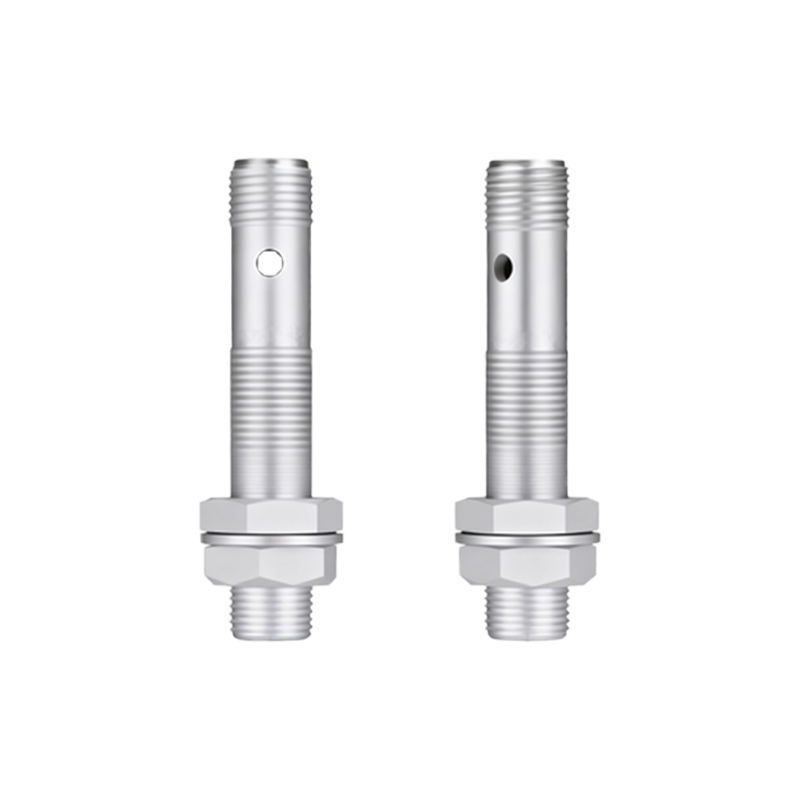
The sensing principle is based on electromagnetic induction. The sensor's active face contains a coil that is part of an oscillator circuit. When powered by 24V DC, this oscillator generates a high-frequency electromagnetic field. When a ferrous or non-ferrous metal target enters this field, eddy currents are induced on the target's surface. This causes a load on the oscillator, leading to a change in its amplitude. An integrated evaluation circuit detects this change and triggers a switching signal—typically a solid-state NPN or PNP output—to indicate object detection. This non-contact operation eliminates mechanical wear, ensuring a long operational life often rated in millions of cycles.
Key Technical Specifications and Selection Parameters
Selecting the correct M12 24V DC sensor requires careful consideration of several parameters beyond just the voltage and thread size:
1. Sensing Distance: Rated as the nominal sensing distance (Sn). Common ranges for M12 sensors are 2mm, 4mm, or 8mm. It is critical to consider a safety factor, typically operating at 70-80% of Sn, to account for temperature fluctuations, voltage tolerances, and target material variations.
2. Output Configuration: The two primary types are NPN (sinking) and PNP (sourcing) transistor outputs. The choice depends on the input circuit of your controller (PLC). A 3-wire design is most common, providing V+, V-, and signal output lines. Some models also feature analog (4-20mA or 0-10V) or IO-Link outputs for advanced data communication.
3. Switching Frequency: This defines how quickly the sensor can detect objects passing by, measured in Hertz (Hz). High-speed applications, like counting small parts on a conveyor, may require sensors with frequencies exceeding 1 kHz.
4. Material and Housing: The housing is typically nickel-plated brass or stainless steel (e.g., 303, 304, 316), offering excellent resistance to oils, coolants, and industrial chemicals. The sensing face is often made of PBT or similar rugged plastic.
5. Protection Rating: An IP67 or IP68 rating is standard, indicating complete protection against dust ingress and the ability to withstand temporary (IP67) or prolonged (IP68) immersion in water. This makes them suitable for harsh washdown environments in food & beverage or pharmaceutical industries.
6. Target Material: The sensing distance is calibrated for mild steel. For other metals like aluminum, brass, or copper, a correction factor (often between 0.3 to 0.9) must be applied, reducing the effective range.
Typical Applications in Industrial Settings
The versatility of the M12 24V DC inductive sensor makes it indispensable across sectors:
Position Sensing: Verifying the end position of cylinders, confirming the closure of gates or doors, and detecting the presence of a part in a fixture or nest.
Object Counting: High-speed counting of metallic components on assembly lines or packaging machinery.
Speed Monitoring: Used in conjunction with a gear tooth or encoder disk to monitor rotational speed.
Level Detection: Detecting the presence of metal bins or containers.
Machine Safety: While not a primary safety device, they can be part of interlock systems to confirm machine guard closure.
Installation and Wiring Best Practices
Proper installation is crucial for reliable performance. Maintain the recommended lateral and axial clearance from metal mounting surfaces to avoid false triggering due to side-effects of the magnetic field. Always refer to the sensor's datasheet for specific mounting dimensions. For wiring, adhere strictly to the color code: Brown wire