In the rapidly evolving landscape of automation and robotics, one technology stands out as a critical enabler for safe and reliable operation: the Lidar obstacle avoidance sensor. Far from being a futuristic concept, these sensors are now integral components in a wide array of applications, from self-driving vehicles and delivery robots to advanced industrial machinery and smart infrastructure. Their primary function is to provide real-time, high-resolution environmental perception, allowing systems to navigate complex, dynamic spaces without human intervention.
At its core, Lidar—which stands for Light Detection and Ranging—operates on a principle similar to radar but uses laser light instead of radio waves. A typical Lidar sensor emits rapid pulses of invisible, eye-safe laser light across its field of view. When these pulses strike an object—be it a pedestrian, another vehicle, a piece of machinery, or an unexpected obstacle—they are reflected back to the sensor. By precisely measuring the time it takes for each pulse to return (Time of Flight, or ToF), the sensor can calculate the distance to that object with extraordinary accuracy, often down to the centimeter level. This process is repeated millions of times per second, generating a dense, real-time 3D point cloud map of the surrounding environment.
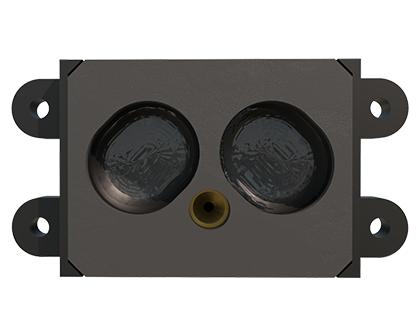
This rich spatial data is what sets Lidar apart from other sensing modalities like cameras or ultrasonic sensors. While cameras provide detailed 2D visual information, they can struggle with depth perception and are highly susceptible to lighting conditions—failing in darkness, glare, or fog. Ultrasonic sensors are cost-effective for short-range detection but lack the resolution and range for high-speed or complex navigation. Lidar fills this gap by providing consistent, accurate, and quantitative distance data regardless of ambient light. Modern solid-state Lidar (SSL) designs, which have no moving parts, further enhance reliability and durability for demanding applications.

The implementation of obstacle avoidance algorithms transforms this raw distance data into actionable intelligence. Sophisticated software processes the point cloud, identifying and classifying objects, tracking their trajectories, and predicting potential collisions. The system can then execute predefined avoidance maneuvers, such as slowing down, stopping, or altering course. This closed-loop process of perception, decision, and action happens in milliseconds, enabling smooth and safe autonomous operation. For instance, an autonomous mobile robot (AMR) in a warehouse uses Lidar not just to avoid static shelving but also to dynamically navigate around human workers and other moving robots, optimizing its path in real time.
The applications are vast and growing. In the automotive sector, Lidar is a cornerstone of Advanced Driver-Assistance Systems (ADAS) and autonomous driving, providing a critical layer of safety for features like automatic emergency braking and adaptive cruise control. In logistics and warehousing, Lidar-equipped robots streamline operations by moving goods safely and efficiently. Drones utilize compact Lidar sensors for terrain following and precise landing. Even in consumer electronics, new devices are incorporating miniaturized Lidar for enhanced augmented reality experiences and improved photography.
However, the journey is not without challenges. Historically, the cost of mechanical spinning Lidar units was a significant barrier to mass adoption. The industry has responded with innovations in solid-state and flash Lidar technologies, which are cheaper to manufacture and more robust. Environmental factors like heavy rain, snow, or dense dust can still scatter laser pulses, potentially reducing effective range. Manufacturers are continuously improving signal processing algorithms and using multiple wavelengths to mitigate these effects. Furthermore, the computational power required to process vast point cloud datasets in real-time demands efficient, specialized processors.
Looking ahead, the future of Lidar obstacle avoidance sensors is incredibly promising. Trends point towards further miniaturization, reduced power consumption, and even lower costs, enabling their integration into a broader spectrum of devices. The fusion of Lidar data with inputs from cameras, radar, and thermal sensors in sensor fusion systems will create even more robust and redundant perception suites. As artificial intelligence and machine learning algorithms become more advanced, they will enable better object recognition and intention prediction from Lidar data alone.
In conclusion, Lidar obstacle avoidance sensors represent a fundamental technological shift towards autonomous systems that can perceive and interact with the world safely and intelligently. By providing a reliable, precise, and real-time understanding of spatial surroundings, they unlock new levels of efficiency, safety, and capability across numerous industries. As the technology continues to mature and overcome its current limitations, its role as the eyes of autonomous machines will only become more pronounced, quietly but powerfully shaping a more automated future.