Inductive proximity sensors are fundamental components in industrial automation, offering non-contact detection of metallic objects. These robust devices operate on a simple yet effective principle, making them indispensable in manufacturing, packaging, robotics, and automotive assembly lines. Unlike mechanical limit switches, they have no moving parts, leading to higher reliability, longer service life, and reduced maintenance needs.
The core working principle is based on electromagnetic induction. The sensor contains a coil wound around a ferrite core, an oscillator, a signal converter, and an output switching circuit. When powered, the oscillator generates a high-frequency alternating electromagnetic field that radiates from the sensor's active face. When a metallic object enters this field, eddy currents are induced on the object's surface. These eddy currents draw energy from the oscillator, causing a reduction in its oscillation amplitude. The sensor's detection circuit monitors this amplitude change. Once the amplitude drop reaches a predetermined threshold, the circuit triggers a change in the output state—typically switching a solid-state transistor (PNP or NPN) from OFF to ON or vice-versa. This provides a clear electrical signal indicating the presence of the target.
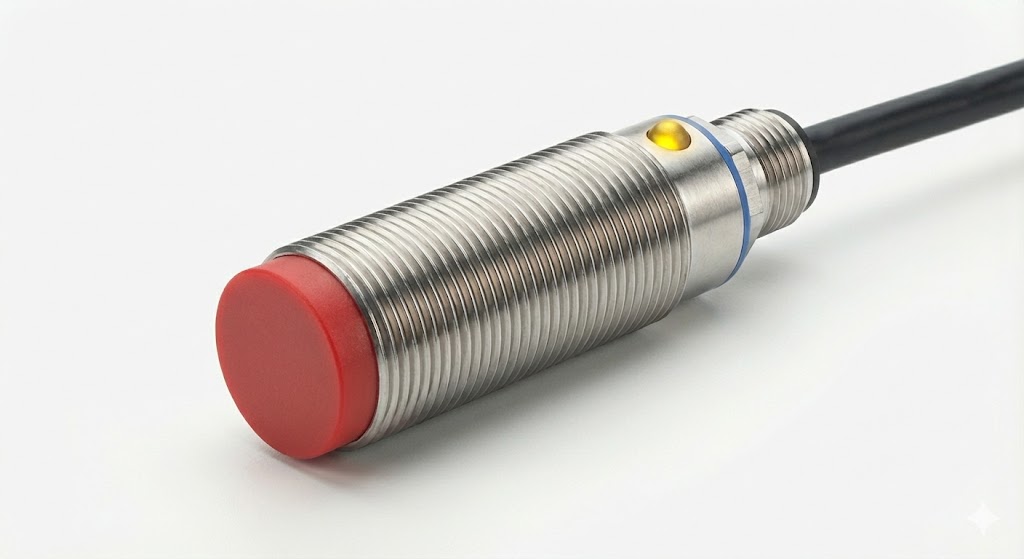
A key characteristic is that only conductive metals, primarily ferrous metals like steel and iron, can be detected effectively. The sensing distance, or nominal range (Sn), is specified for a standard target (usually mild steel). For non-ferrous metals like aluminum, brass, or copper, the effective sensing distance is reduced, often requiring a correction factor. The sensor's performance is largely unaffected by non-metallic materials like plastic, wood, or liquids, making it ideal for harsh, dirty environments where optical sensors might fail.
Several types are available to suit different applications. Shielded (flush-mountable) sensors have a shielded magnetic field, allowing them to be installed flush with metal mounting surfaces without triggering false signals. Unshielded (non-flush) sensors offer a longer sensing range but require a non-metallic surrounding area. Furthermore, analog output sensors provide a continuous signal proportional to the distance to the target, useful for positioning tasks, while standard digital sensors provide a simple on/off switch.
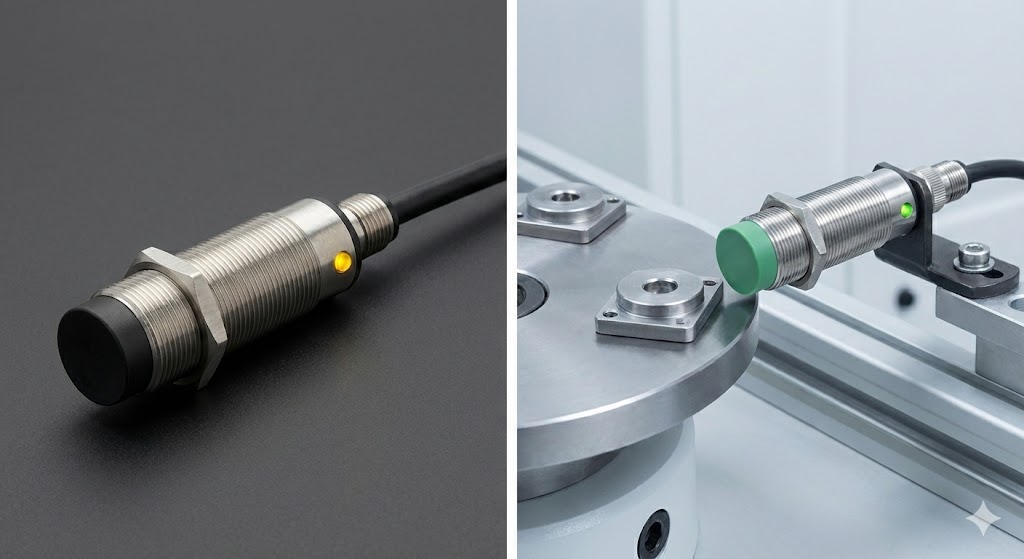
The advantages are numerous. They provide high switching frequency, allowing detection of very fast-moving parts. They are resistant to common environmental contaminants like dust, oil, and coolant splash. With housing typically made of nickel-plated brass or stainless steel, they are mechanically rugged. Their setup is straightforward, requiring no physical contact or alignment with the target.
Typical applications include detecting the presence or absence of metal parts on a conveyor, counting metallic objects, monitoring rotational speed by detecting gear teeth or bolts, confirming end positions of cylinders, and ensuring proper positioning in machine tools. In automotive plants, they verify the placement of engine blocks; in packaging, they confirm the presence of metal lids.
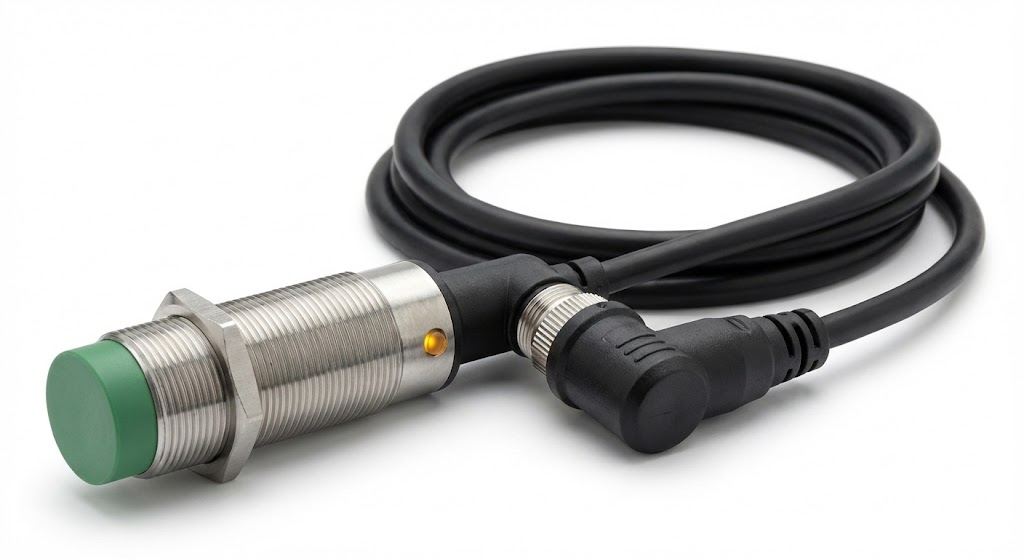
When selecting an inductive sensor, engineers must consider the required sensing distance, target material and size, output type (DC 2-wire, 3-wire, or AC), housing shape (cylindrical, rectangular), and environmental ratings like IP67 for dust and water resistance. Proper installation is crucial, ensuring adequate clearance from other metal objects to prevent interference.
In summary, the inductive proximity sensor is a workhorse of modern industry. Its durability, speed, and reliability in detecting metallic objects without physical contact make it a cornerstone of efficient, automated systems. By converting the physical presence of metal into a precise electrical signal, it forms a critical link between the mechanical and control worlds, enabling smarter, faster, and more reliable machinery.