In the realm of precision measurement and automation, laser sensor positioning systems have emerged as a cornerstone technology. These systems utilize the properties of laser light to determine the precise location, distance, or displacement of an object with exceptional accuracy and speed. Unlike traditional mechanical or ultrasonic methods, laser-based positioning offers non-contact measurement, eliminating wear and tear and enabling applications in sensitive or high-speed environments.
The fundamental principle behind most laser positioning systems is triangulation or time-of-flight measurement. In a triangulation-based sensor, a laser diode projects a visible or infrared spot onto the target surface. The reflected light is focused onto a position-sensitive detector, such as a CCD or CMOS array. As the target's distance changes, the position of the reflected spot on the detector shifts. By calculating this shift through geometric triangulation, the sensor's onboard processor can determine the exact distance to the target with micron-level resolution. Time-of-flight systems, on the other hand, measure the time it takes for a pulsed laser beam to travel to the target and back. Given the constant speed of light, this time interval directly correlates to distance, making this method ideal for longer ranges, though sometimes with slightly lower resolution compared to triangulation.
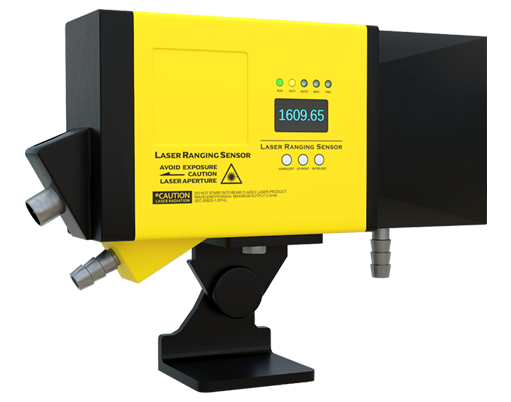
The applications of laser sensor positioning are vast and transformative across numerous industries. In manufacturing and robotics, these systems are indispensable for quality control, guiding robotic arms for precise assembly, and performing 3D scanning for reverse engineering. They ensure components are placed within tolerances often finer than a human hair. In the logistics sector, laser sensors enable automated guided vehicles (AGVs) to navigate warehouses by creating and referencing detailed maps of their surroundings. The automotive industry relies on them for aligning vehicle frames, inspecting panel gaps, and in advanced driver-assistance systems (ADAS) for object detection and collision avoidance.
Furthermore, the construction and civil engineering fields utilize laser positioning for monitoring structural deformations, aligning heavy machinery, and ensuring levelness over large distances. In scientific research, from particle physics to astronomy, laser interferometers—a highly precise form of laser positioning—measure minute displacements, gravitational waves, and the precise positioning of optical components.

The advantages of implementing a laser sensor positioning system are compelling. The primary benefit is high precision and repeatability, unaffected by factors like target color or ambient light in many modern models equipped with sophisticated filtering algorithms. Their non-contact nature prevents damage to both the sensor and the target, which is crucial for measuring soft, delicate, or hot objects. Additionally, laser sensors provide extremely fast response times, capable of taking thousands of measurements per second, which is essential for dynamic processes and high-speed production lines.
Looking toward the future, trends in laser positioning technology point toward greater integration, intelligence, and miniaturization. The convergence with artificial intelligence and machine learning allows systems to not only collect positional data but also interpret patterns, predict movements, and make autonomous adjustments. The development of solid-state LiDAR (Light Detection and Ranging) is making high-resolution 3D positioning more compact and affordable, fueling advancements in autonomous vehicles and mobile robotics. Furthermore, the integration of multiple sensor types—combining laser data with inertial measurement units (IMUs) or vision cameras—is creating robust multi-modal positioning systems that can operate reliably in complex, changing environments.
Selecting the right laser positioning system requires careful consideration of several parameters: required measurement range, resolution, accuracy, target surface properties, environmental conditions (like dust, humidity, or vibration), and necessary data output speed. Consulting with technical specialists is often recommended to match the sensor's capabilities precisely to the application's demands.
In conclusion, laser sensor positioning systems represent a critical enabling technology for the fourth industrial revolution. By providing accurate, reliable, and fast spatial data, they form the sensory foundation upon which automated, intelligent, and precise systems are built. As the technology continues to evolve, becoming more capable and accessible, its role in shaping efficient and innovative solutions across all sectors of industry and research will only become more profound.