For years, smartphone innovation seemed focused on screens and cameras. But a quiet revolution has been happening beneath the glass, powered by a component most users never see: the laser sensor. This technology, once confined to industrial and scientific equipment, is now a critical part of the modern mobile experience, enabling features that feel like magic but are grounded in precise physics.
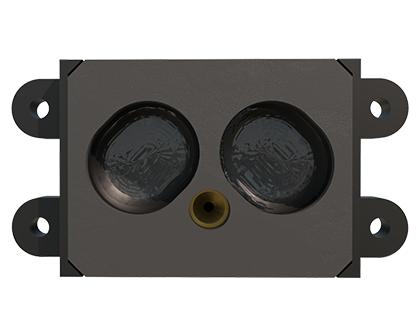
At its core, a laser sensor in a phone is a type of LiDAR (Light Detection and Ranging) or a simpler time-of-flight (ToF) sensor. It works by emitting an invisible, low-power laser beam and measuring the time it takes for the light to bounce back from an object. This calculation provides an extremely accurate measurement of distance. Unlike a camera that captures color and light, a laser sensor captures depth, creating a detailed 3D map of the surrounding environment in real-time.
The most immediate and noticeable application is in photography. Laser autofocus has become a game-changer, especially in low-light conditions. Traditional contrast-detection autofocus can struggle in the dark, hunting back and forth to find focus. A laser sensor instantly knows the distance to the subject, allowing the camera to lock focus almost immediately. This results in sharper night-time photos and faster capture of spontaneous moments. Beyond focus, this depth data enables sophisticated portrait mode effects, allowing software to precisely separate the subject from the background with stunning accuracy.

However, the implications go far beyond better selfies. Augmented Reality (AR) is the true beneficiary of this technology. For AR to be convincing, digital objects must interact realistically with the real world. They need to sit on tables, hide behind chairs, and cast appropriate shadows. A camera-alone image is flat; it lacks depth understanding. A laser sensor provides the detailed spatial map needed to anchor virtual objects in physical space. This enables immersive gaming, practical furniture placement apps, and educational tools that bring historical figures or complex machinery into your living room with realistic occlusion and perspective.
On the accessibility front, laser sensors are powering significant advancements. Applications can use precise distance measurements to help visually impaired users navigate spaces by detecting obstacles, doorways, and changes in elevation, providing audio cues through the phone. Furthermore, the technology enhances security. It can be used for more secure facial recognition by creating a detailed 3D depth map of a user's face, making it much harder to fool with a photograph or mask.
The integration of laser sensing also paves the way for new forms of gesture control. By accurately tracking the position and movement of a user's hand in three-dimensional space, it could allow for touchless interaction with devices, useful in situations where touching the screen is impractical.
Despite its advantages, the technology is not without challenges. The precision of the sensor can be affected by highly reflective or absorbent surfaces, and its effective range is typically limited to a few meters, which is sufficient for most personal and indoor applications but not for long-range mapping. Manufacturers are continuously working to improve power efficiency, range, and accuracy while shrinking the component's size.
Looking ahead, the role of laser sensors is set to expand. As part of the ecosystem for the "spatial computing" and the metaverse, they will be fundamental in digitizing our physical environments. Future iterations could lead to phones capable of instantly creating detailed 3D models of objects or rooms, revolutionizing fields from interior design to online shopping. Combined with advances in machine learning, the data from these sensors will make our devices more contextually aware of their surroundings.
In conclusion, the laser sensor is a quintessential example of a supporting technology that unlocks a multitude of advanced features. It moves the smartphone from being a device that simply sees the world in two dimensions to one that understands and measures it in three. This depth perception is becoming the foundation for the next wave of mobile applications, blurring the lines between the digital and physical worlds and redefining what our pocket-sized computers can truly perceive and achieve.