In the realm of industrial automation and machinery safety, proximity sensors are indispensable components. Among the various models available, the 15PM series stands out for its robust performance and versatility. This article delves into the technical specifications, operational principles, and key application scenarios of the 15PM proximity sensor, providing a detailed guide for engineers and system integrators.
The 15PM is a cylindrical, inductive proximity sensor designed for non-contact detection of metallic objects. Its core operating principle is based on electromagnetic induction. The sensor generates a high-frequency oscillating electromagnetic field from its active face. When a metallic target enters this field, eddy currents are induced on the target's surface. This causes a change in the oscillation amplitude within the sensor's coil, which is detected by the internal circuitry. This detection triggers a switching signal—either PNP (sourcing) or NPN (sinking)—at the output, indicating the presence of the object. A key advantage of this technology is its ability to detect objects without physical contact, thereby eliminating mechanical wear and enabling high-speed, reliable operation.
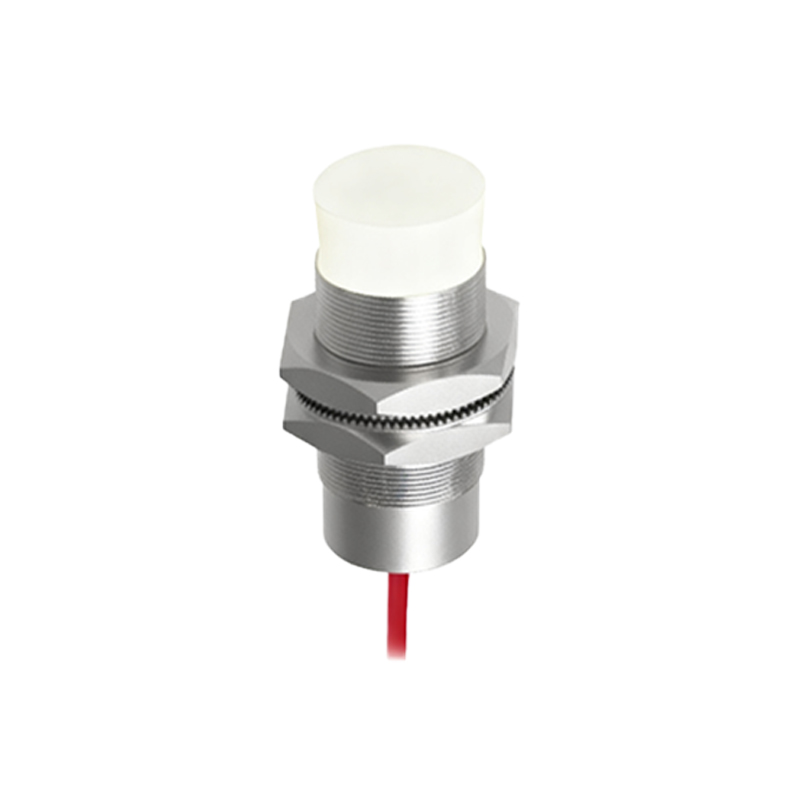
Key technical specifications define the 15PM's capabilities. Typically, these sensors offer a standard sensing range, often up to 15mm, though specific models within the series may vary. The housing is usually constructed from nickel-plated brass or stainless steel, providing excellent resistance to oils, coolants, and industrial debris, conforming to IP67 or higher ingress protection ratings. The operating voltage range is commonly 10-30V DC, making it compatible with standard industrial control voltages. Output configurations are crucial; the 15PM series is available with both PNP (normally open or normally closed) and NPN outputs, allowing seamless integration into diverse PLC (Programmable Logic Controller) and control system architectures. Additionally, many models feature a built-in LED status indicator for visual confirmation of the switching state, greatly aiding in installation and troubleshooting.
The application of the 15PM proximity sensor is vast across industrial sectors. In automotive manufacturing, they are deployed on assembly lines for precise part positioning, verifying the presence of engine blocks, or counting components. Within packaging machinery, these sensors ensure correct bottle cap placement or detect the position of packaging film. In material handling, they are used for pallet detection, conveyor jam prevention, and end-of-travel limit sensing for automated guided vehicles (AGVs). A critical safety application is in machine guarding, where they can be part of a system to detect if a safety door is closed or if an operator's hand is in a hazardous zone before initiating a machine cycle.
Installation and wiring require careful attention. Engineers must consider the sensor's mounting, ensuring adequate clearance from surrounding metal (the flush-mounting capability is a valuable feature for space-constrained installations). The sensing face should be positioned parallel to the target for optimal range. Wiring must adhere to the specified output type: a PNP sensor switches the positive voltage to the load, while an NPN switches the negative or ground side. Incorrect wiring can lead to sensor damage or control system malfunctions. Environmental factors such as extreme temperatures, strong electromagnetic interference (EMI) from motors or welders, and the specific type of target metal (steel, aluminum, brass) can affect the effective sensing distance and must be accounted for during design.
When selecting a 15PM sensor for a project, several factors must be evaluated. First, determine the required sensing distance and apply a safety factor, typically 70-80% of the nominal range, to ensure reliability. Next, identify the target material; inductive sensors are best for ferrous metals, with reduced range for non-ferrous metals like aluminum or copper. The required output type (PNP/NPN) and switching logic (NO/NC) must match the control system input card. Finally, the mechanical housing size (e.g., M12, M18, M30 threading) must fit the mounting location. Regular maintenance, though minimal, involves periodic cleaning of the sensing face to remove dust, metal chips, or oil buildup that could attenuate the electromagnetic field.
In conclusion, the 15PM proximity sensor represents a mature and highly reliable solution for object detection in challenging industrial environments. Its durability, variety of configurations, and straightforward integration make it a cornerstone of modern automation systems. By understanding its operating principles, specifications, and application best practices, engineers can effectively leverage this sensor to enhance machine efficiency, ensure operational safety, and improve overall system reliability. As Industry 4.0 and smart manufacturing evolve, the role of fundamental components like the 15PM remains as critical as ever, providing the essential data points for automated decision-making and control.