Proximity sensors are indispensable components in modern industrial automation, providing non-contact detection of objects within a defined range without physical touch. Their ability to operate reliably in harsh environments, coupled with high switching speeds and long operational life, makes them a cornerstone of manufacturing, packaging, robotics, and automotive assembly lines. Unlike mechanical limit switches, proximity sensors eliminate issues related to contact wear and tear, ensuring consistent performance and reduced maintenance. This article delves into the core working principles of the primary types of proximity sensors: inductive, capacitive, and photoelectric.
Inductive proximity sensors are specifically designed to detect metallic objects, primarily ferrous metals like iron and steel, though some models can also sense non-ferrous metals like aluminum, copper, or brass with adjusted sensing ranges. The fundamental principle is based on electromagnetic induction. The sensor's active face contains a coil wound around a ferrite core, which is part of an oscillator circuit. When an alternating current is passed through this coil, it generates an oscillating electromagnetic field. In the absence of a target metal object, the oscillator operates at a constant amplitude. When a conductive metal object enters this alternating magnetic field, eddy currents are induced on the surface of the object. These eddy currents draw energy from the oscillator circuit, causing a reduction in the oscillation amplitude. This change is detected by a threshold circuit, which subsequently triggers a change in the sensor's output state (e.g., switching a solid-state output ON or OFF). The sensing distance depends on the material's conductivity, permeability, size, and shape, and is typically standardized for a reference target of mild steel. Key advantages include high precision, resistance to environmental contaminants like dust, oil, and coolant, and insensitivity to non-metallic materials.
Capacitive proximity sensors, in contrast, can detect a much wider variety of materials, including metals, plastics, glass, wood, paper, and liquids. Their operation is based on the principle of capacitance change. The sensor face acts as one plate of a capacitor, with the target object acting as the other plate, and the intervening air as the dielectric. The sensor's internal electronics generate an electrostatic field. When an object enters this field, it alters the dielectric constant and thus the capacitance of the system. This capacitance change is measured by the sensor's circuitry. Once the change exceeds a preset threshold, the output switches state. A significant feature is the presence of a sensitivity adjustment potentiometer, allowing engineers to tune the sensor to ignore certain materials (like a container wall) and detect the material inside (like a liquid level). This makes them ideal for applications such as level detection of granular or liquid materials, label detection on glass bottles, or presence verification of non-metallic objects. However, they can be more susceptible to environmental factors like humidity and temperature variations compared to inductive types.
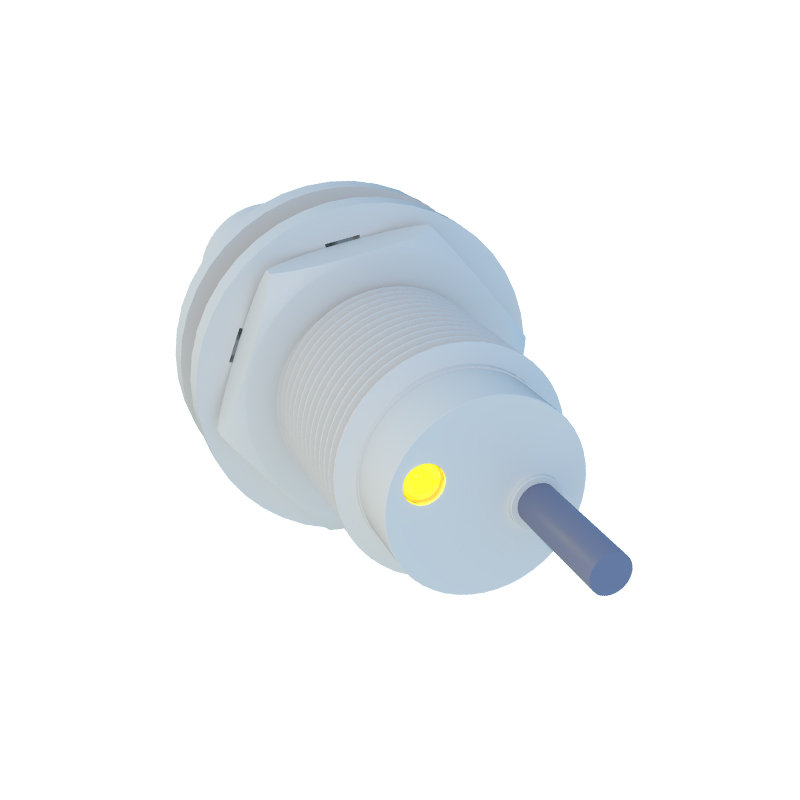
Photoelectric sensors operate on an entirely different principle: light. They consist of a light emitter (usually an LED producing visible red, infrared, or laser light) and a receiver. They are categorized by their sensing modes: through-beam, retro-reflective, and diffuse (proximity) mode. In the diffuse or proximity mode, which is most analogous to inductive/capacitive proximity sensing, both emitter and receiver are housed in the same unit. The emitted light strikes a target object and is diffusely reflected back to the receiver. The amount of light received is evaluated. When it surpasses a set threshold, indicating an object is within range, the output switches. These sensors offer very long sensing ranges and can detect objects of almost any material, color, or surface finish, though highly reflective or absorbent surfaces may require special consideration. They are excellent for detecting small objects and are used extensively in packaging, material handling, and semiconductor manufacturing.
The output stage of these sensors is typically a solid-state switch (PNP or NPN transistor sourcing or sinking) or, less commonly in modern designs, a relay. This provides a clean, bounce-free signal to Programmable Logic Controllers (PLCs) or other control systems. Selection criteria for the appropriate sensor type involve analyzing the target material, required sensing distance, environmental conditions (temperature, presence of contaminants), electrical requirements (voltage, output type), and physical mounting constraints.
In summary, the choice between inductive, capacitive, and photoelectric proximity sensors is dictated by the application's specific demands. Inductive sensors offer rugged, material-selective detection of metals. Capacitive sensors provide versatile detection of nearly any material by measuring capacitance shifts. Photoelectric sensors deliver long-range, precise detection using light beams. Understanding these core working principles empowers engineers and technicians to design more efficient, reliable, and intelligent automated systems, forming the sensory foundation of Industry 4.0 smart factories.