In the realm of industrial automation and electrical engineering, proximity sensors stand as fundamental components for non-contact detection. Among their various types, the inductive proximity sensor, often colloquially referred to in the context of "phase" due to its operating principle involving electromagnetic fields, is a cornerstone. This article delves into the essence of these sensors, their working principles, types, and critical applications.
At its core, a proximity sensor is a device that detects the presence or absence of an object within its sensing range without any physical contact. It converts information about the movement or presence of an object into an electrical signal. The term "phase" in discussions about certain inductive sensors relates to the phase shift in an oscillating circuit caused by the introduction of a metallic target. This phase shift is the key detection mechanism.
The most common type used for metallic object detection is the inductive proximity sensor. Its operation is based on the principle of electromagnetic induction. The sensor contains a coil wound around a ferrite core connected to an oscillator. When powered, the oscillator generates a high-frequency electromagnetic field at the sensing face. When a conductive metal object enters this field, eddy currents are induced on the object's surface. These eddy currents draw energy from the oscillator, causing a change in its amplitude or a phase shift. This change is detected by a threshold circuit, which subsequently triggers a change in the sensor's output state (e.g., switching a solid-state output ON or OFF).
Key characteristics define a sensor's performance. The sensing distance, or nominal range, is specified for a standard target (usually mild steel). Factors like target material, size, and shape can affect this distance. Switching frequency indicates how quickly the sensor can detect objects per second. Another vital specification is the hysteresis, a built-in difference between the switch-on and switch-off points, which prevents output chatter when a target is at the exact sensing limit.
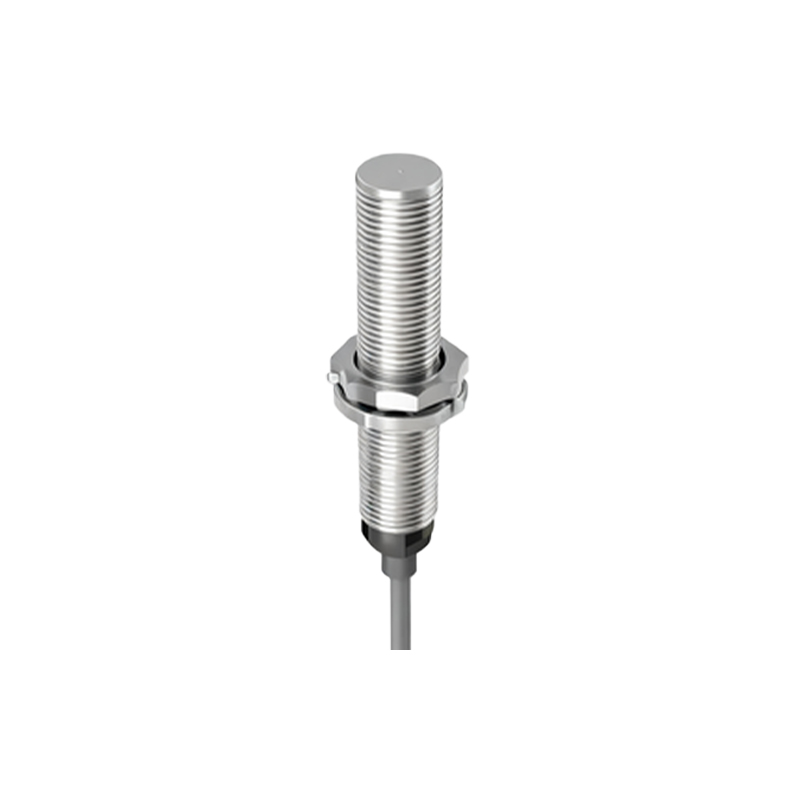
Beyond standard inductive sensors, several variants exist. Factor 1 cylindrical housings are industry-standard. Shielded (flush-mountable) sensors allow installation flush with metal surfaces without affecting their field, while unshielded (non-flush) sensors offer longer ranges but require clearance from surrounding metal. Special types include analog sensors that provide a continuous output proportional to distance, and high-temperature or weld-field immune models for harsh environments.
While inductive sensors detect metals, other proximity sensor technologies cater to different materials. Capacitive proximity sensors can detect both metallic and non-metallic materials (plastics, wood, liquids) by measuring changes in capacitance. Ultrasonic sensors use sound waves to detect objects of any material. Photoelectric sensors employ light beams.
The applications of inductive proximity sensors are vast and critical across industries. They are ubiquitous in manufacturing for tasks like part detection on conveyor belts, counting products, monitoring robot arm position, checking for the presence of a metal component in an assembly, and controlling rotational speed by detecting gear teeth. In automotive assembly lines, they ensure precise positioning. In material handling, they detect the end of a metal roll. Their robustness, reliability, and non-contact nature make them ideal for dirty, oily, or harsh environments where mechanical limit switches would fail.
Selection of the correct sensor requires careful consideration. Engineers must evaluate the required sensing distance, target material and size, environmental conditions (temperature, contaminants), electrical requirements (AC/DC voltage, output type - NPN/PNP, NO/NC), housing style, and connection method. Proper installation is equally crucial; ensuring correct alignment, avoiding mutual interference between multiple sensors, and using appropriate mounting hardware guarantees optimal performance and longevity.
In conclusion, the inductive proximity sensor, with its phase-based detection mechanism, is an indispensable tool in electrical control systems. Its ability to provide reliable, wear-free, and fast detection of metallic objects forms the backbone of modern automated processes. Understanding its principles, variations, and application criteria is essential for any electrical engineer designing, maintaining, or troubleshooting industrial automation systems. As technology advances, these sensors continue to evolve with enhanced intelligence, connectivity, and robustness, further solidifying their role in the industrial landscape.