Flat proximity sensor switches represent a significant advancement in industrial sensing technology, offering unique advantages in space-constrained applications. These sensors, characterized by their low-profile, rectangular housing, are designed to detect the presence or absence of metallic objects without physical contact. Operating primarily on the inductive sensing principle, they generate an electromagnetic field. When a ferrous or non-ferrous metal target enters this field, it causes a change in the field's oscillation, which the sensor's circuitry detects and converts into a switching signal.
The defining feature of the flat or "pancake" design is its minimal installation depth. Unlike cylindrical sensors, which require significant behind-panel space, flat sensors can be mounted in areas with severe depth limitations, such as within narrow machine frames, on robotic arms, or behind thin panels. This makes them indispensable in modern, compact machinery design. Common applications include position verification of machine tool slides, end-of-travel detection on linear actuators, part presence checking in assembly jigs, and counting metallic parts on conveyors. Their robust, often stainless-steel or nickel-plated brass housing provides high resistance to mechanical impacts, cutting fluids, and washdowns, ensuring reliability in harsh industrial environments like automotive manufacturing, metalworking, and packaging.
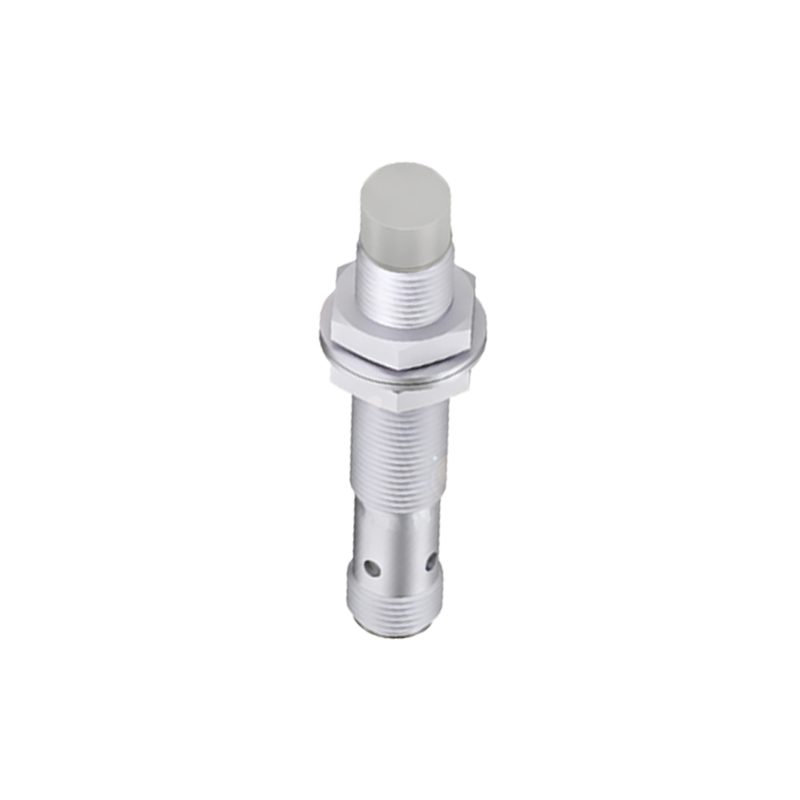
When selecting a flat proximity sensor, several technical parameters are critical. Sensing distance, typically ranging from 1 to 15 mm for standard models, is a key specification. It is crucial to note that this rated distance is defined for a standard square steel target. Factors like target material, size, and shape can affect the actual sensing range. For instance, sensing distance reduces for non-ferrous metals like aluminum or copper. Another vital parameter is the switching frequency, which determines how quickly the sensor can respond to targets passing by. High-speed models are essential for counting or high-cycle production lines.
Output configuration is another major selection criterion. Sensors come with discrete outputs: NPN (sinking) or PNP (sourcing) transistor outputs for connection to PLCs (Programmable Logic Controllers), or relay contacts for higher power loads. Some advanced models feature analog current (4-20 mA) or voltage (0-10 V) outputs, providing continuous distance measurement rather than just a simple on/off signal. This analog capability is useful for precision positioning feedback. Furthermore, many modern flat sensors incorporate IO-Link communication, a point-to-point serial protocol that allows for detailed parameter setting, real-time diagnostics, and process data exchange, enabling Industry 4.0 connectivity and predictive maintenance.
Installation and environmental considerations are paramount for optimal performance. Designers must ensure adequate lateral clearance between multiple sensors to prevent mutual interference. Embedding the sensor in metal (flush mounting) typically reduces its effective sensing range compared to non-flush mounting. The sensor must also be rated for the specific environmental conditions, including operating temperature (commonly -25°C to +70°C), ingress protection rating (e.g., IP67 for dust-tight and immersion protection up to 1m), and resistance to specific chemicals. Electrical considerations include ensuring a stable power supply within the sensor's voltage range (e.g., 10-30 V DC) and protecting the output with a flyback diode for inductive loads to prevent voltage spikes.
In summary, flat proximity sensors are a versatile and robust solution for metallic object detection where space is at a premium. Their low-profile design, combined with high durability and various output options, makes them a fundamental component in automated systems. By carefully considering factors such as sensing distance, target material, output type, and environmental ratings, engineers can seamlessly integrate these sensors to enhance machine reliability, safety, and efficiency. As machinery continues to evolve towards greater compactness and intelligence, the role of the flat proximity sensor will only become more central to innovative industrial automation design.