In the critical field of structural health monitoring and seismic engineering, precision and reliability are non-negotiable. Seismic laser displacement sensors have emerged as a cornerstone technology for measuring minute vibrations, shifts, and deformations in structures during and after seismic events. Unlike traditional contact-based sensors like Linear Variable Differential Transformers (LVDTs) or strain gauges, laser displacement sensors operate on a non-contact principle, offering unparalleled accuracy and eliminating mechanical loading on the measured object.
The core operational principle is laser triangulation or time-of-flight measurement. In triangulation, a focused laser beam is projected onto the target surface. The reflected light is captured by a receiving lens at a known angle and focused onto a position-sensitive detector, typically a Charge-Coupled Device (CCD) or Complementary Metal-Oxide-Semiconductor (CMOS) array. Any displacement of the target alters the position of the reflected light spot on the detector. This change is processed to calculate the exact distance or displacement with micron-level resolution. For long-range measurements on large infrastructures, time-of-flight methods, which calculate distance based on the time a laser pulse takes to return, are often employed.
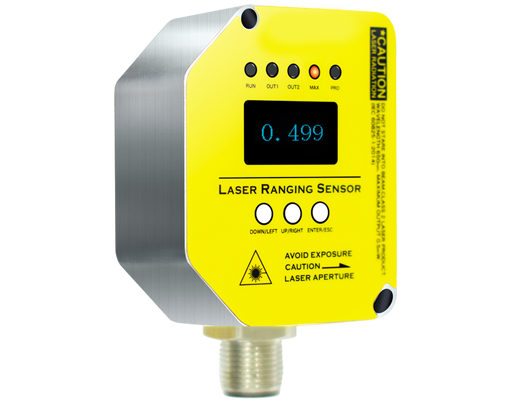
The advantages of seismic laser sensors are manifold. Their non-contact nature is paramount for monitoring fragile historical structures, high-temperature components, or rotating machinery where physical contact is impossible or undesirable. They provide extremely high frequency response, capable of capturing rapid vibrations induced by seismic waves or aftershocks. Furthermore, they are immune to electromagnetic interference, a significant concern in environments with heavy electrical equipment.
In practical seismic and structural applications, these sensors are deployed in diverse scenarios. They are integral to real-time monitoring systems for bridges, dams, skyscrapers, and nuclear power plants. By installing an array of sensors at critical points, engineers can measure relative displacements between structural components, monitor settlement, and assess torsional movements during an earthquake. The data is transmitted to central analysis systems, enabling immediate assessment of structural integrity and informing decisions regarding evacuation or continued operation. Post-seismic, this data is invaluable for damage assessment and planning repairs.

Another crucial application is in active seismic isolation systems for sensitive facilities like semiconductor fabs or research laboratories. Here, laser sensors provide real-time feedback on ground motion to actuators that dynamically stabilize platforms, isolating precision equipment from seismic disturbances.
Recent industry advancements are pushing the boundaries of this technology. The integration of Fiber Bragg Grating (FBG) with laser interrogation systems allows for distributed sensing along lengthy structures like pipelines or tunnels. The development of multi-point laser scanners enables 3D vibration profile mapping of large surfaces. Furthermore, the advent of IoT and wireless sensor networks has facilitated the deployment of wireless laser sensor nodes, reducing installation complexity and cost for large-scale monitoring grids. Data processing has also evolved, with machine learning algorithms being applied to sensor data to not only detect displacement but also predict potential failure modes by recognizing anomalous vibration patterns.
However, challenges remain. Environmental factors such as fog, heavy rain, or dust can attenuate the laser beam, though advancements in laser wavelength selection and signal processing help mitigate these issues. The high initial cost of precision laser systems can be a barrier, though the total cost of ownership is often justified by their durability, accuracy, and the critical nature of the data they provide.
In conclusion, seismic laser displacement sensors represent a sophisticated fusion of optics, electronics, and data science. They provide the essential "eyes" for observing how structures behave under seismic stress, transforming invisible forces into precise, actionable data. As urbanization continues in seismically active regions and the demand for resilient infrastructure grows, the role of these high-precision sensors will only become more central to safeguarding lives, property, and economic continuity. The ongoing trends toward miniaturization, increased connectivity, and smarter data analytics promise to further enhance their capabilities and accessibility in the global effort to build earthquake-resilient societies.