In the realm of industrial automation, photoelectric proximity sensors are indispensable components, offering non-contact detection of objects with high precision and reliability. However, the array of available models can be daunting. Selecting the appropriate sensor hinges on understanding key distinctions in their operating principles, physical designs, and performance specifications. This article delves into the critical differences among common photoelectric sensor models to guide engineers and system integrators in making informed choices.
The fundamental division lies in the sensing mode: through-beam, retro-reflective, and diffuse (proximity) sensors. Through-beam models, also known as opposed-mode sensors, consist of separate emitter and receiver units. The emitter projects a light beam, typically infrared, visible red, or laser, to the receiver. An object is detected when it interrupts this beam. This configuration offers the longest sensing ranges and highest immunity to environmental factors like target color, texture, or reflectivity. They are ideal for precise detection over distances up to several tens of meters but require precise alignment of two separate components, increasing installation complexity.
Retro-reflective sensors house both the emitter and receiver in a single housing. They detect objects that break the light beam projected onto a dedicated reflector, which bounces the light back to the receiver. This design simplifies installation compared to through-beam sensors, as only one device and a reflector need to be mounted. Sensing ranges are shorter than through-beam but longer than most diffuse models. A critical consideration is the polarization filter feature found in many retro-reflective sensors. This filter prevents the sensor from mistakenly detecting shiny, mirror-like objects as the reflector, ensuring reliable operation. Models without this filter may be susceptible to false triggers from reflective surfaces.
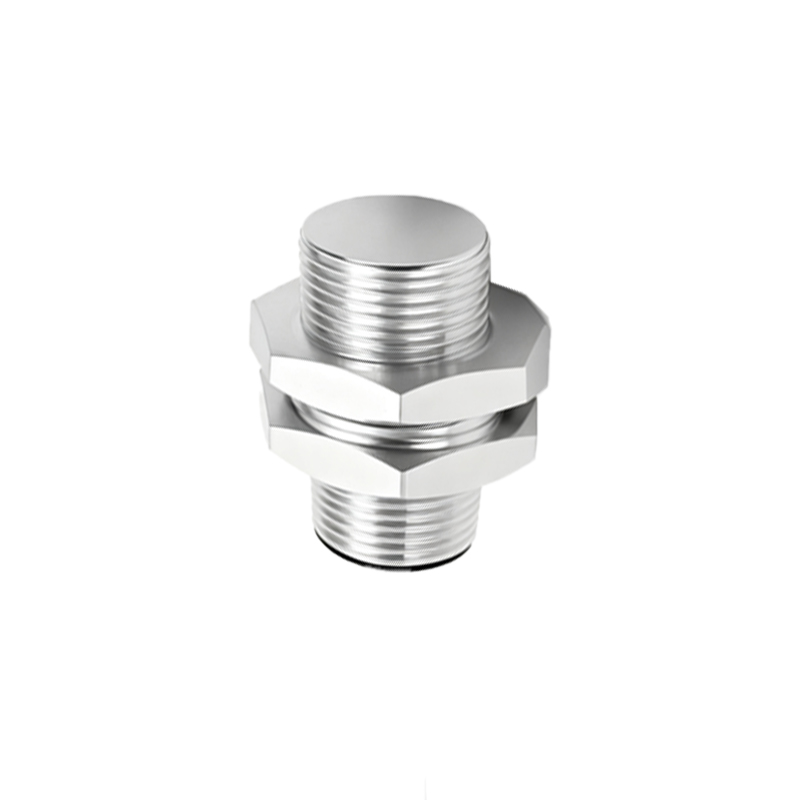
Diffuse or proximity sensors are the most compact, integrating the emitter and receiver into one unit. They detect an object when the emitted light reflects off the target's surface and returns to the receiver. The effective sensing distance is highly dependent on the target's size, color, and surface finish. Light-colored, matte surfaces provide the best reflectivity and maximum range, while dark or glossy black surfaces significantly reduce it. To mitigate this, many diffuse models offer background suppression or fixed-field sensing technology. Background suppression (BGS) models use triangulation to detect objects only within a defined sensing field, ignoring more distant backgrounds. Fixed-field sensors precisely define the start and end of the sensing range, offering excellent immunity to object color and background interference. Standard diffuse models are more economical but lack these advanced features.
Beyond the basic operating modes, other model specifications create further distinctions. Light source is a primary differentiator. Infrared (IR) LEDs are common, offering invisible light that avoids distraction and is less affected by ambient light. Red light (visible LED or laser) models facilitate easier alignment during setup. Laser models provide extremely small, precise beam spots for detecting minute objects or precise positioning. Fiber optic sensor models, which use flexible light guides connected to an amplifier unit, are specialized variants for extreme environments—high temperature, tight spaces, or areas with strong EMI—as the sensitive electronics can be remotely located.
Output type is another crucial factor. Models come with digital outputs (PNP/NPN transistor) or analog outputs (0-10V, 4-20mA). Digital output sensors act as simple switches, while analog models provide a continuous signal proportional to the received light intensity or distance, useful for applications like edge guidance or transparency detection. Connection methods vary from pre-wired cables to quick-disconnect (QD) connectors like M8 or M12, impacting maintenance and replacement ease.
Environmental ratings, denoted by IP (Ingress Protection) and NEMA codes, differentiate models for harsh conditions. A sensor rated IP67 can withstand temporary immersion and dust ingress, suitable for washdown areas in food processing. Housing material, such as stainless steel versus plastic, also dictates suitability for corrosive or cleanroom environments.
Finally, advanced features define premium models. These include teach-in functionality for easy range setting, IO-Link communication for digital parameterization and diagnostics, synchronized operation to prevent crosstalk in dense installations, and built-in timers or logic functions. Choosing between a standard diffuse sensor and a high-end background suppression model with IO-Link, for instance, depends entirely on the application's demands for precision, stability, and data integration.
In conclusion, the "best" photoelectric sensor model does not exist in a vacuum. It is determined by the specific application requirements: required sensing distance, target characteristics, environmental conditions, needed features, and budget constraints. A thorough analysis of these factors against the model differences outlined—sensing mode, light source, output, construction, and intelligence—is essential for deploying a robust and reliable sensing solution that optimizes system performance and longevity.