Laser sensors have become integral components in modern industrial automation, offering unparalleled precision, speed, and reliability. This experimental summary details key findings from a series of tests conducted to evaluate the performance of various laser sensor models in typical industrial environments. The primary focus was on triangulation-based and time-of-flight (ToF) laser sensors, assessing their accuracy, response time, environmental robustness, and integration capabilities.
The experiments were conducted in a controlled laboratory setting simulating real-world conditions, including variable ambient light, temperature fluctuations, and the presence of dust or minor obstructions. For distance and displacement measurement tasks, triangulation sensors demonstrated exceptional accuracy within a range of 10mm to 500mm, with a repeatability error of less than ±0.05%. However, their performance was notably affected by highly reflective or transparent surfaces, requiring surface treatment or sensor parameter adjustment for optimal results. In contrast, ToF sensors provided reliable measurements over longer distances (up to 10 meters) with slightly lower absolute accuracy but superior performance in detecting objects with complex surface properties.
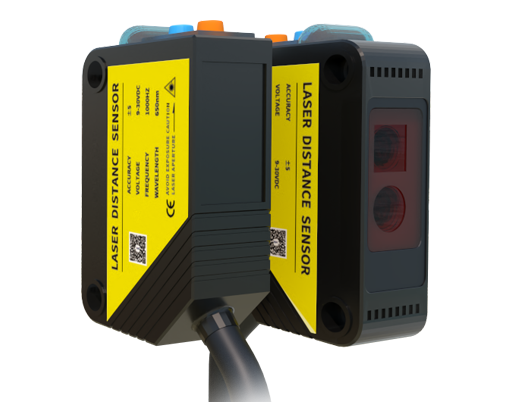
Response time is critical for high-speed automation. Our tests revealed that modern laser sensors can achieve sampling rates exceeding 10 kHz, enabling real-time monitoring and control in dynamic processes like robotic assembly or conveyor belt sorting. The latency from detection to output signal was consistently below 1 millisecond, meeting the demands of most high-speed production lines.
Environmental robustness testing highlighted the importance of ingress protection (IP) ratings. Sensors with IP67 certification maintained functionality in dusty atmospheres and during exposure to mild water splashes. However, extreme temperature variations (below 0°C or above 70°C) affected the stability of some models, indicating the need for careful selection or additional thermal management for applications in harsh climates like foundries or cold storage facilities.
Integration with Programmable Logic Controllers (PLCs) and Industrial Ethernet protocols (e.g., PROFINET, EtherNet/IP) was seamless for most tested units. The experiment included configuring sensors via software interfaces to set measurement windows, output formats (analog 4-20mA, digital IO, or direct data communication), and filtering parameters to ignore background interference. This flexibility proves essential for creating adaptive systems.
A significant part of the experiment involved comparative analysis for specific applications:
1. Position Detection in Robotic Pick-and-Place: Laser sensors provided micron-level precision for guiding robotic arms, drastically reducing misalignment errors compared to traditional mechanical limit switches.
2. Web Guiding and Edge Detection: For continuous material processing (e.g., paper, film), laser sensors accurately tracked material edges, enabling automatic correction and minimizing waste.
3. Fill Level Monitoring: In non-contact level sensing of powders or liquids in opaque containers, ToF lasers offered a reliable alternative to ultrasonic sensors, unaffected by vapor or material density changes.
In conclusion, the experiment confirms that laser sensors are highly versatile tools for industrial automation. Their selection must be based on a thorough analysis of the specific application requirements, including required range, accuracy, environmental conditions, and necessary response speed. Future work will explore the integration of these sensors with machine vision systems and AI-driven predictive maintenance algorithms to further enhance system intelligence and operational efficiency. Proper calibration, regular maintenance, and understanding of their limitations—such as sensitivity to certain surface types—are paramount for achieving long-term, reliable performance.