In the realm of industrial automation, robotics, and smart systems, precise measurement is a cornerstone of efficiency and accuracy. Among the various technologies enabling this precision, laser distance sensors have emerged as a critical tool. These devices, which utilize laser light to determine the distance to a target object, offer unparalleled speed, accuracy, and reliability compared to traditional mechanical or ultrasonic methods. This article delves into the working principles, key applications, and essential factors for selecting the right laser sensor for your needs.
The fundamental principle behind a laser distance sensor is based on the time-of-flight (ToF) method or triangulation. In the ToF method, the sensor emits a short pulse of laser light towards the target. The light reflects off the target's surface and returns to a detector within the sensor. An internal high-speed clock measures the time elapsed between emission and reception. Since the speed of light is a known constant, the distance can be calculated precisely using the formula: Distance = (Speed of Light × Time of Flight) / 2. This method is excellent for long-range measurements, often up to several hundred meters, with typical accuracies in the millimeter range.
For shorter ranges requiring higher precision, often in the sub-micron to millimeter range, the laser triangulation principle is employed. Here, the laser emitter, the reflected spot on the target, and the position-sensitive detector (PSD) or CMOS/CCD receiver form a triangle. The laser projects a spot onto the target. The reflected light is focused onto the PSD or camera. As the target distance changes, the position of the reflected spot on the detector shifts. Using trigonometric calculations, the sensor's electronics compute the exact distance. This method provides extremely high resolution and is less sensitive to the target's surface color or material than ToF over short distances.
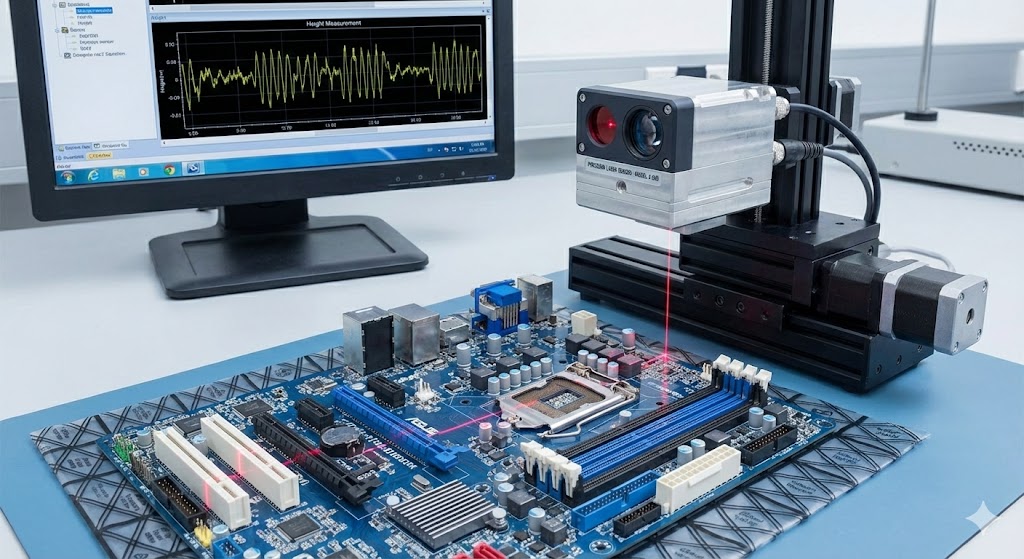
The applications of laser distance sensors are vast and span numerous industries. In manufacturing and logistics, they are indispensable for object detection, positioning, and dimensioning. They guide robotic arms for precise pick-and-place operations, measure the height or width of products on conveyor belts for quality control, and ensure accurate level monitoring in silos or tanks. In the construction sector, laser distance meters (handheld versions of the technology) are ubiquitous for surveying and layout work. More advanced fixed sensors assist in monitoring structural deformations or guiding heavy machinery.
The automotive industry relies on them for assembly line automation and as core components in Advanced Driver-Assistance Systems (ADAS), such as adaptive cruise control and collision avoidance. Furthermore, in emerging fields like autonomous mobile robots (AMRs) and drones, laser sensors, often in the form of LiDAR (Light Detection and Ranging) arrays, create detailed 3D maps of the environment for navigation and obstacle detection.
Selecting the appropriate laser distance sensor requires careful consideration of several parameters. First, define the required measuring range and the desired accuracy or resolution. A sensor's specified range must comfortably encompass the minimum and maximum distances expected in the application. Accuracy defines how close the measurement is to the true value, while resolution is the smallest change in distance the sensor can detect.
Second, consider the target properties. The surface color, material, and angle can affect the strength and quality of the laser reflection. Dark, matte, or transparent surfaces absorb or scatter more light, potentially reducing the effective range or signal quality. Some sensors feature automatic exposure control or specialized algorithms to compensate for varying surface conditions.
Third, the operating environment is crucial. Factors like ambient light (especially sunlight), dust, fog, temperature extremes, and mechanical vibrations can impact performance. Sensors with robust housings (e.g., IP67 rating for dust and water resistance), temperature compensation, and high-intensity visible or infrared lasers are necessary for harsh industrial settings.
Fourth, evaluate the output interface and response time. Common outputs include analog (4-20 mA, 0-10 V), digital (RS-232, RS-485), and industrial Ethernet protocols (EtherNet/IP, PROFINET). The response time, or measurement speed, must be fast enough to keep up with the process dynamics, such as a rapidly moving conveyor.
Finally, consider form factor, mounting options, and ease of integration with existing control systems like PLCs.
In conclusion, laser distance sensors are versatile, high-performance instruments that solve critical measurement challenges across industries. By understanding the core technologies of time-of-flight and triangulation, recognizing their diverse applications from factory floors to autonomous vehicles, and methodically evaluating key selection criteria—range, accuracy, target properties, environmental robustness, and output requirements—engineers and system integrators can harness their full potential. As technology advances, these sensors continue to become faster, more accurate, and more intelligent, solidifying their role as essential components in the toolkit of modern automation and measurement.