Proximity switch displacement sensors, often simply called proximity sensors, are fundamental components in modern industrial automation and control systems. Their primary function is to detect the presence or absence of an object, or to measure its distance, without any physical contact. This non-contact operation eliminates mechanical wear, ensures high reliability, and enables very fast response times, making them indispensable in countless applications from factory floors to consumer electronics.
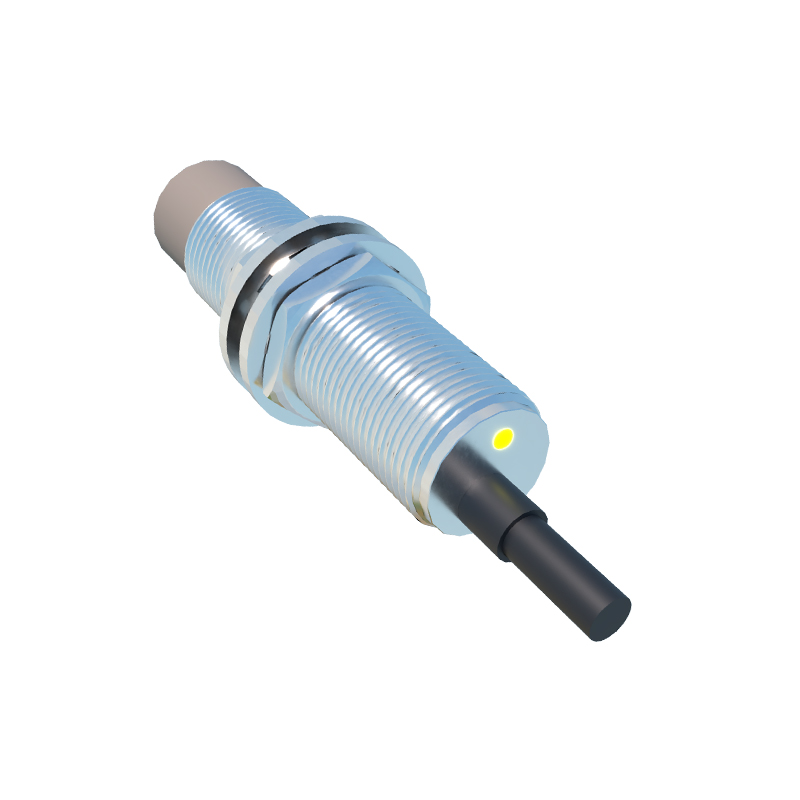
At their core, these sensors operate on the principle of electromagnetic field disturbance. The most common types are inductive, capacitive, and photoelectric. Inductive proximity sensors are the workhorses for detecting metallic objects. They contain a coil that is part of an oscillator circuit, generating a high-frequency electromagnetic field at the active sensing face. When a conductive metal object enters this field, eddy currents are induced on the surface of the object. These eddy currents draw energy from the oscillator, causing its amplitude to decrease. An evaluation circuit within the sensor monitors this amplitude change. Once the amplitude drops below a predefined threshold—corresponding to a specific distance known as the "switching point" or "operating distance"—the sensor's output state changes (e.g., from OFF to ON). The sensing range depends on the material's properties; ferrous metals like iron and steel are detected at the nominal range, while non-ferrous metals like aluminum or copper typically have a reduced sensing distance.
Capacitive proximity sensors, on the other hand, can detect both metallic and non-metallic materials such as plastics, glass, wood, and liquids. They function by generating an electrostatic field. The sensor forms one plate of a capacitor, the target object forms the other, and the air gap is the dielectric. As an object approaches, the capacitance of this system increases. An internal circuit converts this change in capacitance into a voltage change, which triggers a switch when it exceeds a set level. This makes them versatile for level detection of powders or liquids inside non-metallic containers, among other uses.
While not strictly "proximity switches" in the electromagnetic sense, photoelectric sensors are crucial for non-contact displacement and presence sensing, especially for non-metallic objects at longer ranges. They emit a beam of light (visible, infrared, or laser) and detect the reflection (diffuse, retro-reflective, or through-beam). The time-of-flight or triangulation principle is often used in laser versions for precise distance measurement.
The key performance parameters of a proximity switch include its nominal sensing distance (Sn), which is a theoretical value under standardized conditions. The effective or real operating distance (Sr) can vary with temperature, supply voltage, and target material. Hysteresis is a critical feature—it is the difference between the switch-on point (as the target approaches) and the switch-off point (as it moves away). This hysteresis prevents output chattering if the target object vibrates or stops precisely at the sensing edge. Another vital characteristic is the repeat accuracy, which defines how consistently the sensor can detect an object at the same point.
The output of these sensors is typically a switched signal. Common output types include NPN (sinking) and PNP (sourcing) transistor outputs for DC sensors, which are standard in programmable logic controller (PLC) interfaces. Two-wire AC/DC and three-wire DC models are prevalent. Some advanced versions provide analog outputs (e.g., 4-20 mA or 0-10 V) proportional to the distance, functioning as true analog displacement sensors, or IO-Link digital communication for advanced diagnostics and parameterization.
Applications are vast. In automotive manufacturing, inductive sensors count camshaft rotations or verify the presence of engine blocks. On packaging lines, capacitive sensors ensure a liquid level in bottles before capping. Photoelectric sensors register labels on conveyors. In material handling, they provide position feedback for robotic arms or detect the end-of-travel for automated guided vehicles (AGVs). Their robustness, sealed housings (often rated IP67 or higher), and immunity to environmental contaminants like oil and dust make them suitable for harsh industrial environments.
In summary, proximity switch displacement sensors are elegant examples of applied electromagnetism and electronics. By converting a physical parameter—distance—into a reliable electrical signal through non-contact means, they form the sensory foundation for automated systems, ensuring precision, efficiency, and safety in industrial processes worldwide. Selecting the correct type (inductive, capacitive, or photoelectric) based on the target material, required sensing range, environmental conditions, and output needs is crucial for optimal system performance.