In the realm of industrial automation and precision measurement, laser triangulation sensors have emerged as a cornerstone technology. These non-contact sensors provide high-resolution, high-speed distance and displacement measurements, making them indispensable in a wide array of applications from quality control to robotics. This article delves into the operating principle, key components, advantages, and typical use cases of these sophisticated devices.
The fundamental principle behind a laser triangulation sensor is geometric triangulation. The sensor projects a visible or invisible laser spot onto the target surface. The light reflected from this spot is then focused by a receiving lens onto a sensitive position-sensitive detector (PSD), typically a CCD or CMOS linear array. The core of the technology lies in the fact that if the target's distance changes, the position of the reflected light spot on the detector shifts accordingly. By precisely calculating this shift in the image plane, the sensor's onboard processor can determine the exact distance to the target with remarkable accuracy. This method allows for measurements that are largely independent of the target's surface color or brightness, especially when compared to simpler contrast-based sensors.
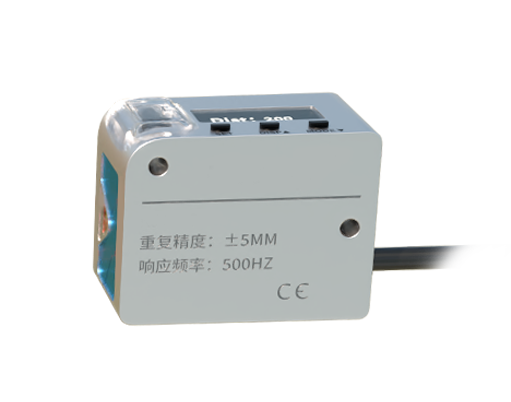
A standard laser triangulation sensor comprises several key components. First is the laser diode, which emits a focused beam of coherent light. Modern sensors often use Class 2 or Class 1 lasers for eye safety. The emitted beam passes through a lens to create a sharp, well-defined spot on the target. The second critical component is the receiving optics, which collects the diffusely reflected light. The quality of these lenses is paramount for minimizing optical aberrations and ensuring a clear image on the detector. The third element is the position-sensitive detector itself. Its resolution, often specified in pixels or micrometers, directly dictates the sensor's measurement resolution. Finally, a powerful digital signal processor (DSP) or microcontroller runs sophisticated algorithms to convert the raw pixel data into a stable, accurate distance value, often compensating for ambient light and other environmental factors.
The advantages of laser triangulation are numerous. Their primary benefit is non-contact measurement, which eliminates mechanical wear and allows for measuring delicate, hot, or moving surfaces without affecting them. They offer very high resolution, down to the sub-micron range for specialized models, and extremely fast response times, enabling in-line inspection on high-speed production lines. Furthermore, their versatility is a major strength. Depending on the model and configuration, they can measure distance, thickness, height, width, vibration, and even detect edges or presence. Modern sensors come with various output options (analog, digital, serial interfaces) and robust housings (often IP67 rated) for harsh industrial environments.
Typical applications span virtually every manufacturing sector. In the automotive industry, they are used to measure gap and flushness between body panels, inspect weld seams, and control robot positioning. In electronics manufacturing, they verify component coplanarity, measure solder paste height, and inspect PCB warpage. In the pharmaceutical and packaging sectors, they ensure consistent fill levels, check seal integrity, and control web thickness. They are also integral to 3D profiling systems, where a line laser is scanned across an object to build a detailed height map for reverse engineering or quality assurance.
When selecting a laser triangulation sensor, engineers must consider several parameters. The measuring range defines the minimum and maximum distances over which the sensor operates accurately. The standoff distance is the fixed working distance from the sensor housing to the target. The spot size influences the lateral resolution and the ability to measure small features. Key performance specifications include linearity error, repeatability, and temperature stability. It is also crucial to consider the target surface properties; highly reflective or transparent materials may require specialized sensors with adjustable exposure or laser power control to ensure reliable readings.
In conclusion, laser triangulation sensors represent a mature yet continuously evolving technology that provides a critical link between the physical world and digital control systems. Their ability to deliver precise, reliable, and fast dimensional data makes them a fundamental tool for enhancing quality, increasing throughput, and enabling advanced automation. As industrial demands for precision and speed grow, so too will the capabilities and applications of these versatile optical measurement devices.
