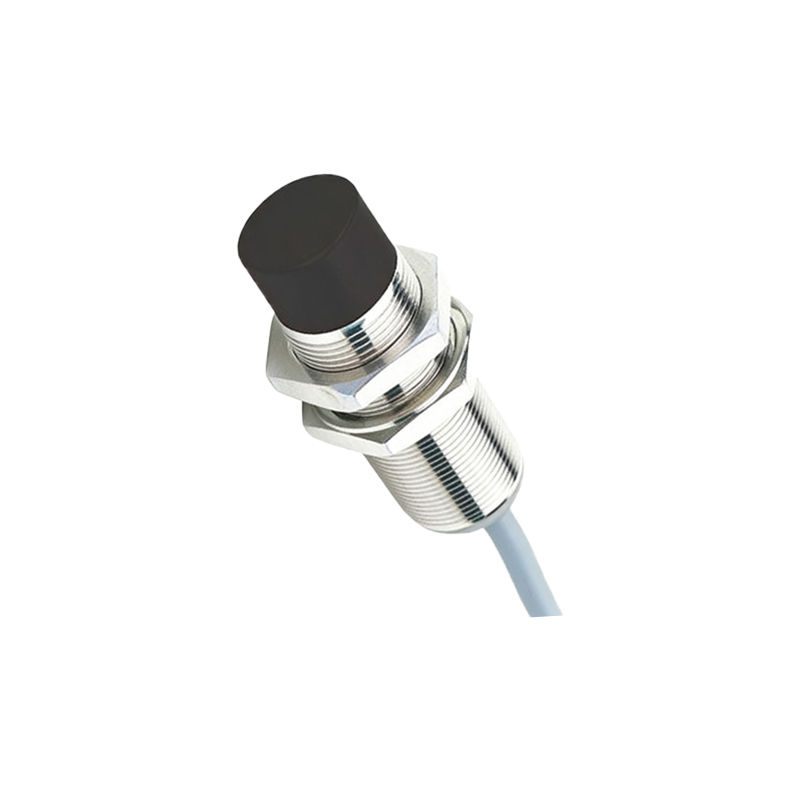
In the realm of industrial automation and electronic sensing, proximity sensors are indispensable for non-contact detection of metallic objects. At the heart of many inductive-type proximity sensors lies a critical, yet often underappreciated, component: the ferrite core. This specialized magnetic core is not merely a passive element; it is the fundamental transducer that dictates the sensor's performance, reliability, and range. This article delves into the engineering principles, material science, and application considerations surrounding proximity sensor ferrite cores.
The primary function of the ferrite core in an inductive proximity sensor is to shape and concentrate the alternating magnetic field generated by the sensor's oscillator coil. When a metallic target enters this focused field, eddy currents are induced within the target. These eddy currents, in turn, create a secondary magnetic field that opposes the original field from the coil. The ferrite core facilitates the efficient detection of this impedance change in the coil circuit, which is then processed to trigger the sensor's output. Without a core designed for high magnetic permeability and low losses, the magnetic field would be diffuse, resulting in poor sensitivity, short sensing ranges, and susceptibility to electromagnetic interference (EMI).
Material selection for these cores is a precise science, predominantly centered on soft ferrites, specifically manganese-zinc (MnZn) and nickel-zinc (NiZn) compositions. MnZn ferrites are typically favored for low to mid-frequency applications (generally up to a few hundred kHz) common in many standard proximity sensors. They offer exceptionally high initial permeability (µi), which translates to high coil inductance and strong field concentration, enabling longer sensing distances for a given coil size. However, their resistivity is lower than NiZn types, making them more susceptible to eddy current losses at higher frequencies. NiZn ferrites, with their higher resistivity and stability at higher frequencies (into the MHz range), are chosen for sensors requiring faster response times or operation in environments with high-frequency noise. The core's geometry—often pot cores, E-cores, or toroids—is equally crucial. Pot cores, for instance, provide excellent magnetic shielding, confining the field and making the sensor less sensitive to side-approaching metal, a key feature for precise positioning.
The design and manufacturing of these cores involve stringent tolerances. Parameters such as permeability stability over temperature (characterized by the Curie temperature), saturation flux density, and core loss factors (hysteresis and eddy current losses) are meticulously controlled. A core must maintain its magnetic properties across the sensor's operational temperature range, which can span from -25°C to +70°C or beyond in industrial settings. Dimensional stability and mechanical robustness are also vital, as cores are often subjected to epoxy potting or encapsulation processes that induce thermal and mechanical stress.
Optimizing a sensor design involves a careful trade-off between core parameters and electronic circuitry. A core with very high permeability allows for a smaller coil or lower drive current to achieve the same sensing range, contributing to a more compact and energy-efficient sensor. However, excessively high permeability can lead to susceptibility to external magnetic fields and saturation at lower magnetic field strengths. Engineers must also consider the target material. While ferrite cores are optimized for detecting ferrous metals like iron and steel, their performance with non-ferrous metals (e.g., aluminum, copper) is different and often requires specific frequency tuning and core geometry adjustments to achieve optimal sensitivity.
In practical applications, the choice of the ferrite core directly impacts key sensor specifications: the nominal sensing distance (Sn), repeatability, hysteresis, and switching frequency. For example, in high-speed counting applications on a packaging line, a sensor with a core optimized for minimal hysteresis and fast magnetic response is essential to avoid missed or double counts. In welding environments, a core material with high thermal stability is paramount to prevent performance drift. Furthermore, the trend towards miniaturization in factory automation pushes for smaller sensors, demanding ferrite cores that deliver high performance in increasingly tiny form factors, a significant challenge for material scientists and core manufacturers.
In conclusion, the proximity sensor ferrite core is a masterpiece of applied magnetics. Its development represents a deep synergy between material chemistry, electromagnetic theory, and practical mechanical design. Selecting the correct ferrite core—with the right material grade, geometry, and magnetic characteristics—is not a secondary task but a primary determinant in creating a proximity sensor that is accurate, reliable, and fit for its intended industrial purpose. As sensing technology evolves towards Industry 4.0 and IoT integration, advancements in ferrite materials, including low-loss and high-temperature variants, will continue to push the boundaries of what proximity sensors can achieve.