Laser distance sensors have become indispensable tools across various industrial sectors, offering high-precision, non-contact measurement capabilities. A critical aspect of their performance, often discussed by engineers and system integrators, is their ability to penetrate or measure through certain materials—a characteristic formally referred to as material penetration or transmission capability. This article delves into the technical principles, influencing factors, and practical considerations of laser sensor penetration.
Fundamentally, most standard laser distance sensors operate on the time-of-flight (ToF) or phase-shift principle, emitting a focused beam of coherent light, typically in the visible red or near-infrared spectrum. The sensor calculates distance by measuring the time delay or phase difference between the emitted beam and the reflection received by its photodetector. For a sensor to successfully "penetrate" a material and measure the distance to a surface behind it, the material must allow a sufficient portion of the laser wavelength to pass through (transmit) with minimal scattering and absorption, and then reflect off the secondary surface back through the material to the detector.
The primary factor governing penetration is the optical properties of the intervening material at the specific wavelength of the laser. Materials like clear glass, certain transparent plastics (e.g., polycarbonate, acrylic), and thin films often have high transmittance for visible and near-IR light, allowing for relatively easy measurement of a background object. For instance, a sensor can measure the fill level of a liquid inside a transparent glass or plastic container. Conversely, materials like metals, ceramics, most colored plastics, and opaque solids are highly absorptive or reflective at the sensor's wavelength, preventing the beam from passing through. Attempting to measure through such materials typically results in the sensor registering the distance to the front surface of the material itself.
Other critical factors include material thickness and surface quality. Even a nominally transparent material will attenuate the laser signal. Beyond a certain thickness, the signal may become too weak for the receiver to detect reliably. Surface imperfections, such as scratches, frosting, or contamination (dust, grease), can cause diffuse scattering, significantly reducing the amount of coherent light that transmits through or returns from the target. The laser's power and the receiver's sensitivity also play roles. High-power class 2M or Class 3R industrial sensors with sensitive detectors can sometimes cope with moderate attenuation better than low-power versions.
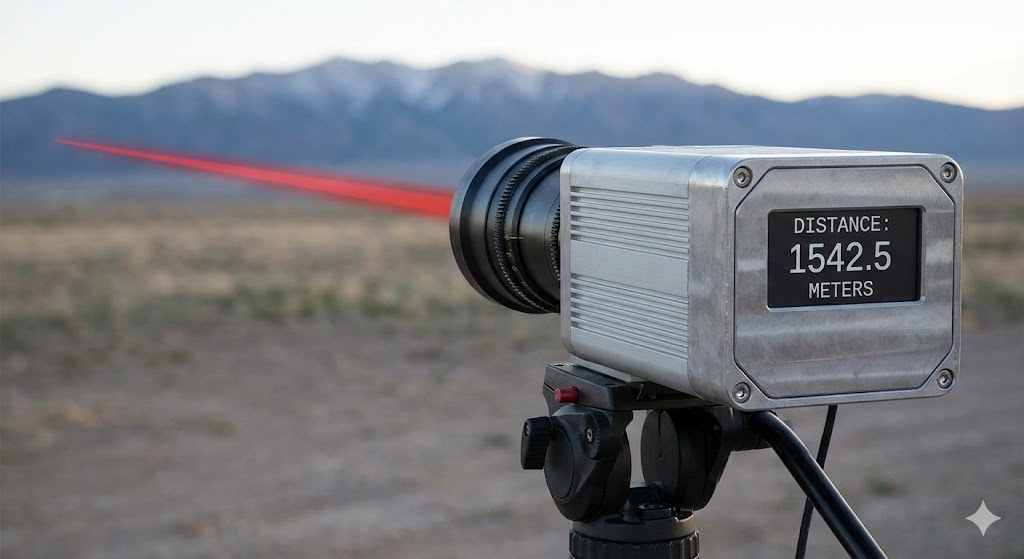
A common application requiring penetration is measuring through protective windows. In harsh environments—filled with dust, moisture, or spray—sensors are often mounted inside an enclosure with a transparent window. The laser must penetrate this window to take external measurements. Engineers must select a window material (like coated borosilicate glass) with high transmission at the sensor's wavelength and ensure it is kept clean. The system must often be configured to account for the fixed offset distance introduced by the window's thickness.
It is crucial to distinguish between true penetration and interference from semi-transparent materials. A laser beam might partially reflect off the front surface of a clear material and partially reflect off the rear surface or target behind it. This can create multiple return pulses, potentially causing measurement errors or instability. Advanced sensors with peak-selection algorithms can be programmed to ignore the strongest (front surface) reflection and lock onto the secondary return from the desired target.
For materials that are not optically transparent to standard lasers, alternative sensing technologies might be necessary. Ultrasonic sensors can penetrate dust and some vapors but are affected by temperature and wind. Millimetre-wave radar sensors can penetrate certain non-metallic materials like thin plastics or dry walls, offering another solution for specific concealed measurement tasks.
In practice, verifying penetration capability requires testing with the actual sensor and material sample under real conditions. Datasheet parameters like "minimum reflectance" provide a baseline, but they usually assume a direct, un-obstructed target. When penetration is needed, consult the sensor manufacturer for specific guidance on material compatibility, potential signal loss, and optimal configuration settings like response time and filter settings to handle weaker return signals.
Ultimately, understanding the limits and requirements of laser distance sensor penetration enables more robust and reliable system design. By carefully matching the sensor's optical characteristics with the material properties of the application barrier, engineers can deploy these powerful measurement tools effectively even in challenging, non-ideal measurement scenarios.