In industrial automation and control systems, proximity sensors are indispensable components for non-contact object detection. A fundamental and frequently asked question by engineers and technicians is: "What is the sensing distance of a proximity sensor?" The answer is not a single, universal figure but depends on a complex interplay of sensor type, target material, environmental conditions, and application-specific standards. This article delves into the technical nuances that define and influence the nominal sensing distance (Sn) and the practical operating distance.
First, it is crucial to understand the terminology. The rated operating distance (Sn) is the theoretical sensing distance under defined standard conditions, typically using a standard target. This value, provided in datasheets, serves as a benchmark for comparison. However, the effective or real operating distance (Sr) in a real-world application can differ significantly. Industry standards, such as IEC 60947-5-2, define these parameters and test methods to ensure consistency across manufacturers.
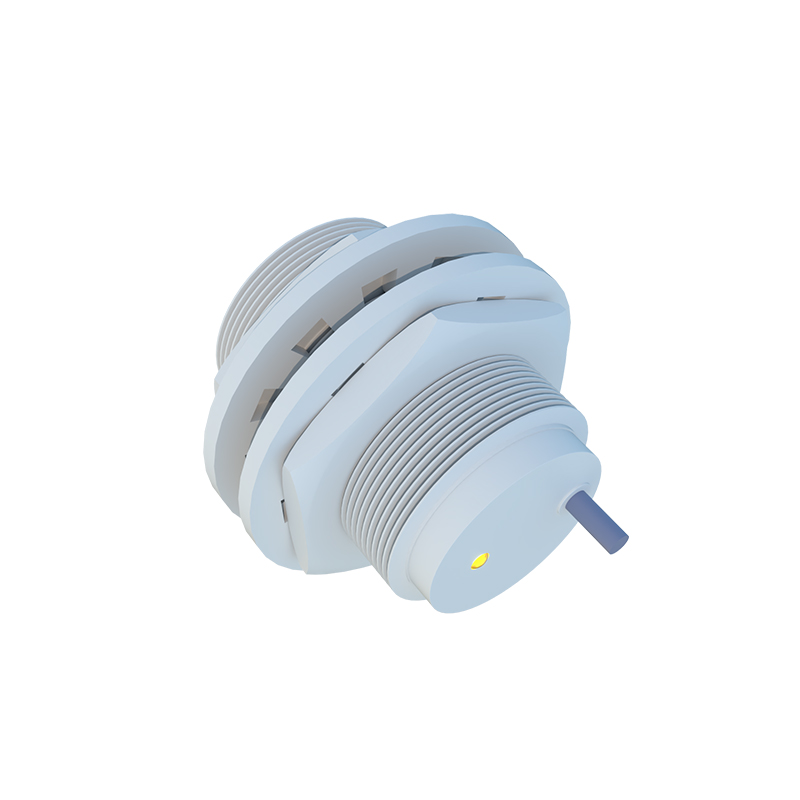
The primary determinant of sensing distance is the sensor's underlying technology. Inductive proximity sensors detect metallic objects, primarily ferrous metals like mild steel. Their sensing range is relatively short, typically from 1mm to 60mm, with longer ranges available in specialized models. The sensing distance is highly dependent on the target material's properties. For instance, the sensing distance for stainless steel is often 60-80% of the value for mild steel, and for copper or aluminum, it can be as low as 30-50%. The correction factor (K) is applied to the Sn value based on the target material.
Capacitive proximity sensors can detect both metallic and non-metallic materials (plastics, wood, liquids, etc.) by sensing changes in capacitance. Their typical sensing ranges are similar to inductive sensors, from a few millimeters up to about 40mm. The sensing distance is influenced by the target's dielectric constant; materials with higher constants (like water) can be detected from a greater distance than those with lower constants (like dry wood).
Ultrasonic sensors use sound waves and offer much longer sensing distances, ranging from 20-30mm up to several meters (e.g., 6m or 8m). Their performance can be affected by the target's surface texture (smooth surfaces reflect better), angle, and environmental factors like temperature, humidity, and air turbulence.
Photoelectric sensors, which use light beams, have the widest range of all. Diffuse reflective models might sense from a few centimeters to a few meters, while through-beam sensors can reliably detect objects over distances of tens of meters. Their effective range is heavily influenced by target color, reflectivity, size, and ambient light conditions.
Beyond the core technology, several critical factors modulate the effective sensing distance:
1. Target Size and Shape: The standard target for inductive sensors is a square of mild steel with a side length equal to the sensor's diameter or 3xSn, whichever is greater. A smaller target reduces the effective sensing distance. For cylindrical targets, the distance is also reduced.
2. Temperature: Extreme temperatures can affect the electronic components and, in ultrasonic sensors, the speed of sound. Datasheets specify operational temperature ranges and potential derating.
3. Voltage Supply Tolerance: Operating outside the specified voltage range can affect sensor performance and stability.
4. Mounting Conditions: Inductive sensors, in particular, are susceptible to flush mounting vs. non-flush mounting. Non-flush (shielded) sensors can be embedded in metal without issue but have a shorter Sn. Non-flush (unshielded) sensors have a longer Sn but require a metal-free zone around the sensing face to prevent false triggering.
5. Hysteresis: This is a built-in feature to prevent output chatter when a target is at the exact sensing point. It is a percentage of the sensing distance (e.g., 3-10% for inductive) and ensures stable switching.
For reliable system design, engineers must never design an application where the target operates at the theoretical Sn. A crucial rule of thumb is to apply a safety or design margin. It is common practice to utilize only 60-80% of the rated sensing distance (Sn) to account for variations in target material, temperature drift, supply voltage fluctuations, and mechanical tolerances. This ensures long-term, fail-safe operation.
In conclusion, the question "What is the distance?" must be met with further questions: "What type of sensor? What is the target made of? What are the environmental conditions?" By carefully consulting manufacturer datasheets, understanding the applicable correction factors, and applying a conservative design margin, engineers can select the correct proximity sensor and ensure robust, reliable performance in any automated system. The sensing distance is not just a