Proximity metal sensors, often referred to as inductive proximity sensors, are fundamental components in industrial automation and control systems. Their primary function is to detect the presence or absence of metallic objects without any physical contact. This non-contact detection capability makes them exceptionally reliable, durable, and suitable for harsh environments where mechanical wear, dust, moisture, or chemicals are present. The core operating principle is based on electromagnetic induction and the detection of eddy currents.
At the heart of an inductive proximity sensor is a coil wound around a ferrite core, which forms part of an oscillator circuit. When powered, this oscillator generates a high-frequency alternating electromagnetic field that radiates from the active face (sensing surface) of the sensor. In the absence of a metallic target within its sensing range, the oscillator operates at a stable, predefined amplitude.
The detection process is initiated when a conductive metal object enters this oscillating electromagnetic field. According to Faraday's law of electromagnetic induction, the changing magnetic field induces circulating currents, known as eddy currents, on the surface of the target metal. These eddy currents themselves generate their own opposing magnetic field, which interacts with the field produced by the sensor's coil. This interaction results in a load on the oscillator circuit. The energy loss due to this eddy current generation causes the amplitude of the oscillations to decrease.
A subsequent evaluation circuit within the sensor continuously monitors the oscillator's amplitude. Once the amplitude drops below a specific threshold—corresponding to the target entering the predefined sensing distance—the circuit triggers a change in the sensor's output state. This output is typically a solid-state switch (like an NPN or PNP transistor) that changes from an "OFF" to an "ON" state (or vice versa, depending on the configuration), providing a clear signal to a connected controller such as a PLC (Programmable Logic Controller).
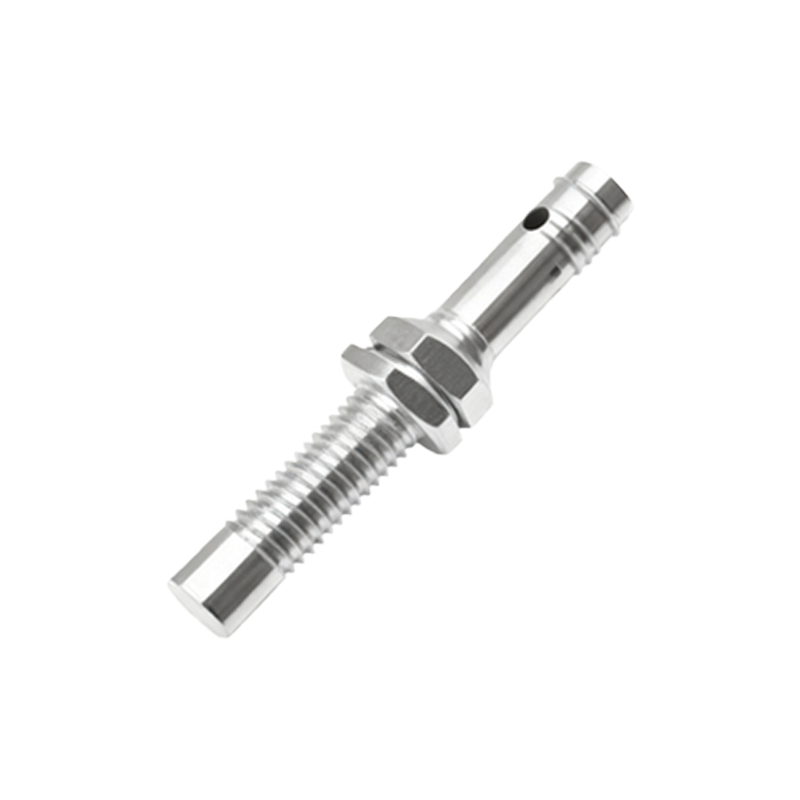
Several key factors influence the performance and sensing distance (Sn) of these sensors. The first is the material properties of the target. Ferrous metals (like iron and steel) are most easily detected and typically yield the standard sensing distance. Non-ferrous metals (such as aluminum, copper, or brass) have lower electrical conductivity and permeability, which generally reduces the effective sensing range, often requiring a correction factor (e.g., 0.3 to 0.8 times Sn). The target's size and shape also matter; ideally, the target should be square and at least equal to the diameter of the sensor's sensing face to ensure the rated sensing distance. Thinner targets may slightly reduce the range.
Another critical characteristic is the hysteresis. This is the difference between the switch-on point (when the target approaches) and the switch-off point (when the target moves away). Hysteresis, typically 3-10% of the sensing distance, prevents output chatter or rapid switching if the target vibrates or stops right at the sensing boundary, ensuring stable and reliable operation.
Modern proximity sensors incorporate various advanced features. Shielded (flush-mounted) types allow for side-by-side installation without mutual interference, as their magnetic field is concentrated forward. Unshielded (non-flush) types offer a longer sensing range but require clearance around them. Many sensors also include built-in protection against short-circuits, overloads, and reverse polarity, along with LED status indicators for easy diagnostics.
The applications of inductive proximity sensors are vast and critical across industries. They are ubiquitously used for position sensing—detecting if a robot arm is in its home position, if a cylinder is fully extended or retracted, or if a metal part is present on a conveyor. They serve as non-contact limit switches in machinery, provide accurate counting of metal parts, monitor rotational speed by detecting gear teeth or bolts, and verify the presence of metal caps or containers in packaging lines. Their robustness allows them to perform these tasks in demanding settings like automotive manufacturing, metalworking, material handling, and packaging machinery, where reliability is paramount.
In summary, the operation of a proximity metal sensor is an elegant application of electromagnetic principles. By generating an oscillating field and monitoring disturbances caused by induced eddy currents in metallic targets, it provides a robust, wear-free, and highly reliable solution for countless detection and control tasks in industrial automation, forming an invisible yet essential layer of interaction between control systems and the physical world.