Proximity sensors are ubiquitous in modern technology, found in smartphones, industrial automation, security systems, and countless other devices. Their primary function is to detect the presence or absence of an object within a specific range without physical contact. A common question that arises is whether these sensors can effectively "see" or detect objects through solid barriers like walls. The short answer is: it depends heavily on the type of sensor technology being used, and for most common types, the answer is generally no for standard walls.
To understand why, we must examine the fundamental operating principles of the major proximity sensor categories. The most prevalent types are inductive, capacitive, ultrasonic, and optical (including infrared).
Inductive sensors are the workhorses of industrial automation, used to detect metallic objects. They generate an electromagnetic field. When a metal object enters this field, it induces eddy currents within the metal, which the sensor detects. This technology is entirely ineffective for non-metallic materials like drywall, wood, or plastic. The electromagnetic field cannot penetrate these materials to detect a metal object on the other side in any practical, reliable way for standard sensing distances.
Capacitive sensors can detect both metallic and non-metallic objects by measuring changes in capacitance. They sense the dielectric properties of a target. While theoretically more capable of detecting changes through thin, non-conductive barriers (like a plastic panel), a typical wall composed of multiple layers (drywall, insulation, wood studs) presents a significant and complex dielectric barrier. The sensor would likely detect the wall itself as the primary target long before it could reliably sense an object on the other side, making practical "through-wall" detection unfeasible.
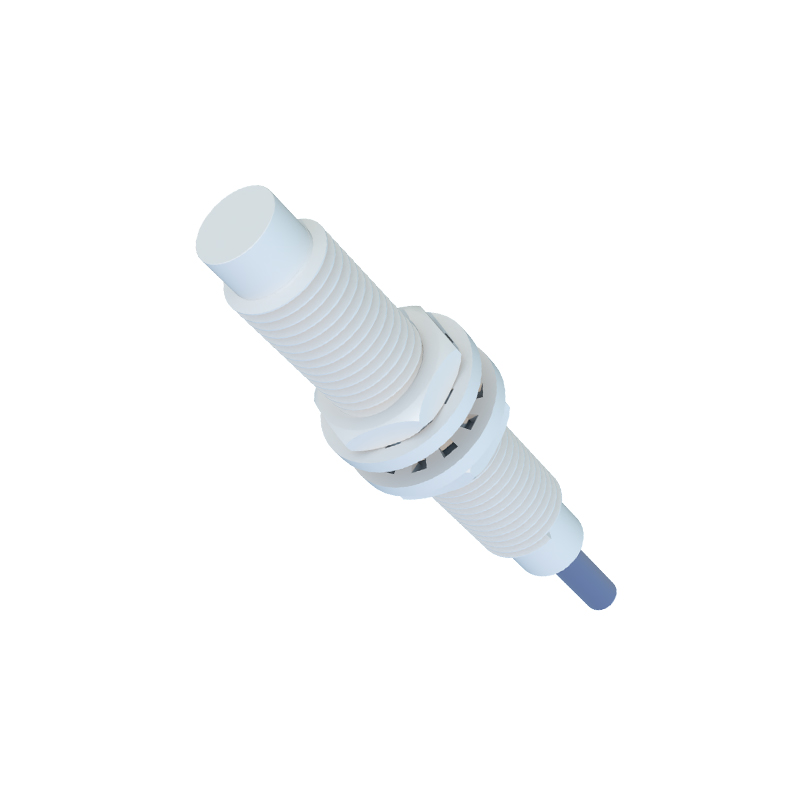
Ultrasonic sensors operate by emitting high-frequency sound waves and measuring the time it takes for an echo to return. Sound waves can travel through solid materials, but with significant complications. When an ultrasonic pulse hits a wall, most of the energy is reflected back. Some energy transmits through, but it is greatly attenuated (weakened). The echo that returns from an object behind the wall would be extremely weak and difficult to distinguish from noise, echoes from the wall's surface, or structural elements within the wall itself. While specialized through-wall radar systems used in search-and-rescue operate on somewhat similar principles, they use sophisticated radio waves and powerful signal processing, far beyond the capability of a standard ultrasonic proximity sensor.
Optical and Infrared (IR) sensors rely on light. A simple wall is completely opaque to the wavelengths of light used in these sensors, making through-wall detection impossible. Any claim of an IR sensor detecting motion through a wall typically refers to passive infrared (PIR) motion sensors, which detect changes in infrared radiation emitted by a warm body. These sensors do not "see through" walls; they detect the heat signature that may radiate from a body near a doorway or window, or the slight temperature changes a body might cause on the surface of a thin barrier, not through a standard interior or exterior wall.
So, what technologies can detect objects or people through walls? These are specialized systems, not standard proximity sensors. Through-Wall Radar (TWR) or Ultra-Wideband (UWB) radar systems are designed for this purpose. They emit low-power radio waves that can penetrate common building materials like drywall and wood. By analyzing the reflected signals with advanced algorithms, they can detect movement, breathing, and even the presence of a stationary person. These systems are used in military, law enforcement, and search-and-rescue operations. Another technology is based on Wi-Fi signal analysis, where perturbations in existing Wi-Fi signals are used to infer motion behind obstacles. Both are complex, expensive, and serve a very different purpose than a standard proximity sensor.
For engineers and designers, the key takeaway is that selecting a sensor requires a clear understanding of the application environment. If the requirement is to detect an object in an adjacent space through a permanent wall, a standard inductive, capacitive, ultrasonic, or optical proximity sensor is the wrong tool. One must either create an opening in the wall for the sensor to function as intended (e.g., using a through-beam optical sensor with a small window) or investigate the feasibility and cost of specialized through-wall radar systems.
In conclusion, while the concept of a sensor detecting objects through a solid wall captures the imagination, the physics of common sensing modalities prevent standard proximity sensors from performing this task reliably. They are engineered for direct line-of-sight or very limited barrier penetration scenarios. True through-wall detection remains the domain of specialized, high-frequency radar-based technologies, underscoring the importance of matching the sensor technology precisely to the application's physical constraints and detection requirements.