In the realm of precision measurement, outdoor laser distance sensors have emerged as indispensable tools across a multitude of industries. Unlike their indoor counterparts, these robust devices are engineered to conquer the challenges posed by the open environment, delivering accurate distance data where traditional methods falter. This guide delves into the core technology, key considerations for selection, and the diverse applications that make these sensors a cornerstone of modern field operations.
At its heart, an outdoor laser distance sensor operates on the principle of Time-of-Flight (ToF). The sensor emits a focused pulse of laser light towards a target. This pulse travels through the air, reflects off the surface, and returns to the sensor's receiver. A high-speed internal clock precisely measures the elapsed time between emission and reception. Since the speed of light is a known constant, the sensor's processor can calculate the distance to the target with remarkable accuracy using the formula: Distance = (Speed of Light × Time of Flight) / 2. For long-range measurements, advanced phase-shift measurement techniques are often employed to enhance precision.
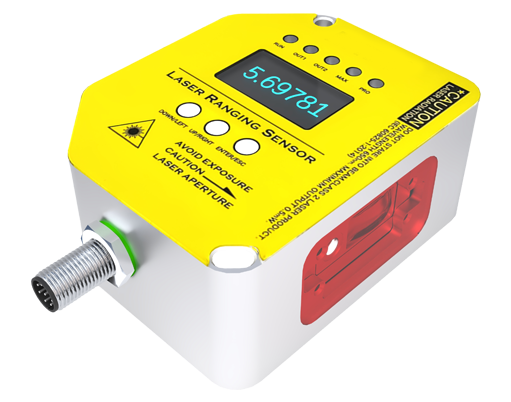
Selecting the right sensor for outdoor use requires careful attention to several critical specifications that define its performance under real-world conditions.
Measurement Range and Accuracy: This is the primary consideration. Ranges can vary from tens of meters for construction applications to several kilometers for surveying or military use. Accuracy is typically stated as ±(X mm + Y ppm), where X is a fixed error and Y is a distance-dependent error. For most civil engineering tasks, an accuracy of ±1.5 mm to ±3 mm is standard.
Laser Class and Wavelength: Outdoor sensors predominantly use Class 1 or Class 2 visible red lasers (around 635-650 nm) or invisible infrared lasers (typically 905 nm). Visible lasers are easier to aim at a specific point, especially in daylight. Infrared lasers often offer better performance in adverse conditions like fog or rain and are eye-safe at higher power levels for longer ranges.
Environmental Durability: This is what truly sets outdoor sensors apart. They are housed in rugged, often IP65 or IP67-rated enclosures that are dust-tight and waterproof, capable of withstanding rain, humidity, and temperature extremes from -20°C to 50°C or beyond. Resistance to shocks and vibrations is also crucial for use on moving vehicles or machinery.
Data Connectivity and Power: Modern sensors offer versatile outputs including analog (4-20 mA, 0-10 V), digital (RS232, RS485), and industrial Ethernet (Profinet, EtherCAT) to integrate seamlessly with PLCs, data loggers, or control systems. Power requirements vary, with many units operating on a standard 12-24 V DC supply, suitable for vehicle or portable battery use.
The applications for outdoor laser distance sensors are vast and growing.
* Construction and Civil Engineering: They are used for monitoring structural deformation (bridges, dams), controlling excavation depth, measuring volumes of stockpiles (gravel, coal), and guiding heavy machinery like pile drivers and pavers.
* Transportation and Logistics: Sensors monitor vehicle presence at toll gates, measure the轮廓 of cargo on trucks or ships for load optimization, and guide autonomous guided vehicles (AGVs) in outdoor yards and ports.
* Agriculture and Forestry: They assist in terrain mapping, monitoring crop growth and canopy height, and controlling the height of harvesting equipment for optimal yield.
* Industrial Automation: In steel mills, lumber yards, and shipping terminals, these sensors measure object dimensions, control crane positioning, and manage inventory of raw materials stored outdoors.
* Security and Perimeter Protection: They form invisible laser fences for critical infrastructure protection, detecting intrusions over long, straight perimeters with high reliability.
To ensure optimal performance, users must be aware of environmental factors. Strong ambient sunlight can sometimes interfere with the sensor's receiver; choosing a model with a narrow optical filter or a higher-power laser mitigates this. Heavy rain, fog, or snow can attenuate the laser beam, potentially reducing the maximum effective range or causing measurement dropouts. Targeting highly reflective surfaces (like mirrors) or low-reflectivity materials (like black asphalt) may require sensor adjustment or specific models with automatic signal gain control.
In conclusion, outdoor laser distance sensors represent a fusion of optical precision and mechanical ruggedness. By transforming the time it takes for light to travel into reliable distance data, they empower professionals to measure, monitor, and control processes with confidence in the most demanding environments. As technology advances, we can expect these sensors to become even more compact, energy-efficient, and intelligent, further solidifying their role in shaping an increasingly data-driven world.