In the realm of industrial automation and control systems, proximity sensors stand as fundamental components, enabling the seamless, reliable, and often unseen detection of objects without physical contact. As an industrial electrical engineer, understanding the nuances of these devices is crucial for designing robust, efficient, and safe automated processes. This guide delves into the core principles, types, applications, and selection criteria for industrial-grade proximity sensors.
At its core, a proximity sensor detects the presence or absence of an object within a specified sensing range. It achieves this by emitting an electromagnetic field, beam, or ultrasonic wave and monitoring for changes in the return signal or field properties. The key advantage is non-contact operation, which eliminates mechanical wear and tear, allowing for high-speed operation and longevity in harsh industrial environments.
The industrial landscape is dominated by several primary types of proximity sensors, each with distinct operating principles and ideal use cases.
Inductive Proximity Sensors: These are the workhorses of metal detection. They generate an oscillating electromagnetic field from a coil. When a metallic object enters this field, it induces eddy currents, causing a change in the oscillation amplitude. This change is detected and triggers the sensor's output. Inductive sensors are highly reliable, resistant to dirt, dust, and moisture (often rated IP67 or higher), and are perfect for detecting ferrous and non-ferrous metals in applications like machine tooling, robotic end-effectors, and conveyor systems. Their sensing range is typically limited to a few millimeters to tens of millimeters.
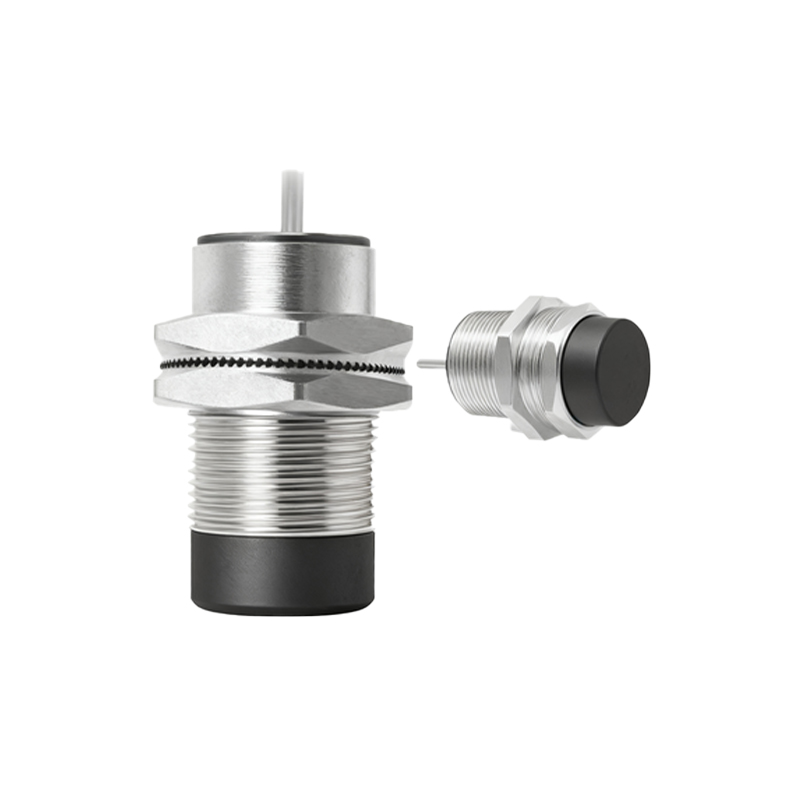
Capacitive Proximity Sensors: These sensors can detect both metallic and non-metallic materials, including liquids, plastics, glass, and wood. They function by generating an electrostatic field. Any object with a dielectric constant different from air will alter the capacitance of the sensor's circuit, triggering detection. This makes them invaluable for level detection in tanks (liquids or granular solids), material handling of non-metallic products, and presence detection of packaging materials. They are generally more sensitive to environmental factors like humidity compared to inductive types.
Ultrasonic Proximity Sensors: Operating on the principle of echolocation, these sensors emit high-frequency sound waves and measure the time taken for the echo to return. They are excellent for longer-range detection (from centimeters to several meters) and can be used for distance measurement, object presence, and level sensing of virtually any material, regardless of color or transparency. They are commonly used in palletizing, collision avoidance on AGVs (Automated Guided Vehicles), and bulk material level control. Performance can be affected by temperature variations, air turbulence, and the object's sound-absorbing properties.
Photoelectric Sensors: While often categorized separately, photoelectric sensors are a vital form of proximity detection. They use a light emitter (usually LED or laser) and a receiver. The presence of an object is detected by either interrupting the light beam (through-beam), reflecting light back to the receiver (retro-reflective), or diffusing light from the object itself (diffuse reflective). They offer the longest sensing ranges and can detect tiny objects. However, their performance can be influenced by ambient light, color, and surface characteristics of the target.
Selecting the right sensor for an industrial application requires careful consideration of several key parameters:
1. Target Material: Is it metal, plastic, liquid, or transparent? This dictates the choice between inductive, capacitive, or ultrasonic sensors.
2. Sensing Distance (Sn): The nominal operating distance specified by the manufacturer. Always account for a safety factor (typically 70-80% of Sn) to ensure reliable operation despite supply voltage tolerances, temperature changes, and target variations.
3. Output Type: Discrete (digital) outputs like NPN, PNP, or relay contacts are standard for simple on/off detection. Analog outputs (4-20mA, 0-10V) are used for continuous distance or level measurement.
4. Environmental Conditions: Consider temperature extremes, presence of chemicals, washdown requirements (IP69K for high-pressure cleaning), and potential for electrical noise. Industrial sensors are built to withstand vibration, shock, and electromagnetic interference (EMI).
5. Mounting and Form Factor: Cylindrical (threaded barrel) and rectangular housings are common. Flush-mounted sensors can be installed without a lateral gap, while non-flush types offer longer ranges but require clearance around the sensing face.
6. Response Time and Switching Frequency: Critical for high-speed production lines. This defines how quickly the sensor can detect an object and change its output state.
In modern Industry 4.0 and IIoT (Industrial Internet of Things) setups, proximity sensors are increasingly equipped with IO-Link communication. This smart sensor protocol allows for bidirectional data exchange, enabling remote configuration, real-time