In the realm of precision measurement and industrial automation, laser displacement sensors are indispensable tools. They provide non-contact, high-accuracy measurements for tasks ranging from surface profiling to vibration analysis. However, a common optical phenomenon known as speckle, or laser speckle, can significantly impact measurement accuracy and stability. This article delves into the nature of speckle patterns in laser displacement sensors, exploring their causes, effects on measurement data, and practical strategies for mitigation.
At its core, a laser displacement sensor operates by projecting a focused laser beam onto a target surface. The reflected light is captured by a receiving element, such as a Position Sensitive Detector (PSD) or a CMOS/CCD array. The position of the reflected spot on the detector is triangulated to calculate the distance to the target. The laser light is coherent, meaning its light waves are in phase. When this coherent light reflects off a surface that is rough on the scale of the laser's wavelength (even surfaces that appear smooth to the naked eye), the reflected waves interfere with each other. This interference creates a random granular pattern of bright and dark spots known as a speckle pattern. This pattern is not a property of the surface itself but an artifact of the coherent illumination and the detector's observation.
The characteristics of the speckle pattern are influenced by several key factors. The laser's wavelength and coherence length are primary determinants. The surface roughness of the target is critical; rougher surfaces generally produce more pronounced and higher-contrast speckle. The optical geometry, including the aperture of the receiving lens and the angle of incidence, also shapes the speckle size and distribution. From a measurement perspective, speckle is problematic because the sensor's detector interprets the intensity pattern of the returned light. A shifting or changing speckle pattern, caused by minute target vibrations, slight changes in angle, or surface inhomogeneity, can cause the calculated centroid of the light spot to jitter. This manifests as noise in the displacement output, reducing repeatability and effective resolution. In severe cases, it can lead to erroneous readings or complete signal dropout.
To combat the adverse effects of speckle, engineers and sensor designers employ several mitigation strategies. One fundamental approach is optical design optimization. Using a laser source with a shorter coherence length can reduce speckle contrast. Some sensors integrate multi-mode lasers or slightly modulate the laser wavelength to average out the speckle pattern over time. Another common technique is spatial averaging, achieved by increasing the size of the receiving aperture or using a detector with larger pixels. This effectively averages the intensity over multiple speckle grains, smoothing the signal. Signal processing plays an equally vital role. Advanced digital filters, such as moving average filters or Kalman filters, can be applied to the raw sensor output to suppress high-frequency noise induced by speckle jitter. For dynamic measurements, ensuring the sensor's internal sampling rate is sufficiently high compared to the speckle fluctuation rate allows for more effective filtering.
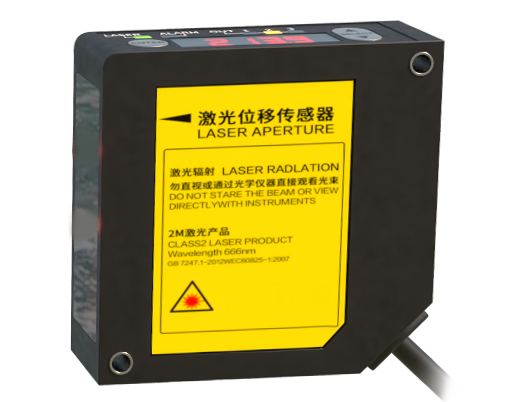
From an application standpoint, understanding speckle guides proper sensor selection and installation. For highly rough or textured surfaces, selecting a sensor model specifically designed with speckle-reduction features is advisable. Ensuring stable mounting for both the sensor and the target minimizes relative motion that excites speckle changes. In some controlled environments, applying a diffuse reflective coating or using a dedicated target plate can provide a more consistent reflective surface. It is also crucial to consult the sensor's specifications; parameters like "resolution" and "repeatability" are often defined under ideal conditions, and real-world performance on speckle-generating surfaces may differ.
In conclusion, laser speckle is an inherent physical characteristic of coherent light interaction with rough surfaces and a significant consideration in displacement metrology. Rather than being an insurmountable flaw, it is a manageable phenomenon. Through a combination of thoughtful optical engineering, intelligent signal processing, and prudent application practices, its impact on measurement integrity can be substantially minimized. A deep understanding of speckle empowers engineers to fully leverage the capabilities of laser displacement sensors, ensuring reliable and accurate data for demanding industrial and research applications.