Capacitive proximity sensors are widely used in industrial automation for non-contact detection of objects, level sensing, and material presence monitoring. Unlike inductive sensors that only detect metals, capacitive sensors can detect a wide range of materials, including liquids, plastics, wood, and granular substances. This versatility makes them essential in various applications, from packaging machinery to food processing and pharmaceutical production.
The fundamental principle of a capacitive proximity sensor relies on changes in capacitance. The sensor consists of an electrode (often the sensor face itself) that forms one plate of a capacitor, with the target object acting as the other plate. When an object enters the sensor’s electric field, the capacitance between the electrode and the object increases. The sensor’s internal oscillator circuit detects this change and triggers an output signal when the capacitance reaches a predefined threshold.
A typical capacitive sensor circuit includes several key components: an oscillator, a demodulator, a trigger circuit, and an output stage. The oscillator generates a high-frequency electric field from the sensing electrode. As the target object approaches, the capacitance rises, altering the oscillator’s amplitude or frequency. The demodulator converts these changes into a DC voltage, which is then compared to a reference level by the trigger circuit. If the voltage exceeds the set threshold, the output stage activates, switching a solid-state relay or providing an analog signal.
Designing a reliable capacitive sensor circuit requires careful consideration of factors such as sensing distance, environmental conditions, and target material properties. The nominal sensing distance (Sn) is specified for standard targets like metal or water. For non-standard materials, the effective sensing distance may be reduced due to lower dielectric constants. For instance, plastics typically have a dielectric constant between 2 and 5, while metals are theoretically infinite. Therefore, sensors often include sensitivity adjustment potentiometers to compensate for different materials and installation conditions.
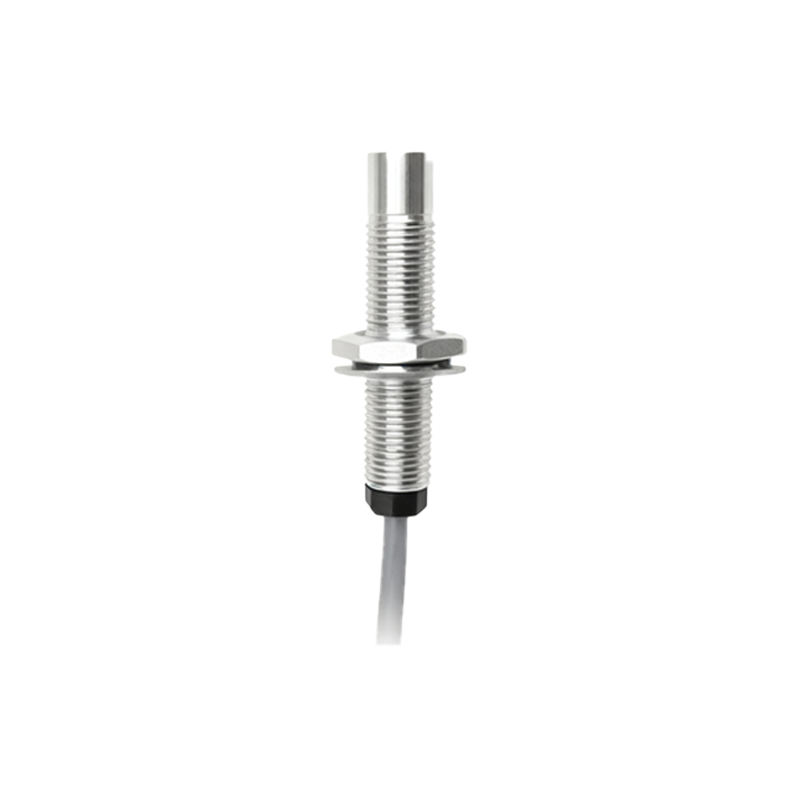
Environmental influences like humidity, temperature, and contamination can affect sensor performance. High humidity or dust accumulation on the sensor face may cause false triggering by altering stray capacitance. To mitigate this, many industrial capacitive sensors feature environmental compensation circuits that ignore slow changes in background capacitance while responding quickly to target approaches. Additionally, shielded (flush-mounted) sensor designs confine the electric field to the front face, reducing susceptibility to side interference, while unshielded (non-flush) versions offer longer sensing ranges but require careful mounting to avoid adjacent metal interference.
In practical applications, capacitive sensors are employed for liquid level detection in tanks, paper or film break monitoring in printing machines, and product counting on conveyor belts. For example, in bottling plants, capacitive sensors detect liquid levels through glass or plastic containers without direct contact, ensuring hygiene and preventing overflow. Another common use is in bulk material handling, where sensors monitor the presence of powders or granules in hoppers, triggering refill operations when levels drop.
Advanced capacitive sensor circuits integrate microcontrollers for digital signal processing, enabling features like teach-in programming, diagnostic outputs, and IO-Link communication. These smart sensors can store multiple parameter sets, adapt to different targets automatically, and provide real-time data on operating status, enhancing predictive maintenance and system integration.
When installing capacitive sensors, grounding and shielding are critical to minimize electrical noise, especially in environments with variable frequency drives or welding equipment. Proper cable routing, using shielded cables, and ensuring a stable power supply with adequate filtering can significantly improve reliability. Additionally, sensors should be calibrated with the actual target material under operating conditions to optimize sensitivity and avoid nuisance trips.
In summary, capacitive proximity sensors offer a flexible solution for object detection across diverse industries. Their ability to sense non-metallic materials, coupled with robust circuit designs that compensate for environmental factors, makes them indispensable in modern automation systems. As technology evolves, the integration of digital interfaces and intelligent algorithms will further expand their capabilities, paving the way for more adaptive and connected industrial applications.