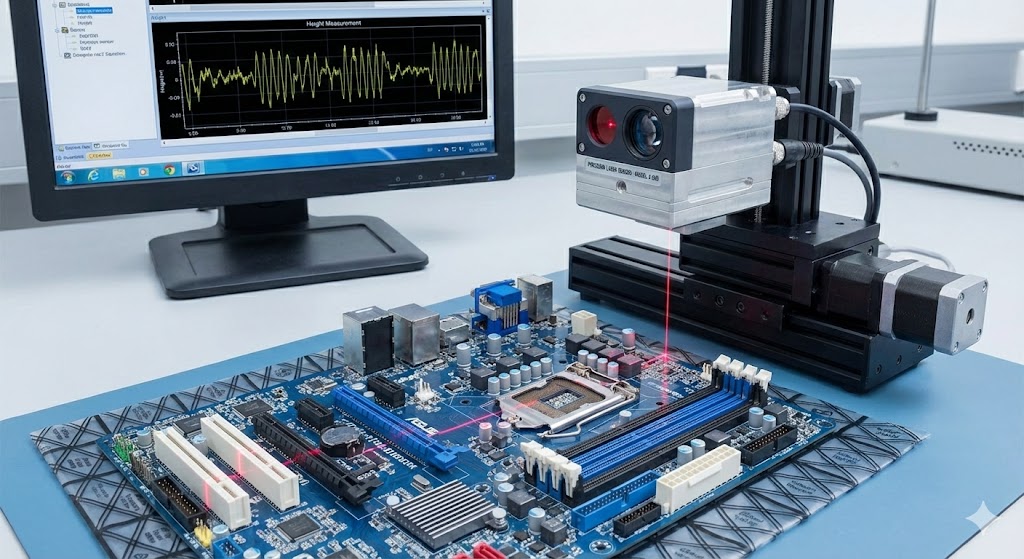
In the realm of industrial automation and precision engineering, the demand for accurate, reliable, and non-contact measurement solutions is paramount. Among the various technologies available, laser displacement sensors with a 1-meter measurement range have emerged as a critical tool for a wide array of applications. These sensors utilize the principle of laser triangulation or time-of-flight to determine the distance to a target object with exceptional accuracy, often reaching micron-level resolution even at their full range.
The core advantage of a 1-meter range laser displacement sensor lies in its versatility. This specific range bridges the gap between short-range, high-precision sensors and long-range, lower-accuracy devices. It is ideally suited for scenarios where the target is not easily accessible or where maintaining a safe distance from moving parts, heat sources, or hazardous environments is necessary. For instance, in automotive assembly lines, these sensors are deployed for gap and flush measurement on vehicle bodies, ensuring panel alignment meets stringent quality standards. The one-meter standoff allows the sensor to be mounted safely away from the production line while still capturing precise data.
The operating principle typically involves projecting a focused laser beam onto the target surface. The reflected light is then captured by a receiving lens and focused onto a position-sensitive detector, such as a CCD or CMOS array. Any change in the target's distance causes a shift in the position of the reflected light spot on the detector. This shift is analyzed by the sensor's internal processor to calculate the exact displacement. Advanced models incorporate features like automatic sensitivity adjustment to handle varying surface colors and textures, from shiny metals to dark, absorbent materials, ensuring stable measurement without manual recalibration.

Key performance specifications for a 1m range laser displacement sensor include linearity, repeatability, sampling rate, and spot size. High linearity ensures the measurement error across the entire range is minimal. Excellent repeatability guarantees consistent results for the same measurement point. A high sampling rate, often in the kilohertz range, is crucial for measuring fast-moving objects on conveyor belts or vibrating surfaces. The laser spot size determines the spatial resolution; a smaller spot allows for measurement on finer features or edges.
Applications extend far beyond automotive manufacturing. In the electronics industry, these sensors measure component height, coplanarity of IC pins, and warpage of printed circuit boards. In metal processing, they monitor thickness, vibration, and deformation during rolling or machining operations. Robotics integration is another significant area, where the sensor provides real-time feedback for precise robotic arm positioning, bin picking, and assembly tasks. Furthermore, in logistics and warehousing, they are used for dimensioning packages and pallet profiling.

Selecting the right 1-meter range sensor requires careful consideration of the application environment. Factors such as ambient light interference, dust, oil mist, and temperature fluctuations must be evaluated. Many industrial-grade sensors are housed in rugged enclosures with IP67 or higher ratings for protection against harsh conditions. The choice between a red laser and a blue laser may also be relevant; blue lasers offer better performance on organic materials and transparent objects due to their shorter wavelength.
Integration into control systems is facilitated through various output options, including analog voltage/current, digital interfaces like RS-485 or Ethernet, and high-speed deterministic protocols such as EtherCAT. This allows seamless communication with PLCs, PCs, and data acquisition systems for closed-loop control and statistical process control (SPC).
In conclusion, the 1-meter range laser displacement sensor is a cornerstone of modern industrial metrology. Its balanced combination of range, speed, and precision addresses the core measurement challenges in automated manufacturing and quality inspection. As industries continue to push for higher efficiency and tighter tolerances, the evolution of these sensors—with smarter algorithms, enhanced connectivity, and robust designs—will continue to play a vital role in enabling the factories of the future. Engineers and system integrators must understand their operational principles and specifications to fully leverage their capabilities for optimizing production processes and ensuring unparalleled product quality.