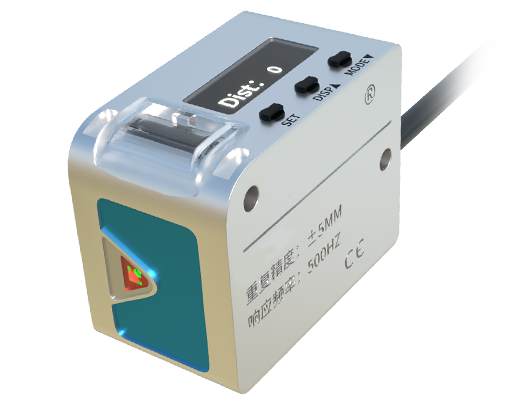
Spot laser sensors represent a cornerstone technology in modern industrial automation, offering unparalleled precision for measurement, detection, and positioning tasks. At their core, these sensors operate on the principle of optical triangulation, a method that combines a focused laser beam with a sensitive photodetector to achieve high-accuracy results. The fundamental components include a laser diode, a collimating lens, a position-sensitive detector (PSD) or a complementary metal-oxide-semiconductor (CMOS) sensor, and sophisticated signal processing electronics. The laser diode emits a coherent, monochromatic light beam, which is then collimated by the lens to form a precise, concentrated spot on the target object's surface. This spot acts as the measurement point. When the laser light strikes the surface, it is diffusely reflected. A portion of this reflected light is captured by the receiving lens and focused onto the photodetector. The key to the sensor's operation lies in the geometric relationship between the laser emitter, the target, and the detector. If the target's distance or position changes, the angle of the reflected light alters correspondingly. This causes the position of the laser spot image on the PSD or CMOS array to shift. A PSD generates analog current outputs proportional to the centroid of the light spot's position, while a CMOS sensor digitally captures the spot's image. The onboard electronics then analyze this positional data. By applying trigonometric calculations based on the known fixed baseline between the emitter and receiver lenses, the sensor's microprocessor precisely calculates the target's distance, height, or presence. This calculation is robust against variations in target color or reflectivity to a significant degree, as modern sensors often incorporate automatic gain control and advanced algorithms to compensate for these factors. The advantages of spot laser sensors are manifold. They provide non-contact measurement, eliminating mechanical wear and allowing inspection of delicate surfaces. Their response time is extremely fast, often in the microsecond range, suitable for high-speed production lines. The spot size can be very small, enabling precise measurements on minute features. Furthermore, their high resolution allows for detection of minute displacements, making them ideal for applications like vibration analysis, thickness gauging, and wafer alignment. Typical industrial applications are diverse. In automotive assembly, they verify part presence and measure gap dimensions. In electronics manufacturing, they precisely control the height of component placement heads. In logistics, they count objects on conveyors or measure package dimensions. In metal processing, they monitor material thickness or detect edge positions. When selecting a spot laser sensor, engineers must consider several parameters: measuring range, spot size, resolution, repeatability, response frequency, and environmental ratings for factors like ambient light, dust, and temperature. Proper alignment and installation are critical, as stray reflections or extreme angles can affect performance. In summary, the principle of the spot laser sensor elegantly translates a simple geometric optical phenomenon into a powerful, reliable, and versatile industrial tool. Its continued evolution, integrating smarter processing and connectivity for Industry 4.0, ensures its vital role in enhancing quality control, efficiency, and automation across countless sectors.