In the realm of industrial automation and precision measurement, laser sensors have become indispensable tools due to their high accuracy, non-contact operation, and rapid response times. A critical parameter that significantly influences their performance is the spot size—the diameter of the laser beam at the target surface. While much attention is often given to minimizing spot size for fine resolution, large spot sizes offer distinct advantages in various applications, warranting a detailed exploration. This article delves into the principles, benefits, challenges, and practical uses of laser sensors with large spot sizes, tailored for electrical engineers and industry professionals.
Laser sensors operate by emitting a coherent light beam that interacts with a target object. The reflected or scattered light is then detected to determine parameters such as distance, position, or surface characteristics. Spot size is primarily determined by the laser's wavelength, lens optics, and beam divergence. A larger spot size results from a combination of factors, including longer wavelengths, specific lens designs that widen the beam, and increased working distances. For instance, sensors using infrared lasers often produce larger spots compared to visible-light lasers, while adjustable optics can modulate the beam diameter to suit different needs.

One of the key benefits of a large spot size is enhanced stability in measurements. In environments with surface irregularities, dust, or minor vibrations, a smaller spot might fluctuate excessively, leading to noisy data. A larger spot averages over a broader area, providing more consistent readings and reducing the impact of localized imperfections. This makes large-spot sensors ideal for rough or textured surfaces, such as in metal fabrication, wood processing, or construction materials. Additionally, they excel in applications requiring thickness measurement of translucent materials, where beam spread helps capture diffuse reflections accurately.
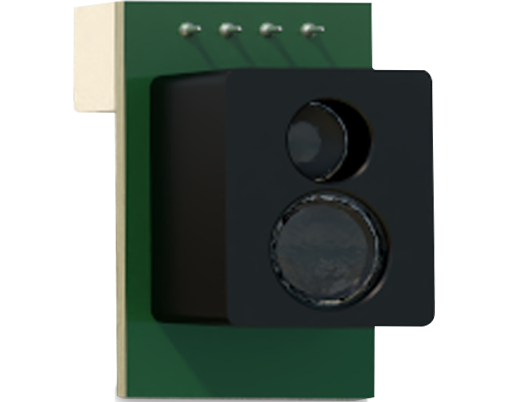
Another advantage lies in safety and compliance. Larger spots distribute laser energy over a wider area, lowering the power density (irradiance) on the target. This reduces risks associated with eye safety and material damage, aligning with international standards like IEC 60825 for laser product safety. In industries like packaging or food processing, where sensors scan moving objects, a large spot ensures reliable detection even with slight misalignments, minimizing downtime and maintenance costs.
However, large spot sizes come with trade-offs. The primary limitation is reduced spatial resolution, which can be a drawback in applications demanding fine detail, such as microelectronics assembly or precision engraving. Engineers must balance spot size with sensor specifications like response time and accuracy. For example, in distance measurement, a large spot may integrate signals from multiple points, potentially introducing errors if the target has steep angles or complex geometries. Calibration and algorithm adjustments are often necessary to mitigate these effects, leveraging techniques like signal averaging or edge detection filters.
In practical terms, large-spot laser sensors find widespread use across sectors. In automotive manufacturing, they monitor paint thickness on car bodies, where a broad beam ensures uniform coverage. In agriculture, sensors with large spots assess crop health by analyzing reflectance over wide areas, aiding in precision farming. The energy sector employs them for inspecting pipeline coatings, where surface roughness is common. Moreover, in robotics, large-spot sensors facilitate object detection and navigation in dynamic environments, enhancing automation efficiency.
Looking ahead, advancements in laser technology and optics continue to refine large-spot sensors. Innovations like adaptive optics and multi-wavelength systems allow dynamic spot size adjustment, catering to diverse industrial needs. As the Internet of Things (IoT) and smart factories evolve, integrating these sensors with data analytics platforms will enable predictive maintenance and real-time optimization. For electrical engineers, understanding spot size dynamics is crucial for selecting the right sensor, ensuring robust system design, and driving innovation in automation.
In summary, while often overshadowed by high-resolution counterparts, laser sensors with large spot sizes play a vital role in many industrial applications. By offering stability, safety, and versatility, they address unique challenges in measurement and detection. Professionals should consider factors like surface properties, environmental conditions, and operational goals when deploying these sensors, leveraging their strengths to enhance productivity and reliability in electrical and automation systems.