In industrial automation and precision measurement, laser distance sensors have become indispensable tools for non-contact displacement, position, and thickness measurement. A critical specification that engineers and system integrators must evaluate is the sensor's travel range, also commonly referred to as measuring range or working range. This parameter defines the minimum and maximum distances over which the sensor can operate reliably and deliver accurate readings. Understanding the nuances of travel range is paramount for selecting the right sensor for a specific application, ensuring optimal performance, and avoiding costly measurement errors.
The travel range of a laser distance sensor is fundamentally determined by its underlying technology and optical design. Most industrial sensors operate on the principle of laser triangulation or time-of-flight (ToF). Triangulation sensors, known for high accuracy at shorter distances, typically have a more limited travel range, often from a few millimeters up to several meters. The range is constrained by the geometry of the receiver lens and the position-sensitive detector (PSD or CMOS). As the target moves, the reflected laser spot moves across the detector; at the extremes of the range, the spot may fall outside the detector's active area, causing a loss of signal. Time-of-flight sensors, which calculate distance by measuring the round-trip time of a laser pulse, are designed for much longer ranges, from several meters to hundreds of meters, but often with slightly lower resolution.
It is crucial to distinguish between the nominal travel range and the effective working range in real-world conditions. The datasheet value for travel range is usually established under ideal laboratory conditions: a perfectly reflective, diffuse white target (like a standard Kodak white card), optimal ambient light, and stable temperature. In practice, the actual usable range can be significantly affected by several factors. Target properties are the most influential. A dark, low-reflective, or glossy target absorbs or specularly reflects most of the laser light, drastically reducing the signal strength returned to the sensor. This can shorten the effective range or, in severe cases, cause measurement dropout. For such challenging surfaces, sensors with adjustable laser power or advanced background suppression algorithms are necessary to maintain a functional range.
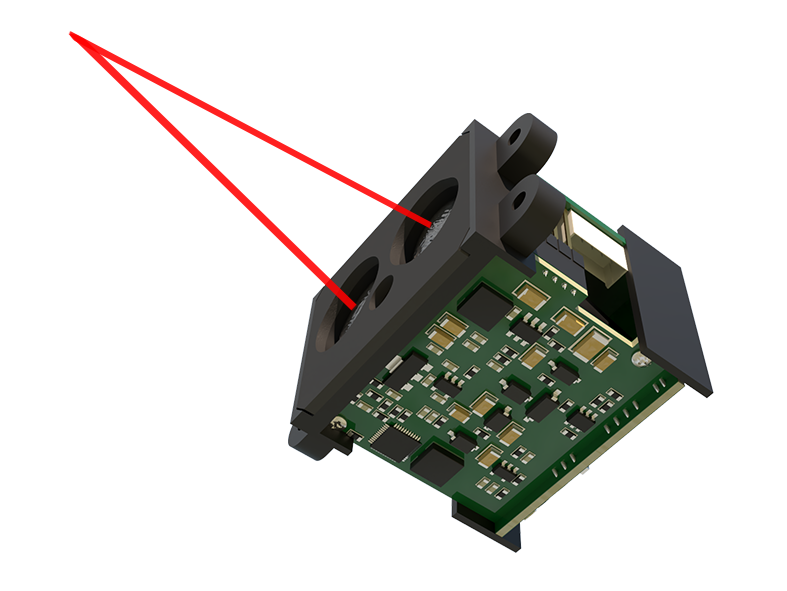
Environmental factors also play a major role. Intense ambient light, especially from other lasers or sunlight containing the same wavelength as the sensor, can flood the receiver and reduce the signal-to-noise ratio. Dust, steam, or oil mist in the air can scatter or attenuate the laser beam. Most industrial laser sensors use a visible red laser or a Class 1 or 2 infrared laser. For long-range outdoor applications, infrared lasers are less susceptible to ambient light interference. Furthermore, the required accuracy over the travel range is not constant. Specifications like linearity error are often expressed as a percentage of the measured value or the full scale. A sensor might have a linearity of ±0.1% of the measured value. This means the absolute error grows with distance; a measurement at the far end of the travel range will have a larger absolute uncertainty than one taken closer to the sensor.
Selecting a sensor with an appropriate travel range involves careful application analysis. A common best practice is to choose a sensor whose nominal range provides a 10-20% buffer beyond the maximum and minimum expected target positions. This buffer compensates for target reflectivity variations, minor misalignments, and potential mechanical drift over time. For example, if a target moves between 500mm and 800mm from the sensor face, selecting a model with a travel range of 300mm to 1000mm is more robust than one with a range of 500mm to 800mm. Additionally, the mounting and orientation must ensure the laser beam is perpendicular to the target surface within the sensor's allowable beam offset specifications to avoid cosine error, which can effectively reduce the perceived travel range.
Modern laser sensors incorporate sophisticated features to maximize usable travel range and reliability. Automatic exposure control (AEC) dynamically adjusts the receiver's sensitivity or the laser's power based on the returned signal strength, allowing a single sensor to handle a wide variety of surfaces without manual recalibration. Advanced digital filtering can distinguish the true laser signal from ambient light noise, preserving range capability in bright environments. Some models offer multiple operating modes or programmable windows, allowing users to define a sub-range within the full travel range for higher sampling rates or improved response times.
In conclusion, the travel range is more than just two numbers on a datasheet. It is a dynamic parameter influenced by a synergy of sensor technology, target characteristics, and the operating environment. Successful implementation requires viewing the travel range as a system-level specification. By thoroughly understanding these interdependencies and applying prudent selection criteria with adequate margin, engineers can leverage laser distance sensors to achieve precise, reliable, and repeatable measurements across the vast landscape of industrial automation, from semiconductor fabrication and automotive assembly to logistics and warehouse management.