In industrial automation, construction, and surveying, laser distance sensors are prized for their high precision, speed, and non-contact measurement capabilities. However, environmental factors, particularly precipitation like rain, can significantly challenge their performance and accuracy. This article delves into the specific effects of rain on laser distance sensors and explores practical engineering solutions for reliable operation in wet conditions.
Rain primarily interferes with laser sensors through two physical mechanisms: absorption/scattering and surface contamination. A laser beam, typically in the visible red or near-infrared spectrum, travels through the atmosphere to a target and reflects back to the sensor's receiver. Raindrops in the beam path act as tiny lenses and obstacles. They absorb a portion of the laser's energy and scatter the light in multiple directions. This scattering, known as Mie scattering for particle sizes similar to the laser wavelength, attenuates the signal strength reaching both the target and the returning receiver. In heavy downpours, the density of raindrops can be so high that the beam is severely weakened or completely blocked, leading to measurement errors, increased noise, or a complete loss of signal.
The second major issue is surface contamination. Rainwater accumulating on the sensor's front-facing protective window or lens creates a film or droplets that distort the outgoing and incoming light. This can deflect the beam, cause unwanted reflections, and further reduce signal intensity. Similarly, a wet target surface alters its reflectivity. A smooth, reflective surface when dry (like metal) can become specular and mirror-like when wet, potentially reflecting the beam away from the sensor. Conversely, a dark, absorptive surface might become more diffusely reflective with a water layer, but the primary issue remains the inconsistent and unpredictable change in reflection properties.
The consequences of these effects are measurable. Users may observe increased measurement jitter (small, rapid variations in the reported distance), occasional outliers or "spikes" in data, a reduced maximum operating range, and in severe cases, complete sensor failure where no valid measurement is returned. For applications like crane positioning, bulk material level monitoring outdoors, or automated guided vehicles (AGVs) operating in all weather, such inconsistencies are unacceptable and pose safety and operational risks.
Fortunately, several mitigation strategies, grounded in both sensor design and system integration, can enhance performance in rainy environments. Firstly, sensor selection is critical. Opt for models with a higher laser power (Class 2M or 3R, used within safety regulations) and receivers with high sensitivity. A stronger signal is more likely to penetrate moderate rain. Secondly, look for sensors with robust environmental ratings. An Ingress Protection (IP) rating of IP65, IP67, or ideally IP69K ensures the housing is dust-tight and protected against powerful water jets, preventing internal damage. A hydrophobic or oleophobic coating on the lens can cause water to bead up and roll off, minimizing droplet adhesion and maintaining a clearer optical path.
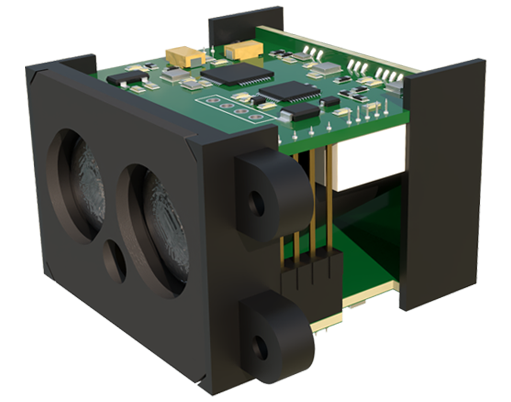
Thirdly, signal processing firmware plays a key role. Advanced sensors incorporate algorithms to filter out noise. Time-of-flight sensors, for instance, can use statistical methods or echo processing to distinguish the true target echo from noise caused by raindrops. Some models offer adjustable response times or averaging filters that can be tuned to smooth out data in variable conditions, though this may trade off some measurement speed.
From a system design perspective, physical protection is straightforward but effective. Installing the sensor under a protective overhang or within a custom hood can shield it from direct rainfall. For critical applications, using a clean air purge system—a constant, low-flow stream of dry, filtered air across the lens—creates a positive pressure barrier that prevents water and dust from settling on the window. This is a common solution in harsh industrial settings.
Finally, operational adjustments and redundancy can provide a system-level solution. In some control systems, it is possible to program a "rain mode" that increases tolerance thresholds for signal quality or switches to a fallback measurement method (e.g., an encoder or inertial system) during known poor weather. For utmost reliability, designing in redundant sensors with physical separation can provide data validation.
In conclusion, while rain presents a non-ideal condition for laser distance measurement, it does not preclude their outdoor use. By understanding the physics of interference—signal attenuation and surface effects—engineers can make informed choices. Selecting sensors with high power, appropriate IP ratings, and intelligent filtering, combined with thoughtful mechanical protection and system design, ensures that laser distance sensors deliver robust and accurate performance, rain or shine. Continuous advancements in laser diode efficiency and digital signal processing will further push the boundaries of environmental resilience for these indispensable tools.